
Custom EVA VR Headset Case: 8 Smart Design Tips
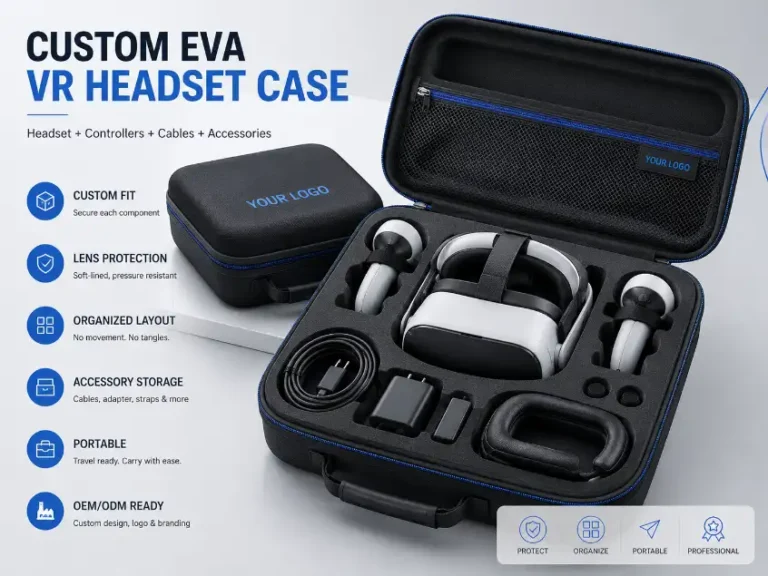
A custom EVA VR headset case must protect more than one electronic device. Most VR kits include a headset, two controllers, charging cables, adapters, straps and other accessories. These components have different shapes and protection requirements, which makes the internal layout especially important.
The headset lens area is sensitive to scratches and pressure. Controllers can move or collide during transportation. Cables can become tangled, while facial interfaces and head straps may lose their shape if the case is too small.
For VR brands, gaming equipment companies, distributors and educational technology suppliers, a custom EVA VR headset case provides a practical way to protect the full kit while improving portability, organization and brand presentation.
This guide explains the most important design decisions for developing an OEM VR headset case that performs well in retail, travel, demonstrations and professional use.
Why VR Equipment Needs a Purpose-Built Carrying Case
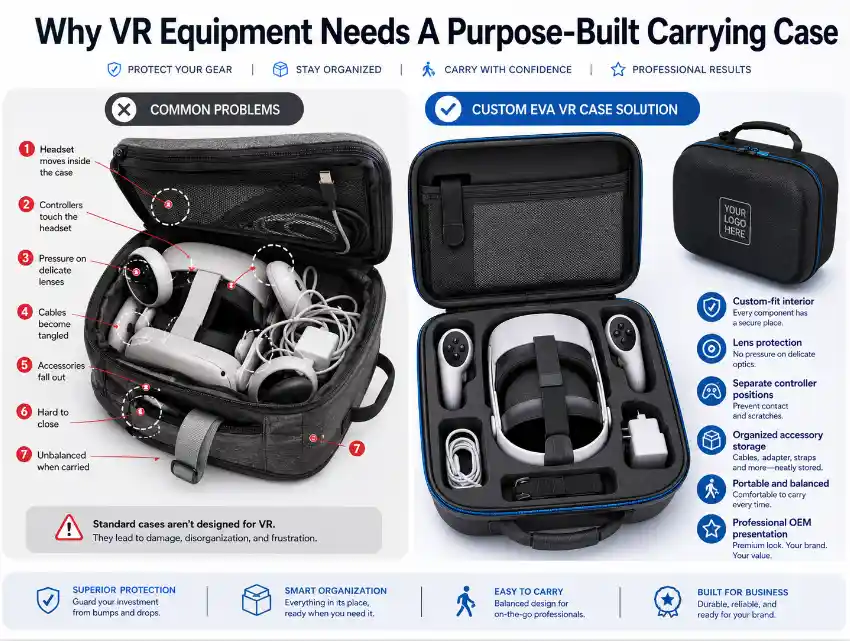
A standard electronics bag may provide basic storage, but it is rarely designed around the shape of a VR headset. The headset body is curved, the lens area is delicate and the controllers usually need separate positions.
Common problems with standard cases include:
- The headset moves inside the case
- Controllers touch or scratch the headset
- Pressure is applied to the lenses
- Charging cables become tangled
- The case is too shallow for the head strap
- Accessories fall out when the case opens
- The zipper becomes difficult to close
- The loaded case feels unbalanced when carried
A custom EVA VR headset case solves these problems by developing the shell and internal structure around the exact VR model and accessory set.
1. Start With the Complete VR Kit
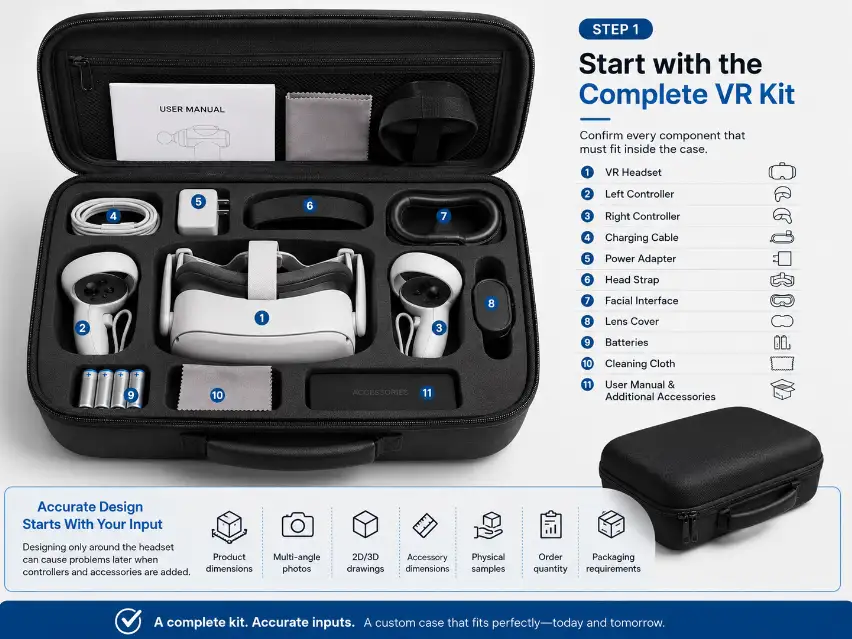
The first design step is confirming every component that must fit inside the case.
A typical VR kit may include:
- VR headset
- Left controller
- Right controller
- Charging cable
- Power adapter
- Head strap
- Facial interface
- Lens cover
- Batteries
- Cleaning cloth
- User manual
- Additional accessories
Some professional or educational kits may also include replacement face cushions, charging docks, data cables or wireless adapters.
The manufacturer should receive the dimensions and weight of the entire kit. Designing only around the headset can create problems later when controllers and accessories are added.
For accurate development, buyers can provide:
- Product dimensions
- Photos from several angles
- 2D or 3D drawings
- Accessory dimensions
- Physical product samples
- Target order quantity
- Packaging requirements
A physical sample is particularly useful because VR headsets often have complex curves and flexible straps.
2. Protect the Lens Area From Pressure
Lens protection is one of the most important requirements in a custom EVA VR headset case. The insert should support the headset without placing pressure directly on the lenses.
The case design should consider:
- Lens position
- Facial interface depth
- Nose area
- Head strap shape
- Adjustment knobs
- Side buttons
- Charging ports
The headset should rest on stable structural areas rather than the lens surface.
A shaped insert can create clearance around the lenses while supporting the headset body. A soft lining or protective fabric may also help reduce surface scratches.
Buyers should test the sample carefully to ensure that the case lid, mesh pocket or stored accessories do not press against the lens area when the zipper is closed.
3. Give Both Controllers Separate Compartments
VR controllers have irregular shapes and can move easily if placed together in one large space. Separate compartments provide better protection and organization.
Individual controller positions help:
- Prevent controller-to-controller contact
- Reduce scratches
- Keep buttons and tracking rings protected
- Make missing accessories easy to identify
- Improve presentation after opening
- Help users return each item correctly
The compartments should hold the controllers securely without making them difficult to remove.
Finger cutouts, lifting spaces or flexible retention straps can improve usability. The design should also avoid placing excessive pressure on triggers, buttons or tracking rings.
For VR kits with different controller versions, the insert may need to be adjusted while keeping the same outer shell.
4. Select the Right Foam Insert Structure
The internal insert is the foundation of a custom EVA VR headset case. The best insert structure depends on the headset shape, product weight, appearance requirements and budget.
CNC-Cut Foam
CNC-cut foam can create accurate compartments for the headset, controllers and accessories. It is suitable for complex layouts and lower-volume product development.
The design can be revised relatively easily during the sampling stage.
Layered Die-Cut Foam
Layered foam is made by combining foam sections with different cutout depths. It can be practical for stable product designs and larger production quantities.
This option can balance protection and cost.
Fabric-Covered Foam
Fabric-covered foam creates a cleaner and more premium appearance. It can be suitable for retail VR kits, branded bundles and high-value gaming equipment.
The fabric also helps hide the raw foam surface.
Molded Inner Tray
A molded tray creates a smooth and integrated internal structure. It may be suitable for brands that want a more finished, consumer-facing appearance.
The correct choice should balance protection, appearance, order quantity and total case cost.
5. Organize Cables Without Creating Pressure
VR systems usually include charging cables, power adapters or data cables. These accessories need enough space, but they should not press against the headset or lenses.
Possible storage solutions include:
- Zippered mesh pocket
- Elastic cable strap
- Dedicated foam compartment
- Fabric accessory pocket
- Separated storage area
- Removable accessory pouch
A mesh pocket in the lid is convenient, but its position must be checked carefully. If the pocket is directly above the headset, a charger or adapter could create pressure when the case closes.
For heavier accessories, a dedicated compartment in the lower insert may be safer.
Cable spaces should also allow users to store cables without bending them too sharply. A practical layout improves both protection and daily usability.
6. Confirm the Correct Case Depth
VR cases often become too large because the designer adds unnecessary empty space. In other projects, the case is made too shallow and compresses the head strap or facial interface.
The correct shell depth should consider:
- Headset height
- Strap position
- Controller height
- Insert thickness
- Lid pocket contents
- Required clearance
- Outer packaging size
- Shipping cost
A compact custom EVA VR headset case can reduce carton size and freight cost, but it should not compromise protection or usability.
The sample should close smoothly without forcing the zipper. If users must press down strongly to close the case, the shell depth or internal layout should be adjusted.
7. Design the Handle for Balanced Carrying
The headset and controllers may not have equal weight on both sides of the case. If the handle is positioned incorrectly, the loaded case can tilt or feel uncomfortable.
The handle location should be tested with the complete kit inside.
Important factors include:
- Total product weight
- Weight distribution
- Handle width
- Handle attachment strength
- Stitching reinforcement
- Carrying direction
- Case opening orientation
For larger professional kits, a shoulder strap may also be considered. However, additional carrying features should only be added when they improve the real user experience.
A compact consumer case may only need a strong, comfortable handle.
8. Match the Case to the VR Application
Not every VR project needs the same case design. The intended application should influence the materials, layout and protection level.
Consumer Gaming
Gaming products often need an attractive branded appearance, compact size and organized controller storage.
Custom colors, rubber logo patches and branded zipper pullers may help support the gaming product identity.
Education and Training
VR equipment used in schools or training programs may be handled frequently by different users. The case may need stronger materials, easy-clean surfaces and clear component positions.
A highly organized layout helps staff confirm that every item has been returned.
Demonstration and Sales Kits
Sales teams may carry VR equipment to meetings, exhibitions and customer demonstrations.
The case should look professional, open neatly and allow the product to be prepared quickly.
Commercial VR Systems
Professional VR kits may include additional cables, adapters, sensors or replacement parts.
These projects may require deeper cases, larger accessory areas and stronger carrying structures.
Understanding the application early helps the manufacturer recommend a suitable custom EVA VR headset case instead of using a generic electronics-case structure.
Custom EVA VR Headset Case vs Standard Hard Case
Both EVA cases and hard plastic cases can protect VR equipment, but they serve different needs.
A hard plastic case may provide stronger resistance to heavy external impact. However, it is usually heavier, bulkier and less flexible for branding and retail presentation.
A custom EVA VR headset case offers:
- Lighter carrying weight
- Molded semi-rigid protection
- Flexible shell shape
- Custom surface materials
- Easier logo customization
- More retail-friendly appearance
- Better balance between protection and portability
The correct option depends on the usage environment.
For routine travel, retail products, educational kits and customer demonstrations, an EVA case often provides a practical combination of protection, weight and appearance. For extreme transport conditions, a heavier hard case may be more appropriate.
Branding Options for OEM VR Headset Cases
An OEM VR headset case can be customized to match the visual identity of the VR product.
Available options may include:
- Printed logo
- Heat-transfer logo
- Embossed or debossed logo
- Rubber logo patch
- Woven label
- Metal logo plate
- Custom zipper puller
- Custom surface color
- Custom lining color
- Printed packaging
For gaming products, bold colors or rubber logo patches may create a stronger visual impact. For educational or professional equipment, a cleaner and more understated design may be more suitable.
Logo size and position should be confirmed on the actual case sample. A logo that looks correct in a digital drawing may appear too large or too small on the finished product.
Sample Testing Checklist
A custom EVA VR headset case should always be tested with the real headset and accessories before mass production.
Use this checklist during sample review:
- Does the headset remain stable when the case is moved?
- Is there enough clearance around the lenses?
- Do both controllers stay in position?
- Are buttons and tracking rings protected?
- Can users remove each item easily?
- Do the cables and charger fit without pressure?
- Does the lid pocket touch the headset?
- Does the case close smoothly?
- Does the zipper move easily around the corners?
- Does the handle feel balanced?
- Does the case fit the planned retail packaging?
- Is the logo position correct?
- Does the interior remain organized after repeated use?
A gentle shake test can help reveal loose components. The case should also be opened and closed repeatedly to check zipper tension and product access.
Water Resistance and Protection Claims
EVA cases can use surface fabrics that resist light moisture and are easy to clean. However, a standard zippered case should not automatically be described as fully waterproof.
Water may enter through:
- Zipper teeth
- Stitching
- Handle attachment points
- Construction seams
- Other openings
If the VR equipment requires a specific level of water protection, the requirement should be discussed during development and verified through suitable testing.
Accurate product descriptions help protect the brand from unrealistic customer expectations.
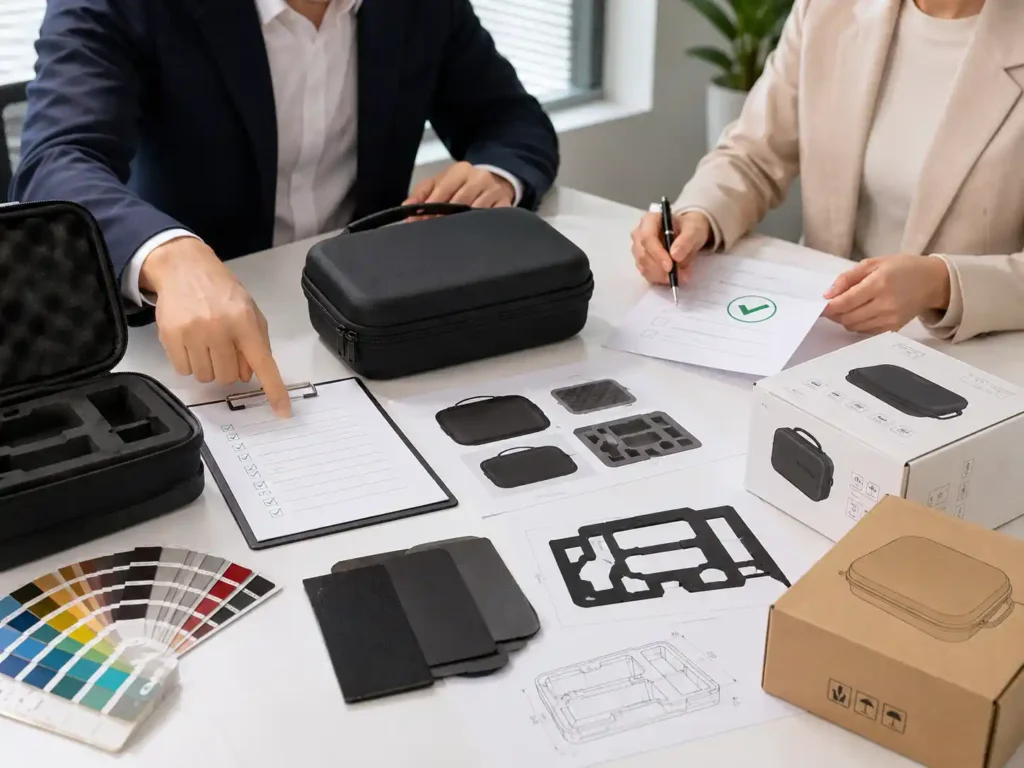
What to Send to a VR Headset Case Manufacturer
To receive an accurate quotation and design recommendation, prepare:
- VR headset dimensions
- Headset weight
- Controller dimensions
- Full accessory list
- Product photos
- 2D or 3D drawings
- Physical product sample, if available
- Required order quantity
- Exterior material preference
- Logo artwork
- Packaging requirements
- Target market
- Delivery schedule
- Destination country or region
The final accessory set should be confirmed before the insert layout is approved.
Common Development Mistakes
Buyers can avoid delays and additional costs by watching for these common mistakes:
- Designing only around the headset
- Adding controllers after the insert is completed
- Allowing accessories to press against the lenses
- Making the case too shallow
- Using one loose compartment for both controllers
- Ignoring the charger size
- Positioning a loaded mesh pocket above the headset
- Approving the sample without the real product
- Selecting colors only from screen images
- Starting production before all revisions are confirmed
A clear design brief and sample-testing process can prevent most of these problems.
Why Work With GAODA EVA CASE?
GAODA EVA CASE develops OEM and ODM protective cases for VR headsets, gaming devices, electronics, tools, medical products, personal care equipment and other branded products.
Our team can support the complete custom EVA VR headset case process, including product evaluation, shell structure development, material selection, insert design, logo customization, sample making, mass production and quality inspection.
Production resources in China and Vietnam also provide international buyers with additional supply-chain planning options.
Each case is developed around the buyer’s actual headset, controllers, accessories, protection requirements and target market. This helps ensure that the outer shell and internal layout work together as a complete carrying solution.
How to Design a Custom VR Headset Carrying Case
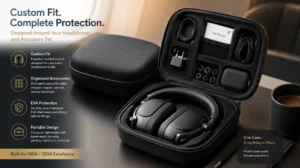
A custom VR headset carrying case should be developed around the complete headset kit, including the controllers, charging cable, adapter and other accessories. Accurate product dimensions help the manufacturer create a compact structure without placing pressure on the lens area.
For brands and equipment suppliers, a custom VR headset carrying case can improve product protection, portability and presentation. The internal layout can include separate controller compartments, a shaped foam insert and dedicated cable storage.
Can a Custom VR Headset Carrying Case Fit Different Models?
A custom VR headset carrying case is normally designed around a specific headset model and accessory configuration. In some projects, the same outer shell can support several products by using different internal inserts.
Before mass production, the custom VR headset carrying case should be tested with the actual headset, controllers and accessories to confirm product fit, zipper performance and carrying balance.
FAQ About Custom EVA VR Headset Cases
Can the case be customized for a specific VR headset model?
Yes. The outer shell and internal insert can be designed around the exact headset, controllers and accessories.
Can the lens area be protected without touching the lenses?
Yes. The insert can support the headset around stable structural areas while leaving clearance around the lens region.
Can both controllers have separate compartments?
Yes. Separate controller compartments can be created using CNC-cut foam, layered foam, fabric-covered inserts or molded trays.
Can one outer shell support different VR product bundles?
In some projects, one outer shell can use several insert versions. This depends on the differences between the headset models and accessory sets.
Can the case include a shoulder strap?
Yes, depending on the case size, total weight and carrying requirements. For compact kits, a reinforced handle may be sufficient.
Is the case fully waterproof?
A standard zippered EVA case may resist light moisture depending on its materials, but it should not be described as fully waterproof unless the complete construction has been tested for that requirement.
Can the case be used as retail packaging?
Yes. The case can be used as part of the retail product bundle and combined with a printed box, paper sleeve, label or other outer packaging.
Final Thoughts
A successful custom EVA VR headset case must protect the lens area, stabilize the headset, separate both controllers and organize cables without creating pressure.
The shell depth, insert structure, handle position and accessory storage should all be developed around the complete VR kit and its real usage scenario.
For brands, distributors and equipment manufacturers, a purpose-built EVA case can improve protection, portability, product presentation and customer experience.
Contact GAODA EVA CASE with your VR headset dimensions, controller details, accessory list and target quantity to begin developing your custom EVA VR headset case.
GAODA — Professional Custom EVA Case Manufacturer | ISO 9001 Certified | Shenzhen + Vietnam Dual Factories | 20+ Years OEM/ODM Experience
 English
  Korean
  Japanese
  French
  German
  Spanish
  Russian
  Arabic
  Italian
  Portuguese
  Turkish
  Thai
Thai  Vietnamese
  Chinese