
EVA vs. EPE: The Ultimate Guide to Choosing the Best Foam for Your Project
When designing custom packaging, industrial gaskets, or protective inserts, one of the most frequent dilemmas engineers and procurement managers face is the choice between two popular materials: EVA (Ethylene-Vinyl Acetate) and EPE (Expanded Polyethylene).
On the surface, they might look like “just foam,” but the technical differences between them can significantly impact your product’s safety, brand perception, and long-term costs. In this comprehensive guide, we will break down the EVA vs EPE foam debate to help you make an informed decision for your next project.

Technical Comparison: EVA vs EPE Foam。
In the world of manufacturing, every cent counts. However, so does every customer review. Choosing a cheap material for a high-end product can lead to damaged goods and a “cheap” brand image. Conversely, over-engineering a simple shipping spacer with premium foam can eat into your profit margins.
The question isn’t just “which is better?” but rather “which is right for your specific application?” Let’s dive into the details.
What is EPE Foam? (The Cost-Effective Lightweight)
EPE (Expanded Polyethylene), often referred to in the industry as “Pearl Cotton,” is a molded semi-rigid, non-cross-linked foam. It is composed of countless independent bubbles produced by physical expansion.
Key Characteristics of EPE:
Low Density: It is extremely lightweight, which helps reduce shipping costs.
Shock Absorption: It offers decent cushioning for one-way transit.
Recyclability: It is an eco-friendly plastic that can be recycled and repurposed.
Aesthetics: It has a slightly “pebbly” or “beaded” texture and is usually available in white, black, or red.
The Downside: EPE is prone to “compression set.” Once it is crushed or heavily squeezed, it does not fully return to its original shape. This makes it less ideal for repeated use.
What is EVA Foam? (The Premium Powerhouse)
EVA (Ethylene-Vinyl Acetate) is a closed-cell foam known for its rubber-like elasticity and high density. Unlike EPE, EVA is cross-linked, which gives it a much finer, smoother cell structure and superior physical properties.
Key Characteristics of EVA:
High Resilience: It is incredibly “bouncy.” It can be compressed thousands of times and still return to its original thickness.
Durability: It is tear-resistant and stands up well against friction and impact.
Chemical Resistance: It is highly resistant to oils, chemicals, and UV radiation.
Fine Texture: The surface is smooth and matte, giving it a premium look and feel.
The Downside: It is heavier than EPE and comes with a higher price tag per cubic meter.
EVA vs EPE Foam: The 5 Key Differences
1. Durability and “Bounce Back”
The most significant technical difference is Resilience.
EPE is like a piece of bread; if you press your thumb into it hard, the dent stays there. It’s perfect for one-time shipping where the foam’s job is to sacrifice itself to protect the product once.
EVA is like a high-quality sneaker sole. It absorbs the impact and immediately recovers. For tool box inserts or reusable luxury cases, EVA is the only choice.
2. Aesthetics and Brand Perception
If your product is a $500 drone or a $2000 medical laser, the packaging is part of the “unboxing experience.”
EPE can look a bit “industrial” or “cheap” because of its visible bubble structure. It may flake or shed small bits of foam over time.
EVA looks professional. Its smooth finish can be laser-engraved with your logo, and it feels soft yet firm to the touch. It signals to the customer that the product inside is high-value.
3. Protection Levels and Hardness (Shore Hardness)
EVA foam comes in a wide range of hardness levels, measured by a Shore Durometer (e.g., 38°, 45°, 60°, 70°). This allows engineers to specify exactly how much “give” the foam should have.
EPE foam is generally much softer and has limited density options. It cannot support heavy industrial machinery as a permanent base, whereas high-density EVA can.
4. Precision Fabrication
Because EVA is a denser, cross-linked material, it can be processed with much higher precision:
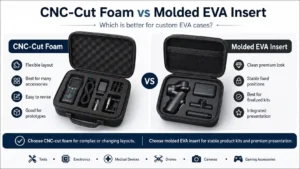
CNC Routing: EVA leaves clean, sharp edges.
Die-Cutting: EVA creates crisp corners without crushing the surrounding material.
EPE, due to its beaded structure, can sometimes have “ragged” edges when cut, making it less suitable for complex, tight-tolerance cavities.
5. Chemical and Water Resistance
Both are closed-cell foams, meaning they don’t absorb water. However, EVA offers much better resistance to chemicals and oils. In automotive workshops or medical labs where spills are common, EVA will last for years, while EPE may degrade or discolor.
Comparison Table: At a Glance
| Feature | EPE Foam (Pearl Cotton) | EVA Foam |
| Durability | Low (One-time use) | High (Multi-use) |
| Resilience | Poor (Deforms easily) | Excellent (Bounces back) |
| Texture | Coarse / Beaded | Smooth / Fine |
| Weight | Very Lightweight | Medium to Heavy |
| Fabrication | Simple Cutting | Precision CNC / Laser |
| Cost | Budget-friendly | Premium |
| Lifespan | Short | Very Long |
Real-World Use Cases: Which Should You Choose?
Choose EPE Foam If:
Shipping Fragile Items: You are shipping electronics or glassware one-way from a warehouse to a customer.
Large Volume, Low Margin: You need to keep packaging costs to a minimum for a mass-market product.
Large Gap Fillers: You need big blocks of foam to stop a product from moving inside a large shipping carton.
Choose EVA Foam If:
Luxury Brand Packaging: You are selling cosmetics, jewelry, or high-end electronics.
Tool & Instrument Organizers: You need a shadow board for tools that will be taken out and put back daily.
Medical & Scientific Gear: You require a sterile-looking, high-precision insert for delicate sensors.
Marine & Outdoor Gear: You need a material that survives UV rays and saltwater.
Quick Summary on EVA vs EPE foam:
Choosing between EVA vs EPE foam depends on your budget and protection needs. While EVA vs EPE foam is a common debate, remember that EVA vs EPE foam offers better durability for long-term use, whereas EVA vs EPE foam in its EPE form is better for one-way shipping. When you compare EVA vs EPE foam, always consider the “unboxing experience” of your brand.
Frequently Asked Questions (FAQ)
Is EVA foam more environmentally friendly than EPE?
Both are forms of plastic. However, EPE is easier to recycle in standard facilities. EVA is often considered “eco-friendly” in a different way—because it lasts so much longer, it reduces waste by not needing to be replaced frequently.
Can I laminate EVA and EPE together?
Yes! Some clever packaging designs use a thick layer of cheap EPE at the bottom for cushioning and a thin layer of premium-looking EVA on top for aesthetics. This is a great way to balance cost and quality.
Does EVA foam smell?
New EVA foam can have a slight “vinegar” smell due to the foaming agent. However, high-quality EVA from Gaoda EVA is processed to ensure minimal odor, making it safe for indoor and medical use.
Conclusion: Making the Right Investment
At the end of the day, the choice between EVA vs EPE foam comes down to your product’s lifecycle. If the packaging is thrown away immediately after opening, go with EPE. If the packaging is part of the product’s long-term value, go with EVA.
At Gaoda EVA, we help businesses across the globe design the perfect foam inserts. Whether you need the budget-friendly protection of EPE or the high-end precision of EVA, our CNC and die-cutting experts are here to help.
Ready to start your project?
Contact Gaoda EVA today for a free material consultation and a custom quote!


 Turkish
  English
  Korean
  Japanese
  French
  German
  Spanish
  Russian
  Arabic
  Italian
  Portuguese
  Thai
Thai  Vietnamese
  Chinese