
Custom First Aid Kit Case: What It Is and How to Choose the Right Design
A first aid kit is usually made up of many small medical supplies. Bandages, gauze pads, scissors, tapes, gloves, wipes, masks, medicine packs and emergency tools all need to be stored in a clean and organized way. When these items are placed in a simple pouch without structure, the kit may look compact at first, but users may struggle to find the right item quickly when they need it.
A custom first aid kit case is designed to solve this problem. Instead of using one loose storage space, the case is developed around the actual medical supply list, usage scenario and brand requirements. Each item can have a clear storage position, making the full kit easier to carry, easier to open and easier to use in an emergency.
For healthcare brands, emergency product suppliers, medical distributors, outdoor equipment companies and OEM buyers, the case is more than packaging. It directly affects product organization, user trust and practical performance. A well-designed custom first aid kit case can make the product look more professional and help users access supplies faster.
This guide explains what a custom first aid kit case is, how it organizes medical supplies and how buyers can choose the right EVA case design for OEM and ODM healthcare projects.
What Is a Custom First Aid Kit Case?
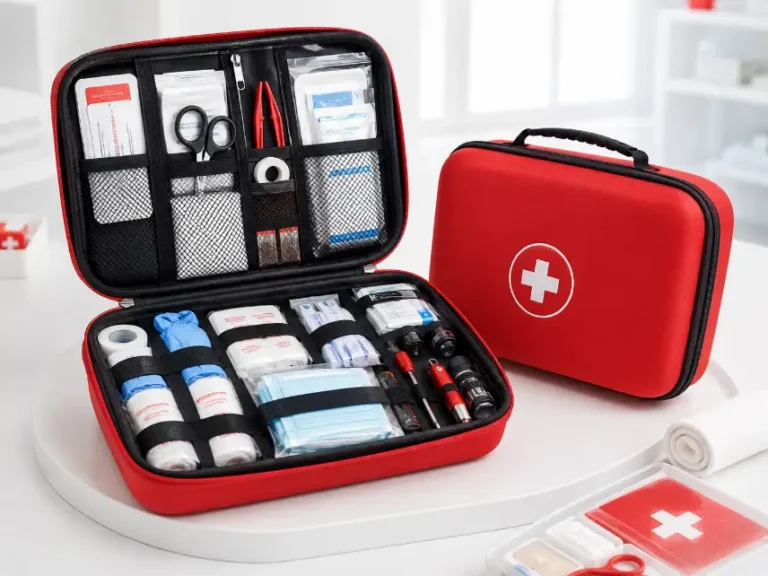
A custom first aid kit case is a protective and organized carrying case designed for first aid supplies, emergency tools and healthcare accessories. Unlike a standard soft pouch or simple plastic box, it can be developed according to the exact supply list, case size, storage layout, target market and branding requirements.
In many OEM projects, the case uses a semi-rigid EVA shell. This shell helps the case keep its shape while remaining lightweight and easy to carry. Inside the case, mesh pockets, elastic straps, dividers, transparent pockets or custom compartments can be added to organize different medical items.
The shell of a custom first aid kit case is commonly made with <a href=”https://www.sabic.com/en/products/polymers/ethylene-vinyl-acetate-eva” target=”_blank” rel=”noopener”>EVA material</a>, which is suitable for lightweight molded protective case structures.
A complete custom EVA first aid case may include:
- Molded EVA outer shell
- Durable surface fabric
- Inner lining
- Mesh pockets
- Elastic straps
- Transparent compartments
- Zippered storage areas
- Custom dividers
- Reinforced handle
- Smooth zipper
- Printed or embossed logo
- Retail or export packaging
The purpose is not only to hold medical supplies. The case should help users find items quickly, keep the contents organized and make the complete first aid kit easier to carry.
How a Custom First Aid Kit Case Improves Organization
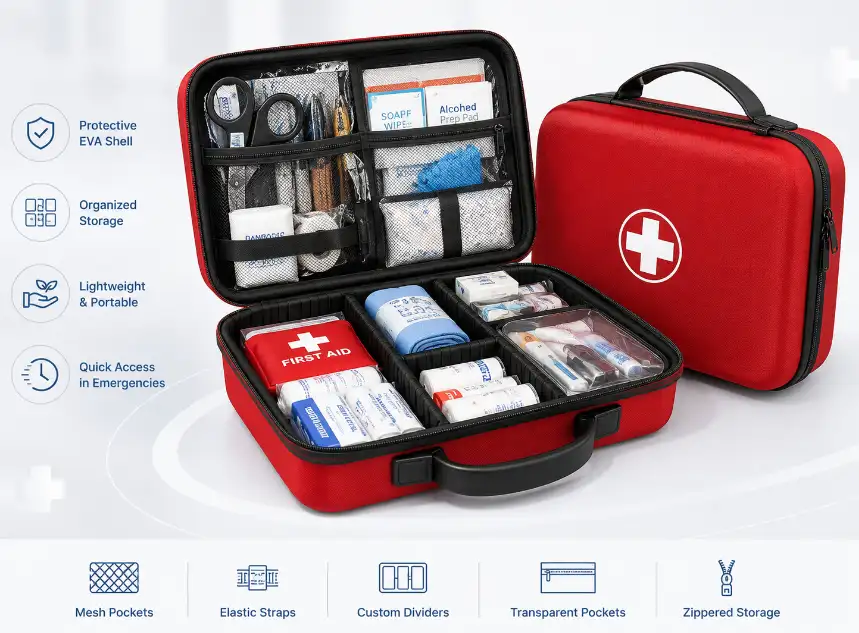
A first aid kit needs a different design logic from a general storage case. The main challenge is not only protection. It is also visibility and access. In many situations, users open a first aid kit because they need something quickly. If all items are mixed together, the case may become frustrating to use.
A custom first aid kit case improves organization by creating separate areas for different supplies. Bandages can be stored in one section. Gauze and tapes can be placed in another. Tools such as scissors, tweezers or thermometers can be fixed with elastic straps. Small packs can be placed in mesh or transparent pockets so users can see them easily.
When the internal layout is designed properly, the case can help solve common problems:
- Supplies are easier to identify.
- Small items are less likely to be lost.
- Tools stay in fixed positions.
- Soft supplies do not get crushed.
- The kit looks cleaner when opened.
- Users can return items to the correct place.
- The full kit feels more reliable and professional.
This is why the internal structure matters so much. A first aid kit may have good supplies inside, but if the case layout is messy, the product experience will still feel weak.
Main Parts of a Custom First Aid Kit Case
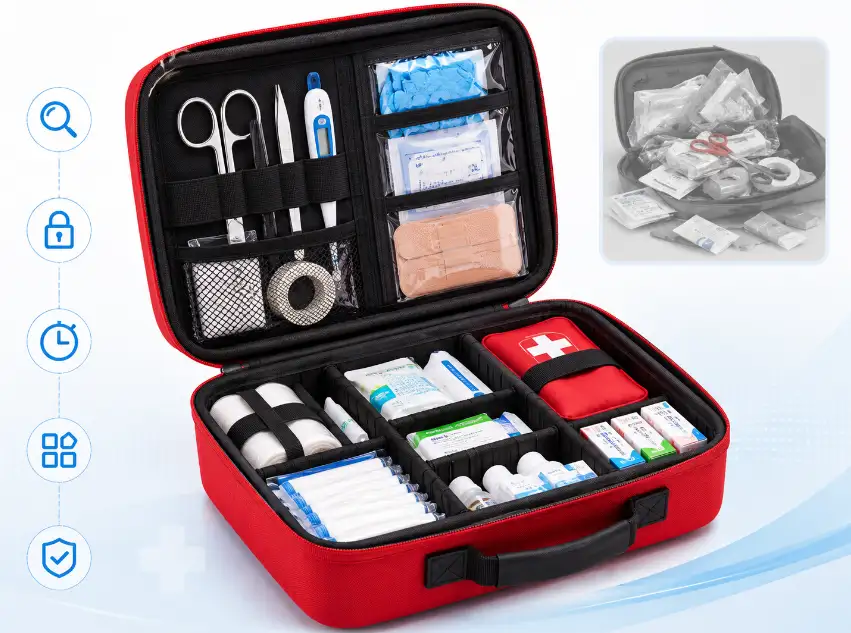
A good first aid kit case is made from several connected parts. Each part affects durability, organization, appearance and cost. Buyers should confirm these details before approving the final design.
EVA Molded Shell
The EVA molded shell gives the case its shape. For first aid kits, the shell should be firm enough to protect the contents during storage, carrying and shipping. At the same time, it should not be unnecessarily heavy or bulky.
A small home first aid kit may only need a compact shell. An outdoor emergency kit may need a stronger and more durable structure. A professional medical kit may require a larger shell with more internal compartments.
The correct shell design depends on the number of supplies, the expected use scenario and the target market.
Surface Fabric
The surface fabric affects durability and appearance. Common choices include polyester, nylon, PU and Oxford fabric. For first aid kits, buyers often prefer materials that look clean, practical and easy to handle.
A red surface is common for emergency-related products, but other colors can also be used depending on the brand and market. For outdoor first aid kits, stronger fabric may be more suitable. For retail healthcare kits, a cleaner and more consumer-friendly surface may be better.
The surface material should also match the logo method and packaging style.
Inner Lining
The inner lining affects how the case looks and feels when opened. For medical and healthcare products, the inside should look clean, organized and trustworthy.
A simple lining may be enough for basic first aid kits. For higher-value medical kits or branded healthcare products, a smoother lining and better internal finishing can improve the overall product presentation.
The lining should also work well with pockets, straps and dividers.
Mesh Pockets and Transparent Compartments
Mesh pockets are useful because they allow users to see the contents while keeping items in place. Transparent compartments can also improve visibility, especially for small medical supplies.
These pockets can be used for bandages, gauze pads, wipes, gloves, medicine packs, masks and other lightweight items. If the item is small and easy to lose, a pocket with a zipper or secure closure may be better.
The goal is to make the kit easy to understand when opened.
Elastic Straps and Tool Holders
Elastic straps are useful for fixing tools such as scissors, tweezers, thermometers, small bottles or emergency accessories. They help prevent tools from moving around inside the case.
However, the straps should not be too tight. Users should be able to remove the tools quickly. In first aid situations, access speed matters.
A good strap layout keeps tools stable while still making them easy to take out.
Zipper and Handle
The zipper should open smoothly and allow the case to open wide enough for easy access. If the opening is too small, users may need to search inside the case, which reduces convenience.
For larger first aid kits, a handle can improve portability. The handle should be strong enough for the full weight of the contents and positioned where the case feels balanced.
OEM Branding Details
For healthcare brands and distributors, branding helps the case look professional and consistent with the product line. Logo options may include printed logo, embossed logo, rubber patch, woven label, metal plate or customized zipper puller.
A branded custom first aid kit case can improve product recognition and make the kit feel more complete.
How to Design a Custom First Aid Kit Case
A successful first aid kit case starts with the supply list. Many design problems happen when the case is created before the buyer confirms what will go inside. If new supplies are added later, the layout may become crowded or difficult to use.
Start With the Complete Supply List
Before designing the case, buyers should confirm every item that will be stored inside. A typical first aid kit may include bandages, gauze, tape, scissors, gloves, wipes, masks, cotton swabs, emergency blanket, medicine packs, antiseptic pads and instruction cards.
If the kit has different versions, such as a home kit, travel kit, car kit or outdoor kit, this should be explained early. Different versions may need different internal layouts.
The manufacturer should know the size and quantity of each item. This helps create a case that is compact but still practical.
Group Supplies by Usage
A first aid kit becomes easier to use when similar items are grouped together. Soft supplies such as gauze and bandages can be placed in one section. Tools can be fixed with straps. Small packs can be placed in visible pockets. Larger items can have deeper compartments.
This grouping method helps users find items faster. It also makes the case look cleaner when opened.
The layout should follow how people actually use the kit, not just how items fit into the smallest space.
Make Important Items Easy to Reach
In an emergency, users should not need to dig through the entire case to find basic supplies. Frequently used items should be placed in visible and easy-to-reach areas.
For example, bandages, wipes, gloves and scissors can be placed in positions that are easy to identify. Less frequently used items can be stored deeper or in separate pockets.
A custom first aid kit case should support fast access, not only neat storage.
Avoid Overcrowding the Interior
A common mistake is trying to fit too many supplies into a small case. This may reduce cost and size, but it can make the kit difficult to use. If items are packed too tightly, users may struggle to remove them. After one use, it may also be difficult to return everything to the original position.
The case should leave enough space for users to remove and replace supplies comfortably. The layout should feel organized, not compressed.
This is especially important for kits used in cars, outdoor activities, workplaces and emergency situations.
Choose Materials Based on the Usage Scenario
Different first aid kits need different material choices. A home first aid kit may focus on a clean appearance and basic organization. A car first aid kit may need better durability and a compact shape. An outdoor first aid kit may require stronger fabric and a more secure zipper. A workplace kit may need a clear layout and larger capacity.
The best material choice should match the real usage scenario.
For buyers who need broader healthcare case development, our <a href="/th/”/custom-eva-medical-device-case-design/”/">custom EVA medical device case</a> guide explains more design considerations for portable medical products.
How to Choose the Right Custom First Aid Kit Case
Choosing the right case depends on the supply list, target user, sales channel and budget. A small travel kit and a professional emergency kit should not use the same design logic.
For travel first aid kits, the case should be compact, lightweight and easy to carry. The internal layout should focus on basic supplies and quick access.
For outdoor first aid kits, the case may need stronger surface fabric, better organization and a more secure zipper. Users may carry the kit in backpacks, vehicles or outdoor equipment bags.
For workplace or industrial kits, the case should be easy to open and easy to check. A clear internal layout helps users confirm whether supplies are complete.
For retail and e-commerce products, presentation matters. The case should look clean in product photos and create a good impression when opened.
For OEM projects, branding consistency is important. Surface color, logo method, zipper style, internal pocket layout and packaging should all be confirmed before production. Buyers who want to understand the full development process can also review our <a href="/th/”/oem-eva-carrying-case-production-guide/”/">OEM EVA carrying case</a> guide.
How Much Space Should a First Aid Kit Case Have?
The right case size depends on the number and type of supplies inside. A case that is too small may make the kit difficult to use. A case that is too large may waste material, increase shipping cost and make the product less convenient to carry.
The case should leave enough space for supplies, pockets, straps and easy access. It should also allow users to return items after use without forcing the zipper closed.
At the same time, the case should not contain too much empty space. If supplies move freely inside the case, the layout will feel messy and the product may look less professional.
The best size is confirmed through sample testing. Buyers should place the complete supply list inside the sample and check whether the case opens, closes and organizes properly.
In short, the right size is the one that balances storage capacity, access speed, portability, appearance and cost.
Can a Custom EVA First Aid Case Replace a Plastic Box?
Some buyers compare EVA first aid cases with plastic boxes. Both options can be useful, but they serve different needs.
A plastic box may provide a rigid structure and can be suitable for fixed storage. However, it may be heavier, less flexible for branding and less convenient for travel or daily carrying.
A custom EVA first aid case is usually lighter, softer to carry and easier to customize. It can be designed with different pockets, straps, colors and logo options. For travel kits, car kits, outdoor kits, healthcare promotions and OEM retail products, EVA can provide a practical balance between protection, organization and presentation.
The right choice depends on how the kit will be used and what experience the brand wants to provide.
Common Mistakes to Avoid
Most first aid kit case problems come from incomplete planning or rushed sample approval.
Buyers should avoid these mistakes:
- Designing the case before confirming the supply list
- Trying to fit too many items into a small case
- Using one loose pocket for all supplies
- Forgetting tool holders for scissors or tweezers
- Making important items difficult to reach
- Choosing materials only by price
- Ignoring the final filled weight
- Approving the sample without placing all supplies inside
- Adding branding details too late
- Starting production before all revisions are confirmed
These issues can usually be avoided by preparing a full item list and testing the sample with real contents.
What Information Should You Send for a Quote?
To receive a faster and more accurate quotation, buyers should prepare the following information:
- Full first aid supply list
- Size and quantity of each item
- Required case size, if available
- Target use scenario
- Required order quantity
- Surface material preference
- Inner lining preference
- Pocket and strap requirements
- Logo artwork
- Packaging requirements
- Target market
- Delivery schedule
- Destination country or region
If the buyer is not sure how to organize the contents, the supply list can be sent first. A professional manufacturer can help recommend a suitable layout based on the item sizes and usage scenario.
Why Work With GAODA EVA CASE?
GAODA EVA CASE provides OEM and ODM custom EVA case solutions for first aid kits, medical devices, healthcare products, electronics, tools, gaming accessories, drones, cameras, headphones, VR headsets and other portable products.
Our team can support the full custom first aid kit case development process, including item layout planning, shell structure design, material selection, pocket and strap design, logo customization, sample development, mass production and quality inspection.
Each case is developed around the actual contents, usage needs, protection requirements and target market. This helps ensure that the outer shell and internal layout work together as one practical carrying solution.
For broader protection needs, you can also learn more about our <a href="/th/”/eva-protective-case-manufacturer-oem-solutions/”/">EVA protective case manufacturer</a> solutions.
FAQ About Custom First Aid Kit Cases
Can the case be customized for my first aid supply list?
Yes. A custom first aid kit case can be designed around your exact supply list, item dimensions and target use scenario.
Can the case include mesh pockets and elastic straps?
Yes. Mesh pockets, transparent pockets, elastic straps, dividers and zippered compartments can be added according to the contents.
Can I add my logo to the first aid kit case?
Yes. Logo options include printed logo, embossed logo, rubber patch, woven label, metal plate and custom zipper puller.
Can the same outer case support different first aid kit versions?
In some projects, the same outer shell can use different internal layouts. This depends on the supply list, item sizes and total thickness.
Is an EVA first aid kit case waterproof?
A standard zippered EVA first aid kit case may resist light moisture depending on materials, but it should not be described as fully waterproof unless the full structure has been designed and tested for that requirement.
What information is needed before sample development?
The manufacturer usually needs the full supply list, item dimensions, quantity, material preference, logo requirements, packaging expectations and target delivery schedule.
Conclusion
A custom first aid kit case should organize medical supplies clearly, protect the contents and make the kit easy to carry and use. The case should not only look good from the outside. It should also help users find the right items quickly when they open it.
The best design starts with the complete supply list, then builds the shell, pockets, straps, lining, zipper and branding around real usage needs. When the outer case and internal layout work together, the final product becomes more practical, more organized and more professional.
If you are looking for a custom first aid kit case manufacturer for your next OEM or ODM healthcare project, GAODA EVA CASE can support you from design and sampling to mass production.
Contact us today with your supply list, case requirements and target quantity to begin your custom first aid kit case project.
GAODA — Professional Custom EVA Case Manufacturer | ISO 9001 Certified | Shenzhen + Vietnam Dual Factories | 20+ Years OEM/ODM Experience
 Thai
Thai  English
  Korean
  Japanese
  French
  German
  Spanish
  Russian
  Arabic
  Italian
  Portuguese
  Turkish
  Vietnamese
  Chinese