
Top 2026 Guide: Why Not All Protective Cases Are Created Equal – The Science Behind Premium Custom EVA Packaging
When it comes to protecting high-value assets—whether it’s delicate medical devices, sensitive electronics, or high-end collectibles like Gundam models—generic plastic boxes simply fail. The secret to ultimate protection lies in the science of Ethylene-Vinyl Acetate, and understanding that premium custom EVA packaging is fundamentally different from mass-market alternatives.
As a professional OEM/ODM EVA case manufacturer, we frequently get asked: Why is there such a huge difference in performance between seemingly similar cases? The answer comes down to molecular structure, precise density calibration, and rigorous testing standards.
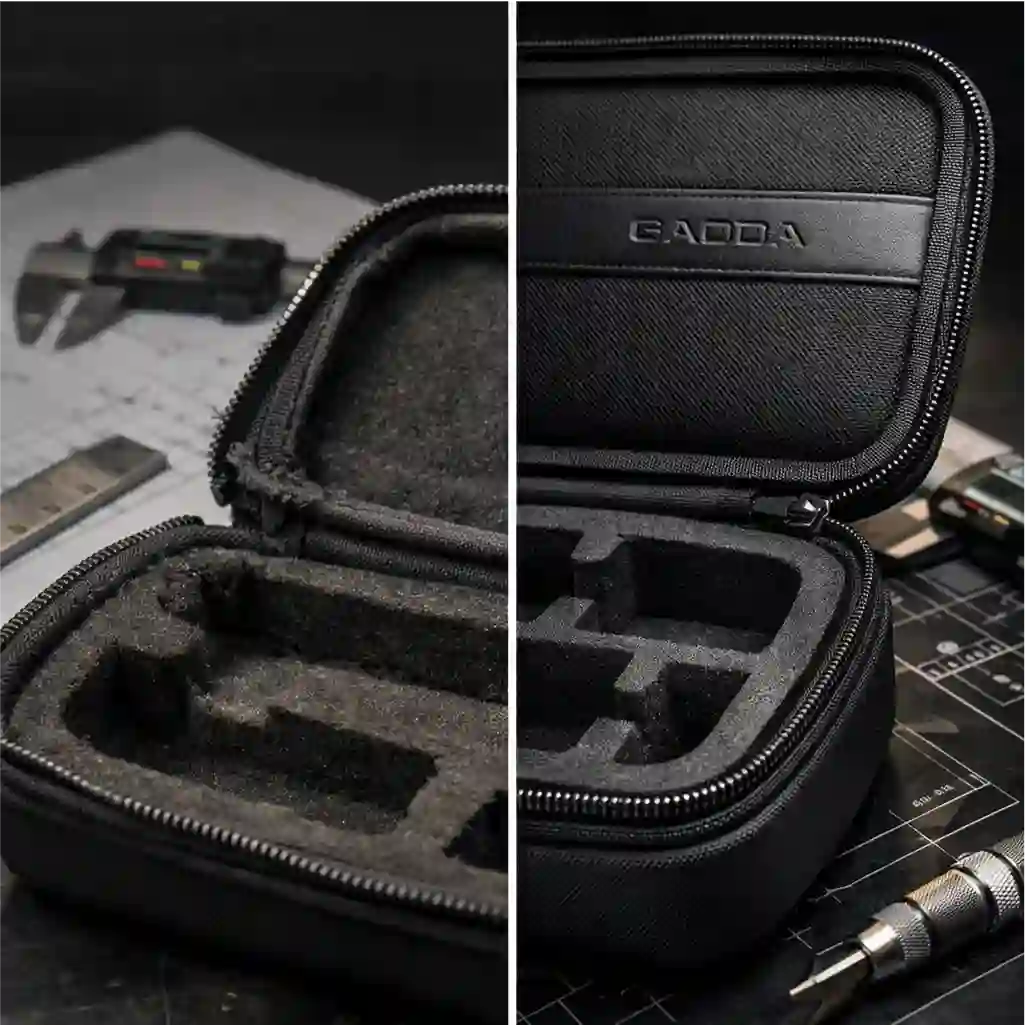
1. The Core Chemistry: What is EVA Foam?
EVA (Ethylene-Vinyl Acetate) is a blended copolymer of ethylene and vinyl acetate. In a high-quality sheet of EVA foam, the weight percentage of vinyl acetate usually ranges from 10% to 40%.
This specific chemical ratio is the first differentiator. A lower concentration of vinyl acetate increases the foam’s rigidity and wear resistance, while a higher concentration improves resilience and flexibility. Cheap cases often use generic, poorly mixed foams, resulting in cases that either crack under pressure or fail to absorb shock.
2. Density and Shore Hardness: The Metrics of Protection
Purchasing or manufacturing a case based solely on how it “looks” will result in rapid material failure under heavy loads. Premium custom EVA packaging is engineered using strict physical metrics.
Foam Density ($\rho$)
Density dictates how the foam responds to constant, heavy pressure. It is calculated using the formula $\rho = \frac{m}{V}$ (where $m$ is mass and $V$ is volume).
$33 – 60 \text{ kg/m}^3$: Ultra-light, highly compressible (used in soft packaging).
$150 – 220 \text{ kg/m}^3$: High strength, extremely low compression set (ideal for premium tool trays and heavy industrial pads).
Shore Hardness
While density determines internal mass, Shore Hardness (Durometer) measures surface indentation resistance. For premium protective cases, engineers calibrate the exact Shore A or Shore C rating needed:
$38^\circ – 45^\circ$ Shore A: Provides medium-low hardness, perfect for general electronics protection.
$60^\circ – 80^\circ$ Shore A: High hardness for heavy machinery gaskets and anti-collision shells.
3. The Thermoforming Process: Shaping the Perfect Defense
The manufacturing method is where premium custom EVA packaging truly separates itself. High-end cases are created through a process called thermoforming.
In this process, the EVA foam sheet is gently heated to its forming temperature (typically between $100^\circ\text{C}$ and $130^\circ\text{C}$) until it softens. A strong vacuum then pulls the material over a custom-designed CNC aluminum mold. Once cooled, the foam retains its shape permanently. This closed-cell structure makes the final case impermeable to water, moisture, and bacteria, which is essential for medical and outdoor applications.
4. International Testing Standards: ASTM D3575 & D4168
You can spot a premium custom EVA packaging manufacturer by their adherence to international testing standards. We don’t just guess if a case will survive a drop; we prove it.
ASTM D3575: This standard defines the testing procedures for flexible cellular materials. It evaluates critical properties like compression strength, tensile strength, and water absorption.
ASTM D4168: This standard is crucial for evaluating the shock-absorbing capacity of the material during free-fall scenarios, ensuring your products survive international shipping and logistics.
5. The Future: Sustainable Bio-Based EVA
In 2026 and beyond, premium doesn’t just mean protective; it means sustainable. The industry is currently revolutionizing packaging with Bio-based EVA.
Derived from responsibly-sourced sugarcane ethanol instead of fossil fuels, bio-based EVA acts as a “drop-in” solution. It provides the exact same flexibility and impact resistance as traditional EVA, but significantly reduces greenhouse gas emissions. In fact, life cycle assessments show that Braskem’s I’m green™ bio-based EVA captures $2.1 \text{ kg}$ of $\text{CO}_2$ per ton produced.
Conclusion: Invest in Premium Custom EVA Packaging
Not all protective cases are created equal because not all manufacturers understand the science of protection. From calculating the exact $\text{kg/m}^3$ density to vacuum-forming the perfect fit and passing ASTM drop tests, engineering a reliable case requires deep technical expertise.
If your brand requires packaging that matches the high quality of your products, don’t settle for generic shells. Partner with a professional OEM/ODM manufacturer to design your ultimate protective solution.


 Japanese
  English
  Korean
  French
  German
  Spanish
  Russian
  Arabic
  Italian
  Portuguese
  Turkish
  Thai
Thai  Vietnamese
  Chinese