
GAODA / OEM buyer’s guide
How Much Does a Custom EVA Case Cost?
A practical guide to materials, tooling, order quantities and the details behind a comparable quotation.
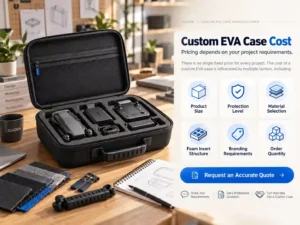
The cost of a custom EVA case depends on its size, shell construction, outer fabric, lining, foam insert, accessories, logo method, tooling and order quantity. Custom projects need specification-based quotations; there is no single price that applies to every design.
To build a realistic budget, separate the finished-case unit price from development, tooling and delivery costs. Start with product dimensions or CAD files, quantity, protection requirements and packaging details.
Start with the total project cost
A useful EVA case quotation separates the price of each finished case from development, tooling and delivery costs. A low unit price is difficult to evaluate if the insert, logo, packaging or inspection requirements are excluded.
Quantity × finished-case unit price
+ development & tooling
+ separately quoted services
+ delivery & applicable import costs
Count each item once. If tooling is already spread across the unit price, do not add the same tooling fee again. Likewise, check whether retail packaging, testing and freight are included or listed separately.
| Cost category | What to confirm |
|---|---|
| Finished-case unit price | Approved shell, outer fabric, lining, insert, zipper, handle, logo, assembly and agreed packaging. |
| Development and tooling | Design work, samples, molds, cutting tools, logo setup and the number of revisions included. |
| Additional services | Testing, third-party inspection, special labeling or documentation, where required. |
| Delivery | Freight, insurance, destination handling and applicable import charges, according to the agreed delivery terms. |
Use the same currency, specification revision, order quantity and delivery basis when comparing suppliers. Ask for a quotation validity period so your budget is tied to an identifiable offer.
What determines the cost of a custom EVA case?
Case size, shape and usable space
Larger cases generally require more shell material, fabric and lining, and may increase packed shipping volume. Shape also matters: a deep shell, detailed contour or difficult-to-access seam can change the forming and assembly work. Two cases with the same outside dimensions can therefore have different production costs.
Specify both the product dimensions and the space needed for accessories. Ask the supplier to distinguish external case dimensions from usable internal dimensions; fitting the product tightly into an undersized case is not a reliable cost-saving measure.
EVA thickness and shell construction
The shell specification includes more than thickness. Material grade, density or hardness, laminated layers and the formed geometry should be defined together. Increasing thickness alone does not establish a higher protection level. The complete case, including its insert and the packed product, needs to meet the agreed handling requirements.
Ask for an appropriate construction first, then compare an alternative specification against the same acceptance criteria. This is more useful than requesting the thickest or cheapest EVA available.
Zippers, handles and internal accessories
Zipper length and type, custom pullers, reinforced handles, mesh pockets, elastic straps and dividers add components and assembly steps. A small accessory may also introduce a separate minimum purchase quantity or customization charge.
How outer fabric and lining affect the quotation
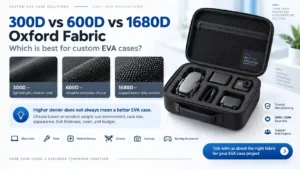
Material names alone are not enough to compare prices. Two fabrics described as “polyester” may differ in weave, weight, coating, backing, finish and color requirements. The same applies to leather-like coverings and soft linings.
| Component | Options to discuss | Cost questions to ask |
|---|---|---|
| Outer textile | Polyester / Oxford fabric | Which grade, backing, finish and color are included? Is it a stocked material or a custom production run? |
| Leather-like exterior | PU covering | What surface texture, backing and forming compatibility are required? Does the finish need additional validation? |
| General lining | Polyester or other specified textile | How is the lining bonded or sewn, and which product-contact surfaces does it cover? |
| Soft-touch lining | Velvet or comparable soft fabric | What are the requirements for appearance, abrasion, color transfer and cleanliness? |
| Special material | Application-specific grade | Is the exact specification available, and are material minimums, lead times or test reports involved? |
Request swatches with clear material references, not just color photographs. Once a sample is approved, record the selected material and permitted substitutions. A later change in fabric or lining can alter both appearance and the production process.
Explore GAODA’s EVA case customization options to organize the exterior and interior choices in your brief.
How foam inserts affect EVA case cost
A fitted insert adds material and fabrication work, but can help organize accessories and control movement inside the case. Its cost depends on the foam grade, thickness, number of layers, cutout geometry, bonding and finishing—not simply the number of items stored.
| Insert option | Design considerations | Quotation variables |
|---|---|---|
| EVA foam insert | Fitted cavities, finger access and presentation | Material grade, cutout depth, layers, machining or cutting work and lamination. |
| Flexible PU foam | Cushioning and contact with delicate surfaces | Exact foam grade, firmness, thickness, cutting and any lining or surface treatment. |
| EPE / polyethylene foam | Cushioning and separation, subject to product requirements | Grade, density, thickness, fabricated shape and joining method. |
| Molded tray or insert | A repeatable shape for an approved product layout | Dedicated tooling, geometry, production quantity and the cost of later design changes. |
These are options to evaluate, not a universal ranking of protection or price. Polyethylene foam, for example, is used for cushioning and surface protection, but that does not establish the performance of a specific finished insert. See Pregis’s polyethylene foam overview for material-use context.
CNC-cut versus molded inserts
CNC cutting describes a fabrication process; EVA, PU and EPE describe material families. They should not be treated as equivalent categories. A cut insert and a molded insert may have different setup costs, production steps and revision requirements. Ask the supplier to quote both routes where technically suitable, using the same product layout and expected order volume.
How much does EVA case tooling cost?
There is no reliable tooling price without a defined design. The quotation should identify the tools needed for the shell, insert and branding, rather than grouping every setup charge under a single unexplained “mold fee.”
Why tooling may be required
A custom molded shell needs tooling that defines its shape. A shaped insert, cutting operation or embossed logo may require separate tooling or setup. Existing tools may be usable only if their dimensions and construction suit the new project and their use is permitted.
Is tooling a one-time cost?
An initial tool charge may cover development of a particular design. It does not automatically cover future modifications, replacement, maintenance or indefinite storage. An unchanged repeat order may reuse serviceable tooling, but the reuse terms should be agreed in writing.
- Which tools are included, and who owns them?
- What happens if dimensions or logo artwork change after approval?
- How are storage, maintenance and replacement handled?
- Can the tools be reused for repeat orders, and are there further setup charges?
Ask for these answers before paying the tooling charge. Tool ownership, physical possession and permission to use a tool are separate issues.
How order quantity affects unit cost
A larger order can spread fixed setup work across more cases. It may also improve material purchasing, cutting layouts and production scheduling. However, quantity discounts are not automatic or linear, and ordering more than you need introduces storage and inventory risk.
Illustration only: T is the same fixed tooling charge. This shows tooling allocation per case, not a quoted unit price, available MOQ or guaranteed discount.
If the charge stays unchanged, allocating it over 1,000 cases rather than 500 halves that component of the cost per case. Material and labor costs still remain. If the supplier charges tooling separately, the production unit price may not show this allocation at all.
Request quantity breaks against one unchanged specification. Also confirm whether the MOQ applies per design, size, color or logo version; splitting one order across several variants can change the quotation.
Sample cost versus mass production cost
A sample price should not be used as the expected bulk unit price. Sampling may involve design development, small material purchases, manual work, trial assembly and revisions that are spread differently in a production run.
- Define the brief
- Develop a sample
- Review and revise
- Approve the specification
- Start production
Confirm whether the sample is a visual mockup, a fit-check prototype or a production-intent sample. These serve different purposes. Ask which materials and processes represent the planned bulk order, how many revisions the sample fee includes, and whether sample courier charges are separate.
Any sample-fee credit against a later order must be stated in the quotation. Before bulk production, record the approved dimensions, material references, insert layout, logo artwork, packaging and acceptance criteria. See GAODA’s manufacturing process for the development-to-delivery workflow.
Does logo customization increase the cost?
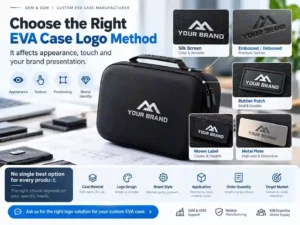
Logo application can add both setup and per-case costs. The result depends on the artwork, size, number of colors, selected surface and attachment method. A universal “cheapest to most expensive” ranking can be misleading.
| Method | What to specify | What may add cost |
|---|---|---|
| Screen printing | Artwork size, color count and print position | Separate screens, multiple passes and registration requirements. |
| Heat transfer | Artwork, coverage and compatible surface | Transfer preparation, application steps and finish validation. |
| Rubber / PVC patch | Dimensions, colors, thickness and attachment | Patch tooling, minimum component quantities and sewing or bonding. |
| Embossing | Logo depth, position and suitable material | Dedicated tooling and changes to the shell or material process. |
| Metal badge | Material, finish, dimensions and fixing | Badge production, surface finishing and attachment work. |
Confirm method availability for the selected case construction. Approve the logo on the actual material, not only in a digital rendering. If durability matters, define how appearance and attachment will be checked under the intended use conditions.
China versus Vietnam: compare the complete delivered cost
GAODA offers manufacturing in China and Vietnam. The appropriate location depends on the particular order, material sourcing, available production capacity and delivery requirements. A country name alone does not determine the lower-cost option.
| Factor | Use the same comparison basis |
|---|---|
| Materials and components | Where are the specified materials sourced, and does the plan require extra transport or minimum purchases? |
| Tooling and production | Can the approved tools and processes be used at the proposed facility? Is new setup required? |
| Capacity and scheduling | What is the confirmed production window after sample approval and material readiness? |
| Delivery | Compare freight route, packing volume, shipment timing and the same delivery terms. |
| Import treatment | Obtain a destination-specific assessment of classification, origin documentation and current applicable charges. |
Request two comparable project quotations if both locations are feasible. Keep specification, quantity, inspection requirements and delivery basis consistent. Have your customs broker confirm applicable import treatment for the actual goods and route; this guide does not assume a tariff advantage for either location.
Example: how to build a comparable quotation brief
The following is an illustrative buying exercise, not a GAODA customer order or published price. Imagine a portable electronic device that needs a case, cable storage and a fitted insert. A usable brief would define:
| Item | Baseline to agree |
|---|---|
| Product and dimensions | The device drawing, weight, protruding parts and usable internal space required. |
| Exterior and shell | A specified polyester fabric and an EVA construction recommended for the handling requirements. |
| Interior | A cut EVA insert with device and cable cavities, with agreed access and retention. |
| Branding | One approved artwork file, location and application method. |
| Quantity and packaging | A 1,000-piece comparison quantity and a specified individual packing method. |
| Delivery and approval | Destination, target date, delivery basis and the approved specification revision. |
Ask the supplier to price this baseline first. Then request an alternative with, for example, a simpler insert layout or a different logo method. Keep the other requirements unchanged so the cost difference can be traced to a real design decision.
Compare the revised sample against the same fit and protection requirements. A cheaper option only helps if it still performs the job. This approach produces a useful cost breakdown without relying on an unsupported market-wide price range.
How to reduce cost without losing essential function
- Finalize the product layout early. Changes after tooling or sample approval can create rework.
- Ask about stocked materials. An available fabric or zipper may avoid a special component order.
- Reduce unnecessary variation. Compare a common shell with different inserts against several completely separate case designs.
- Simplify the insert where appropriate. Remove unnecessary cavities or layers while retaining support and access.
- Match branding to the surface. Quote one suitable method before requesting multiple premium treatments.
- Review packed dimensions. Confirm carton size and packing quantity when comparing delivery costs.
- Plan realistic order quantities. Balance unit-price savings with demand, storage and the risk of future product changes.
What information is needed for an accurate EVA case quote?
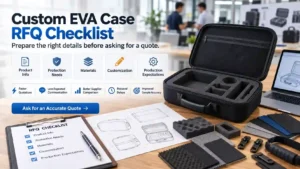
Send one consolidated brief, ideally with a dated drawing revision. If a detail is still undecided, say so and ask the supplier to list the assumption used in the quotation.
| Provide | Include these details |
|---|---|
| Product information | Dimensions, weight, photos, CAD files or a physical sample; include protrusions and sensitive surfaces. |
| Case and interior | Preferred case size, accessories list, insert layout and storage needs. |
| Protection requirements | Handling environment, repeated use, moisture exposure and any agreed test methods or acceptance criteria. |
| Materials and appearance | Fabric, lining, preferred color, texture and reference samples where available. |
| Branding | Vector artwork, logo size, placement and preferred application method. |
| Order structure | Quantity per design or color, reorder expectations and target budget if you have one. |
| Packaging and delivery | Individual packing, labels, carton requirements, destination and target delivery date. |
When reviewing the response, check the unit price, tooling and sample charges, inclusions, exclusions, production assumptions, payment terms and quotation validity. Confirm what triggers the lead-time countdown and whether transit time is included.
Frequently asked questions
How much does a custom EVA case cost?
Custom EVA cases are quoted by specification and quantity. The main variables are shell size and construction, fabric, lining, insert, accessories, logo, tooling and packaging. Ask for a finished-case unit price plus separately identified development and delivery costs. A price range without those assumptions is not a dependable project budget.
What is the MOQ for a custom EVA case?
The MOQ must be confirmed for the particular design, materials and order variants. Ask whether it applies per shell size, color or branding version. A minimum for an existing construction may differ from a new molded design or a project using specially ordered materials. State the quantity you actually need when requesting a quote.
How much does EVA case tooling cost?
Tooling is quoted after the shell shape, dimensions, insert and branding requirements are reviewed. Request an itemized scope covering the tools and setup work required for your design. Confirm ownership, revision charges, storage and reuse terms. A single unexplained mold fee makes first-order and repeat-order budgets difficult to compare.
Will I pay for tooling again on a repeat order?
An unchanged repeat order may be able to use existing serviceable tools, subject to the supplier’s written terms. Design changes, damage, replacement or other setup requirements can introduce additional charges. Ask the quotation to explain tool reuse and any ongoing fees rather than assuming the first payment covers all future orders.
How long does it take to make a custom EVA case?
The schedule depends on design readiness, tooling, material availability, sampling, revisions and production capacity. Request separate dates for sample completion, approval, production and shipment. Confirm when each stage starts and allow for product-fit testing and shipping. A general lead-time statement should not replace a confirmed schedule for your order.
Can I order a prototype before mass production?
Ask for a sample-development quotation before committing to bulk production. Clarify whether the sample checks appearance, fit or the planned production construction. Agree the fee, revision allowance and shipping cost, and document approval before the production run. Any credit of the sample fee toward a later order should be confirmed in writing.
Does a custom foam insert increase the price?
A fitted insert generally adds material and fabrication work compared with an otherwise identical empty case. The amount depends on foam grade, depth, layers, cutout complexity and production method. Compare complete interior designs against the same retention, access and protection requirements instead of assuming one foam type is always cheaper or more protective.
Can EVA cases be manufactured in Vietnam?
GAODA offers manufacturing in Vietnam as well as China. Confirm which location is suitable for the specified materials, construction, quantity and delivery plan. Compare quotations on an equivalent basis and assess the complete delivered cost. Manufacturing location alone does not establish the lower price or the applicable import treatment.
 Japanese
 English
 Korean
 French
 German
 Spanish
 Russian
 Arabic
 Italian
 Portuguese
 Turkish
 Thai
 Vietnamese
 Chinese
