
EVA Case vs Fabric Bag: Which Is Better for Your Product?
When developing a carrying solution for a new product, brands often face an important decision: should they choose a custom EVA case or a traditional fabric bag?
At first glance, both options can provide convenient storage and portability. However, they offer different levels of structural support, product organization, customization and everyday protection.
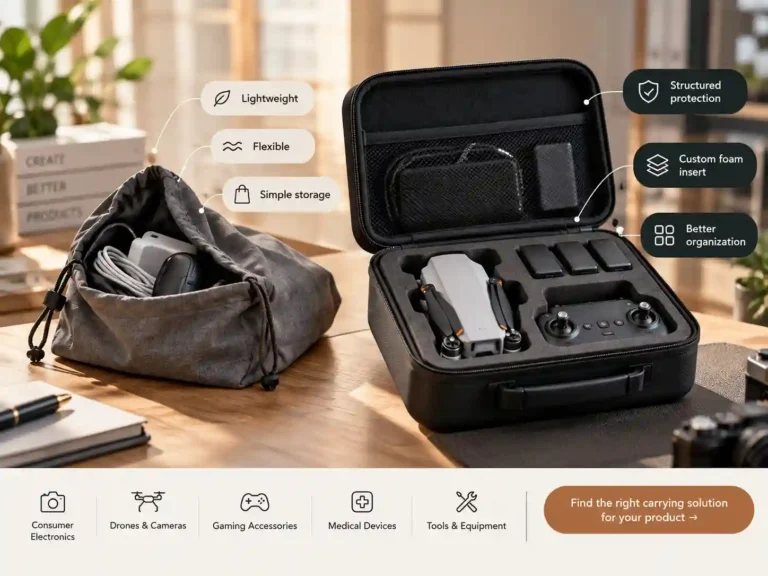
A simple fabric bag is usually flexible and lightweight, making it suitable for products that do not require a defined protective structure. A custom EVA case, on the other hand, uses a semi-rigid shell that helps maintain its shape and can be combined with customized foam inserts to hold products securely.
For B2B brands developing electronics, medical devices, tools, drones, cameras or gaming accessories, the decision should be based on the product’s weight, fragility, accessories, transportation environment and target market.
This guide compares EVA cases vs fabric bags from a practical OEM and ODM perspective, helping product managers, sourcing teams and brand owners select the right carrying solution.
Quick Answer: EVA Case or Fabric Bag?
Choose a fabric bag when your product mainly needs lightweight storage, flexibility and basic organization. It is particularly suitable for products that are not highly sensitive to pressure or impact.
Choose a custom EVA case when your product needs a semi-rigid outer structure, better shape retention, customized internal support and a more structured presentation.
Neither option is automatically better for every application. A well-designed padded fabric bag can provide meaningful protection, while an EVA case with an unsuitable foam insert may still fail to protect a product properly.
The best solution depends on how the product will be carried, stored and used.
What Is the Difference Between an EVA Case and a Fabric Bag?
Before comparing their performance, it is important to understand how these two products are constructed.
What Is a Custom EVA Case?
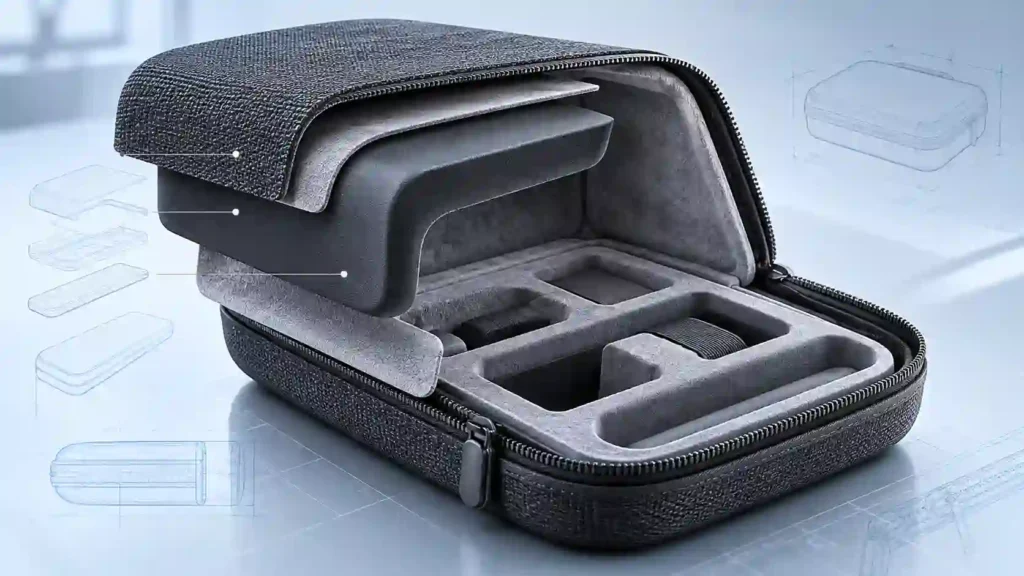
A custom EVA case is a semi-rigid protective carrying case developed using EVA material, outer fabric and an internal lining.
The materials are combined and formed into a structured shell, creating a case that maintains its shape better than a typical unstructured fabric pouch.
Depending on the project, the interior can include:
CNC-cut foam inserts
Molded EVA trays
Sponge inserts
Egg-crate foam
Mesh pockets
Elastic straps
Custom functional compartments
The outer shell, lining, zipper, handle, logo and internal layout can all be customized.
EVA, or ethylene-vinyl acetate, is a copolymer material used in applications where lightweight construction and foamability are important. Its actual performance depends on the material formulation and finished case construction.
For more information, buyers can refer to SABIC’s EVA material overview.
What Is a Fabric Bag?
A traditional fabric bag is generally constructed from textile materials such as polyester, nylon or Oxford fabric.
Unlike a molded EVA shell, a basic fabric bag usually relies on its fabric panels, stitching, padding and internal compartments to hold its shape and protect the contents.
Common features include:
Fabric outer panels
Soft lining
Zipper closures
Sewn pockets
Elastic straps
Optional foam padding
Adjustable compartments
Fabric bags can also be customized extensively. Some professional soft-sided cases include dense padding, reinforced panels and custom foam inserts.
Therefore, the real comparison is not between a good EVA case and a poorly designed fabric bag. It is between two different construction approaches.
EVA Case vs Fabric Bag: Main Comparison
The following table provides a practical comparison for B2B buyers.
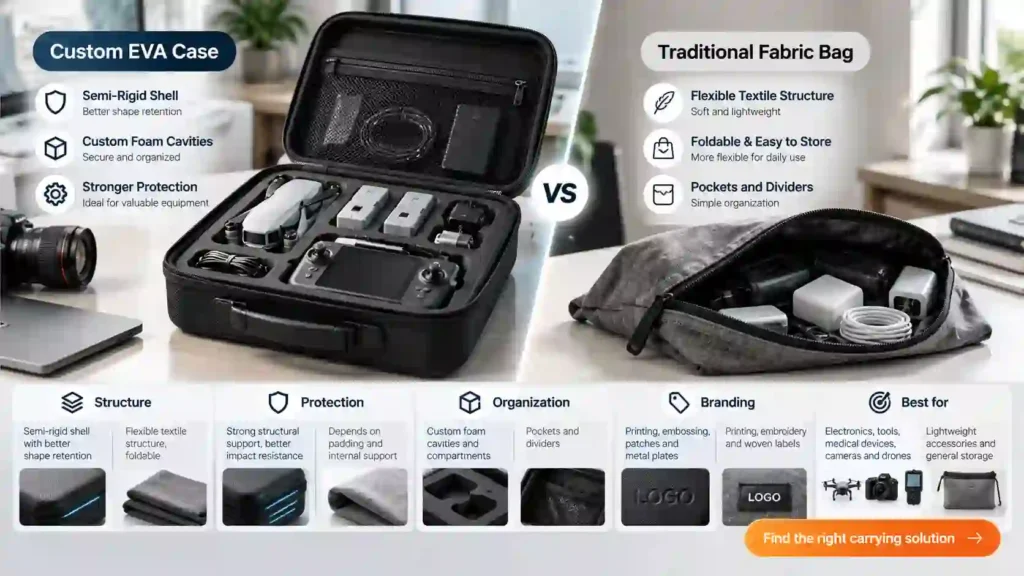
| Comparison Factor | Custom EVA Case | Traditional Fabric Bag |
|---|---|---|
| Structure | Semi-rigid shell | Flexible textile structure |
| Shape retention | Generally better | Depends on padding and reinforcement |
| Impact protection | Can combine shell and custom cushioning | Depends on padding and internal support |
| Compression resistance | Better structural support in many designs | Limited in unstructured designs |
| Weight | Lightweight, but shell adds structure | Often lighter for simple designs |
| Portability | Suitable for structured product kits | Flexible and easy to fold |
| Internal organization | Custom foam cavities and compartments | Sewn pockets and dividers |
| Product positioning | Professional and structured | Casual and flexible |
| Branding | Printing, embossing, patches and metal plates | Printing, embroidery and woven labels |
| Customization | Shell, fabric, lining, inserts and hardware | Fabric, pockets, padding and straps |
| Best applications | Electronics, instruments, medical devices and tools | Lightweight accessories and general storage |
The most important difference is structural support.
A fabric bag can be a practical storage solution, but a custom EVA case offers a more defined protective structure when the product needs to stay in a fixed position during transportation.
1. Product Protection: Which Offers Better Protection?
Protection is usually the first consideration when choosing between an EVA case and a fabric bag.
A standard fabric bag provides a flexible outer layer, but its ability to protect against pressure and impact depends heavily on its padding and internal structure.
If the product is placed inside an unpadded bag, it may move freely or come into contact with other accessories.
A custom EVA case provides a semi-rigid shell that helps maintain the external structure. When combined with a properly designed foam insert, it can hold the product in a defined position and reduce unwanted movement.
This can be particularly useful for:
Portable electronic devices
Medical diagnostic equipment
Precision instruments
Camera lenses
Drone components
Professional tools
However, a semi-rigid EVA case should not be confused with a certified crush-proof enclosure. Its protection performance depends on shell construction, foam properties, product fit and testing.
For products with demanding transportation requirements, buyers should define the expected protection level and validate the complete case through suitable testing.
2. Weight and Portability
Weight is another important factor, especially for products that customers carry frequently.
A basic fabric bag is often lighter because it does not require a formed semi-rigid shell. It can also be folded or compressed when empty, which is useful for products that need flexible storage.
An EVA case adds structural support, but the final weight depends on its dimensions, EVA thickness, outer fabric, lining, foam insert and accessories.
For many portable electronics and professional equipment kits, EVA cases provide a practical balance between structure and portability.
The correct choice depends on whether the product needs more flexibility or a more defined protective enclosure.
3. Internal Organization: Foam Inserts vs Sewn Pockets
Internal organization is one area where custom EVA cases offer significant design flexibility.
A fabric bag usually uses sewn pockets, elastic straps or adjustable dividers to organize accessories.
These features work well for products with flexible storage requirements.
However, products with precise shapes or multiple accessories may benefit from dedicated compartments.
A custom EVA case can incorporate CNC-cut foam or molded EVA inserts to create specific positions for each component.
For example, a drone kit may include separate spaces for:
The drone body
Remote controller
Batteries
Propellers
Charging cables
Accessories
A camera case may require dedicated spaces for the camera body, lenses, batteries and filters.
The right insert helps keep components organized and reduces unnecessary movement.
| Internal Design | Boîtier en EVA | Fabric Bag |
|---|---|---|
| Custom foam cavity | Common option | Can be added |
| Sewn pockets | Can be included | Common option |
| Elastic straps | Available | Available |
| Molded internal tray | Available | Not typical |
| Adjustable storage | Possible with modular inserts | Often flexible |
| Fixed product positioning | Well suited | Depends on construction |
For a more detailed comparison, see our guide to CNC-cut foam vs molded EVA inserts.
4. Durability and Everyday Use
The durability of a carrying case depends on more than its main material.
For fabric bags, performance is influenced by fabric strength, stitching, reinforcement, zipper quality and handle construction.
For EVA cases, buyers should evaluate the shell, fabric lamination, seams, zipper, handle and internal structure together.
GAODA supports different outer materials, including:
300D Oxford
600D Oxford
900D Oxford
1680D Oxford
PU leather
Snowflake fabric
Knitted fabric
Velvet
Different materials suit different applications.
For example, a lightweight accessory case may use a lighter fabric, while a professional tool case may require a heavier outer material and additional structural support.
Neither an EVA case nor a fabric bag should be described as waterproof simply because of its material. Water resistance depends on the complete construction, including the zipper, seams and attachment points.
If water protection is important, the requirement should be defined and tested on the finished case.
5. Customization and Brand Presentation
For B2B brands, a carrying case is also part of the product experience.
The appearance, texture and internal organization can influence how customers perceive the complete product package.
Fabric bags offer flexibility in color, fabric selection, printing, embroidery, pockets and straps.
Custom EVA cases offer these options as well, with additional possibilities for shell shape, molded structure and customized internal inserts.
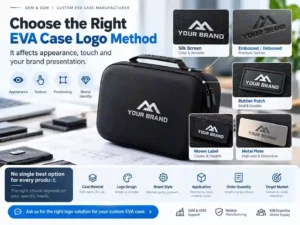
Common EVA case branding options include:
Silk screen printing
Embossing and debossing
Rubber patches
Woven labels
Metal plates
An EVA case can be designed around the product’s dimensions and brand identity, rather than relying on a standard bag size.
For brands that sell premium electronics, medical devices, cameras or professional equipment, this can create a more coordinated product presentation.
Explore our EVA case customization options to learn more about available materials, structures, lining and branding methods.
6. Cost Considerations: Which Is More Economical?
A basic fabric bag may have a lower initial cost because its construction is relatively simple and it may require fewer structural components.
However, a customized fabric bag with multiple pockets, reinforced panels, dense padding and complex internal organization can also become a substantial manufacturing project.
Similarly, an EVA case may require additional forming, material preparation and insert development, depending on the design.
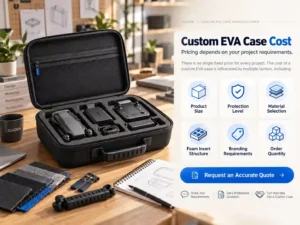
For an accurate comparison, buyers should consider:
Product dimensions
Material selection
EVA thickness
Foam insert structure
Number of compartments
Logo process
Zipper and handle specifications
Order quantity
Packaging requirements
The cheapest option is not necessarily the most economical solution if it does not meet the product’s protection and usability requirements.
For OEM projects, the better approach is to compare quotations based on equivalent product specifications.
Which Industries Should Choose EVA Cases?
Different industries have different carrying and protection requirements.
The following table provides a practical starting point.
| Industry | Recommended Solution | Design Considerations |
|---|---|---|
| Electronics | EVA case or padded fabric bag | Device protection, cable organization and screen clearance |
| Medical devices | Custom EVA case | Dedicated compartments, clean lining and organized accessories |
| Tools and instruments | Custom EVA case | Reinforced carrying structure and fitted inserts |
| Drones | Custom EVA case | Protection for gimbals, controllers, batteries and propellers |
| Cameras | Custom EVA case | Lens clearance, foam cavities and accessory separation |
| Gaming equipment | EVA case or padded fabric bag | Console, controller and accessory organization |
| Lightweight accessories | Fabric bag | Portability, flexible storage and basic protection |
The recommendation should always be based on the actual product rather than the industry name alone.
Electronics Brands
Electronics products often include delicate screens, connectors, cables and accessories.
If the product requires defined storage positions and protection against everyday handling, a custom EVA case with a fitted insert may be more suitable.
For lighter accessories that are not particularly fragile, a padded fabric bag may be sufficient.
Medical Device Brands
Portable medical devices often include several components that need to remain organized.
A custom EVA case can provide dedicated compartments for the main device, cables, sensors and accessories.
The internal layout should also consider how users remove and return each component.
Tool and Instrument Brands
Professional tools and testing instruments may be heavy, irregularly shaped or supplied as a complete kit.
A structured EVA case with suitable foam inserts can help keep tools in their designated positions.
The handle and overall carrying construction should be evaluated against the actual loaded weight.
Drone and Camera Brands
Drones and cameras contain components that may be sensitive to pressure and movement.
A custom EVA case can provide dedicated spaces for the main device, lenses, batteries, controllers and accessories.
The insert should be designed to avoid pressure on sensitive components such as camera lenses and gimbals.
Can You Combine EVA and Fabric Bag Designs?
Yes. A hybrid design can combine the flexibility of textile construction with the structural support of EVA.
For example, a custom case may use:
A semi-rigid EVA outer shell
Soft fabric lining
Mesh pockets
Elastic straps
Custom foam inserts
Additional sewn compartments
This approach allows buyers to balance protection, storage flexibility and product presentation.
For products with multiple accessories, a combination of fixed foam compartments and flexible pockets may be more practical than using either structure alone.
The final layout should be developed around the product and its complete accessory list.
How to Choose the Right Carrying Solution for Your OEM Project
Before selecting an EVA case or fabric bag, buyers should evaluate seven questions.
1. How fragile is the product?
Products with delicate screens, lenses, sensors or precision components may require a more structured protective solution.
2. How heavy is the complete product kit?
The weight of the main product and accessories affects the required shell, handle and carrying structure.
3. Does the product need fixed internal compartments?
If every accessory needs a dedicated position, custom foam inserts may be beneficial.
4. How will customers use the case?
Daily carrying, field work, travel, retail storage and warehouse handling create different design requirements.
5. Does the product need to retain its shape?
A semi-rigid EVA structure is useful when the case should maintain a defined shape.
6. What is the target product positioning?
A premium professional device may need a more structured and coordinated presentation than a simple accessory.
7. What is the target order quantity and budget?
Material, construction, customization and volume should all be considered when comparing manufacturing quotations.
Answering these questions before requesting a quotation helps manufacturers recommend a suitable solution rather than simply quoting a standard product.
What Information Should You Provide to an EVA Case Manufacturer?
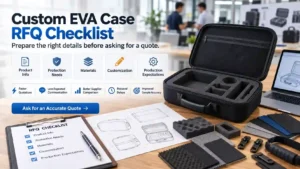
To develop a suitable custom EVA case, buyers should prepare:
| Information | Details |
|---|---|
| Product name | Main product and model |
| Product dimensions | Length, width and height |
| Product weight | Main product and complete kit |
| Accessories | Full list of components |
| Protection requirements | Expected handling and transportation conditions |
| Preferred case structure | EVA case, fabric bag or hybrid |
| Outer material | Oxford fabric, PU leather or other materials |
| Internal design | Foam insert, pockets or dividers |
| Branding | Logo artwork and preferred process |
| Quantity | Initial order and estimated demand |
| Packaging | Individual and export packaging requirements |
| Target market | Destination country or region |
If the product design is still under development, product photographs, CAD drawings or a physical sample can help the manufacturer evaluate the project.
How GAODA Develops Custom EVA Cases for B2B Brands
GAODA EVA CASE was founded in 2007 and provides OEM and ODM custom EVA case manufacturing services for global brands.
With production facilities in Shenzhen, China and Vietnam, GAODA develops protective cases for electronics, tools, medical devices, drones, cameras, gaming accessories and other portable products.
Our customization capabilities include:
Custom case size and shape
EVA shell thickness from 2mm to 8mm
300D, 600D, 900D and 1680D Oxford fabric
PU leather and other outer materials
CNC-cut foam and molded EVA inserts
Mesh pockets and functional dividers
Custom lining, handles and zippers
Silk screen, embossing, rubber patches and metal logos
For most custom projects, our regular MOQ starts from 500 pcs. Sample development usually takes 7–10 days, while bulk production typically takes 25–35 days after sample approval.
Our quality inspection process can include raw material inspection, first article confirmation, production inspection, functional testing, final inspection and pre-shipment sampling inspection.
Testing can be arranged according to product requirements, including zipper testing, tensile testing, color difference testing, water resistance testing, UV aging testing, vibration and shock testing, and drop testing.
You can learn more about our custom EVA case manufacturing capabilities and explore our complete range of customization options.
FAQ About EVA Cases vs Fabric Bags
Is an EVA case better than a fabric bag?
An EVA case is generally more suitable when a product needs a semi-rigid structure, better shape retention and customized internal support. A fabric bag is often sufficient for lightweight products that mainly require flexible storage and basic protection.
Does an EVA case provide better protection than a soft bag?
A properly designed EVA case can provide better structural support than a basic unpadded fabric bag. However, a well-padded soft-sided case can also offer substantial protection. The actual result depends on the shell, padding, insert design and product fit.
Are EVA cases heavier than fabric bags?
A simple fabric bag is often lighter because it does not have a semi-rigid shell. EVA cases add structural material, but their final weight depends on size, thickness, fabric, lining and insert design.
Are EVA cases waterproof?
Not automatically. EVA cases may use water-resistant surface materials, but standard zippers, seams and stitching can allow water to enter. Full waterproof performance requires suitable construction and testing of the complete case.
Can a fabric bag include custom foam inserts?
Yes. Fabric bags can incorporate foam padding and customized internal compartments. However, the outer structure may remain more flexible than a semi-rigid EVA case.
Which is better for electronic products?
For electronics that need fixed positioning, screen protection and organized accessory storage, a custom EVA case is often a practical choice. For lightweight accessories with lower protection requirements, a padded fabric bag may be sufficient.
Which is better for medical devices?
A custom EVA case is often suitable for portable medical devices that require structured storage, dedicated compartments and a professional appearance. The design should consider the device’s weight, sensitivity and accessory requirements.
Can EVA cases be customized with my company logo?
Yes. Common options include silk screen printing, embossing, rubber patches, woven labels and metal plates. The best method depends on the case material and brand requirements.
What is the MOQ for custom EVA cases at GAODA?
GAODA’s regular MOQ starts from 500 pcs, depending on case dimensions, materials, construction and customization requirements.
How long does it take to develop a custom EVA case?
Sample development typically takes 7–10 days after the main specifications are confirmed. Bulk production usually takes 25–35 days after sample approval.
Conclusion: Choose the Case Structure Around Your Product
The decision between an EVA case and a fabric bag should start with the product’s actual protection and carrying requirements.
A fabric bag is a practical choice when flexibility, lightweight storage and simple organization are the main priorities.
A custom EVA case is a stronger option when the product needs a semi-rigid structure, defined internal compartments, better shape retention and coordinated brand presentation.
For many B2B projects, the most effective solution is not simply the most rigid or the least expensive one. It is the structure that provides the right balance of protection, portability, usability and manufacturing cost.
If you are developing a new product and are unsure whether to choose a custom EVA case or a fabric bag, GAODA EVA CASE can help evaluate your product dimensions, accessories, materials and intended use.
Contact GAODA with your product details and target quantity to discuss a suitable OEM or ODM carrying case solution.
GAODA — Professional Custom EVA Case Manufacturer | ISO 9001 Certified | Shenzhen + Vietnam Dual Factories | 20+ Years OEM/ODM Experience
 French
 English
 Korean
 Japanese
 German
 Spanish
 Russian
 Arabic
 Italian
 Portuguese
 Turkish
 Thai
 Vietnamese
 Chinese
