
CNC-Cut Foam vs Molded EVA Insert: Which Is Better for Custom EVA Cases?
If you are developing a custom EVA case, the outer shell is only one part of the protection system. The insert inside the case is just as important. It decides whether the product stays stable, whether accessories are organized, whether the case looks professional when opened and whether the end user can remove each item easily.
For many OEM and ODM projects, buyers often compare two common options: CNC-cut foam insert and molded EVA insert.
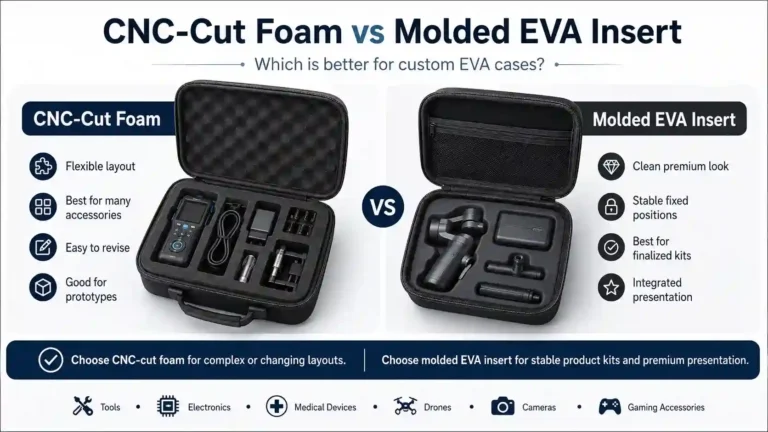
A CNC-cut foam insert is usually better when your product has many accessories, irregular shapes, changing layouts or a need for precise compartments during development. A molded EVA insert is often better when the product design is stable and the brand wants a cleaner, more integrated and premium internal presentation.
In simple terms, CNC-cut foam is more flexible for layout adjustment, while molded EVA insert is more suitable for finalized product kits that need a clean branded appearance.
This guide explains how CNC-cut foam and molded EVA inserts work, how they differ and how B2B buyers can choose the right custom EVA foam insert for tools, electronics, medical devices, drones, cameras and gaming accessories.
Quick Answer: CNC-Cut Foam or Molded EVA Insert?
Choose a CNC-cut foam insert if your product has multiple accessories, requires precise cutouts or may need layout changes during sample development. It is especially useful for tools, electronics, medical devices, drones, cameras and instruments because each product and accessory can have its own fixed compartment.
Choose a molded EVA insert if your product design is already finalized and you want a cleaner, more integrated internal appearance. Molded EVA inserts are often used for branded product kits, retail packaging, consumer electronics, beauty devices and premium product sets.
The best choice depends on product weight, shape, accessory quantity, order volume, appearance requirement, sample development stage and budget.
What Is a CNC-Cut Foam Insert?
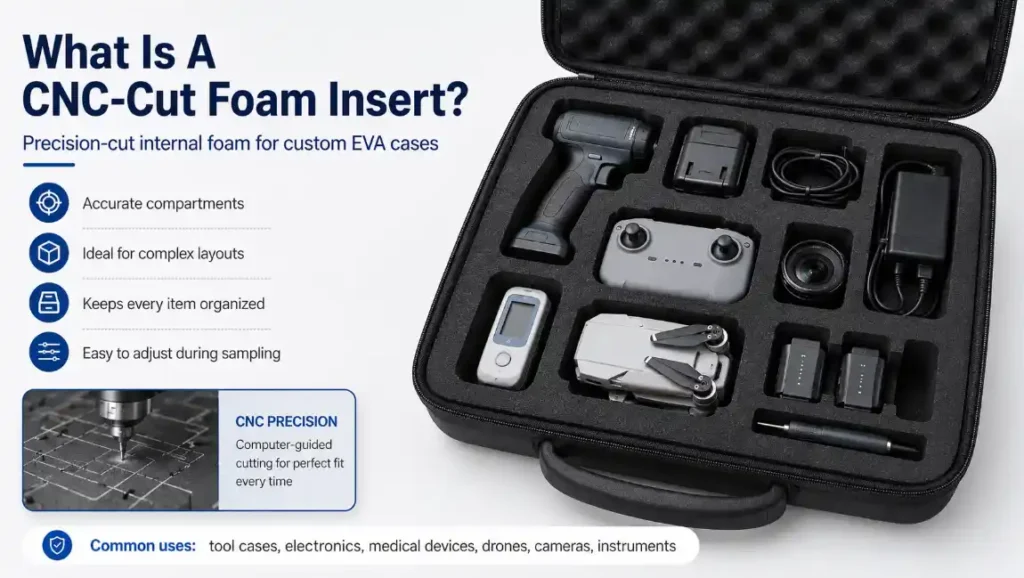
A CNC-cut foam insert is an internal foam structure cut by CNC equipment according to the product dimensions and layout design. It creates precise compartments for the main product and its accessories.
In a custom EVA case, a CNC-cut foam insert can be used to hold items such as tools, chargers, batteries, cables, controllers, medical devices, camera lenses, drone accessories or testing instruments. Each item can be placed in a specific position so the full kit stays organized.
CNC-cut foam is useful when the product has a complex shape or multiple parts. It can create accurate spaces for different components and can be adjusted during the sample stage if the layout needs improvement.
A CNC-cut foam insert is often used for:
Tool cases
Electronics cases
Medical device cases
Drone carrying cases
Camera cases
Instrument cases
Testing equipment cases
Game console cases
Product sample kits
Multi-accessory OEM kits
For buyers who are still testing product layouts, CNC-cut foam is often a practical starting point.
What Is a Molded EVA Insert?
A molded EVA insert is an inner tray or support structure formed into a specific shape to fit the product and accessories. Compared with CNC-cut foam, it usually has a cleaner and more integrated appearance.
A molded EVA insert is often used when the product design is stable and the buyer wants the inside of the case to look more finished. It can make the case feel more like a complete branded package rather than a basic protective storage solution.
Molded EVA inserts are commonly used for:
Consumer electronics kits
Beauty and personal care devices
Premium product sets
Retail packaging cases
Medical product kits
Gaming accessories
Camera accessories
Branded demonstration kits
A molded EVA insert can make the product look more organized and professional when the case is opened. This is especially useful for products sold through retail, e-commerce or premium B2B channels.
CNC-Cut Foam vs Molded EVA Insert: Main Comparison
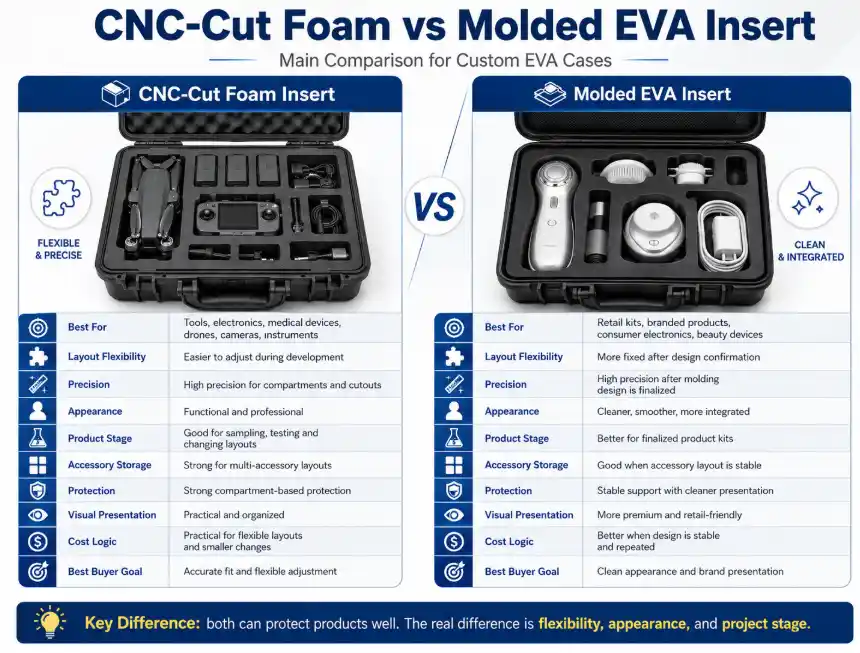
The table below gives a practical comparison for B2B buyers.
| Factor | CNC-Cut Foam Insert | Molded EVA Insert |
|---|---|---|
| Best for | Tools, electronics, medical devices, drones, cameras, instruments | Retail kits, branded products, consumer electronics, beauty devices |
| Layout flexibility | Easier to adjust during development | More fixed after design confirmation |
| Precision | High precision for compartments and cutouts | High precision after molding design is finalized |
| Appearance | Functional and professional | Cleaner, smoother and more integrated |
| Product stage | Good for sampling, testing and changing layouts | Better for finalized product kits |
| Accessory storage | Strong for multi-accessory layouts | Good when accessory layout is stable |
| Protection | Strong compartment-based protection | Stable support with cleaner presentation |
| Visual presentation | Practical and organized | More premium and retail-friendly |
| Cost logic | Practical for flexible layouts and smaller changes | Better when design is stable and repeated |
| Best buyer goal | Accurate fit and flexible adjustment | Clean appearance and brand presentation |
The key difference is not simply protection. Both options can protect the product well if designed correctly. The real difference is flexibility, appearance and project stage.
Which Insert Protects the Product Better?
Both CNC-cut foam and molded EVA inserts can protect products effectively, but they protect in slightly different ways.
A CNC-cut foam insert protects by creating accurate compartments. The product and accessories are placed into cutouts so they do not move freely inside the case. This is useful for products with many parts, such as tools, drones, cameras or medical equipment kits.
A molded EVA insert protects by supporting the product with a shaped structure. It can hold the product neatly and create a cleaner appearance. This is useful for consumer-facing products where presentation matters as much as protection.
For heavy or complex product kits, CNC-cut foam may offer better flexibility because each compartment can be adjusted during sampling. For finalized branded products, molded EVA inserts may create a more polished user experience.
The best insert is not the one that looks strongest on paper. It is the one that fits the actual product, accessory layout and use scenario.
Which Insert Is Better for Tools?
For tool cases, CNC-cut foam inserts are often a strong choice. Tools usually come in different sizes and shapes, and many tool kits include accessories, small parts, chargers, batteries or replacement components.
A CNC-cut foam insert can create fixed compartments for each tool. This helps users quickly see whether all items are present. It also prevents tools from rubbing against each other during carrying or shipping.
For heavier tools, the case may also need thicker EVA material, stronger outer fabric and reinforced handle design. The insert alone is not enough. The shell, handle, zipper and foam layout should work together.
A molded EVA insert can also be used for tool kits, especially when the layout is simple and the buyer wants a cleaner appearance. However, if the tool set includes many irregular parts, CNC-cut foam is usually easier to adjust.
Which Insert Is Better for Electronics?
For electronics, the choice depends on the product style and sales channel.
A CNC-cut foam insert works well for electronics kits with several accessories, such as chargers, cables, controllers, batteries or adapters. It can create separate spaces for each item and prevent hard accessories from scratching the main device.
A molded EVA insert may be better for consumer electronics products that need a clean retail presentation. When customers open the case, a molded insert can make the product look more integrated and premium.
For example, a testing device with cables and probes may use CNC-cut foam. A beauty device, headphone kit or small electronic product set may use a molded EVA insert for better presentation.
For more information about the full case structure, buyers can review our <a href="/fr/”/eva-case-customization-options/”/">EVA case customization options</a> page.
Which Insert Is Better for Medical Devices?
For medical devices, the insert must balance protection, organization and professional appearance.
A CNC-cut foam insert is useful when the medical device has accessories such as sensors, cables, chargers, testing parts, small tools or replacement components. Each item can be placed in a fixed position, making the kit easier to check and use.
A molded EVA insert may be suitable for healthcare products that need a cleaner appearance, especially retail medical kits, home healthcare devices or professional demonstration sets.
Medical products often need a tidy and trustworthy opening experience. If the device and accessories look messy inside the case, the user may feel less confident about the product.
For many medical device cases, the best solution may combine a clean molded layout with precise accessory compartments. The final choice should be based on device weight, sensitivity, accessory list and branding needs.
Which Insert Is Better for Drones and Cameras?
Drones and cameras usually have multiple accessories. These may include controllers, batteries, chargers, propellers, lenses, filters, memory cards, cables and small tools. Because of this, CNC-cut foam is often useful in the early design stage.
A CNC-cut foam insert can create precise spaces for each component. It can protect sensitive areas such as drone cameras, gimbals, camera lenses and controller joysticks by giving them enough clearance.
A molded EVA insert can also work well when the product kit is finalized and the brand wants a cleaner, more retail-friendly look. For camera accessory kits or consumer drone kits, a molded insert may improve presentation.
If the product has many accessories or may change between different bundle versions, CNC-cut foam is usually easier to adjust. If the layout is stable and visual presentation is more important, molded EVA insert may be the better choice.
Which Insert Is Better for Gaming Accessories?
For gaming accessories, the insert should protect screens, buttons, joysticks, controllers, cables and small parts.
A CNC-cut foam insert is useful when the case needs accurate compartments for a game console, controller, charger, game cards or accessories. It keeps the kit organized and reduces movement inside the case.
A molded EVA insert may be better when the gaming product is sold as a premium retail bundle. It can create a smoother internal appearance and make the product feel more complete when opened.
For gaming brands, the decision often depends on the product position. A functional accessory kit may choose CNC-cut foam. A branded consumer product set may choose molded EVA insert for better presentation.
CNC-Cut Foam vs Molded EVA Insert: Cost and Development Considerations
Cost should not be judged only by the insert material. It also depends on product size, insert depth, layout complexity, order quantity, appearance requirements and sample revisions.
CNC-cut foam can be practical when the layout may change. If a buyer is still testing the best position for accessories, CNC-cut foam is often easier to revise during sample development.
Molded EVA inserts may be more suitable when the layout is already confirmed. Once the design is stable, the final result can look cleaner and more consistent across production.
For B2B buyers, the important question is not simply “Which insert is cheaper?” A better question is: which insert reduces project risk and creates the right product experience?
If the project is still changing, flexibility may save time. If the product is already finalized, a molded insert may improve brand value.
How to Choose the Right Custom EVA Foam Insert
Choosing the right insert becomes easier when buyers start from the real product, not from the insert type.
Ask these questions before choosing:
| Question | If Your Answer Is Yes | Recommended Option |
| Does the product have many accessories? | Yes | CNC-cut foam insert |
| Is the layout still changing? | Yes | CNC-cut foam insert |
| Does the product need a clean retail presentation? | Yes | Molded EVA insert |
| Is the product design already finalized? | Yes | Molded EVA insert |
| Does the product include irregular shapes? | Yes | CNC-cut foam insert |
| Is the product a premium consumer kit? | Yes | Molded EVA insert |
| Do you need precise compartments for tools or instruments? | Yes | CNC-cut foam insert |
| Do you want a smoother integrated inner look? | Yes | Molded EVA insert |
In many projects, the answer is not completely one or the other. The case may use a molded EVA insert for the main product and additional pockets or foam compartments for accessories.
How Insert Choice Affects the Full EVA Case Design
The insert should not be designed separately from the case shell. It affects the case size, depth, zipper position, handle balance and final appearance.
For example, if a CNC-cut foam insert is thick, the outer case may need more depth. If the case includes a molded EVA tray, the shell shape may need to match the tray structure. If accessories are stored in the lid pocket, the insert must leave enough clearance so the lid does not press against the product.
This is why custom EVA foam insert design should be considered early in the project. If the insert is designed after the outer case is finalized, the case may become too tight, too bulky or difficult to close.
A good custom EVA case should make the shell and insert work together as one complete protection system.
What Other Insert Options Are Available?
CNC-cut foam and molded EVA inserts are two common choices, but they are not the only options. GAODA can also support several other internal structures depending on product needs.
| Insert Type | Best For | Main Advantage |
| Egg-crate foam | General cushioning | Flexible and cost-effective |
| Sponge insert | Lightweight devices | Soft surface protection |
| DIY grid foam | Flexible layouts | Easy to adjust by removing blocks |
| Elastic foam | Irregular shapes | Flexible holding performance |
| Functional compartments | Multi-accessory kits | Better organization and user access |
| Mesh pockets | Cables, manuals and light accessories | Simple and convenient storage |
| Elastic straps | Tools, cables and slim accessories | Keeps items in position |
These options can also be combined. For example, a case may use a CNC-cut foam insert in the base, a mesh pocket in the lid and elastic straps for cables or tools.
The best design depends on the product, not on one insert type alone.
Common Mistakes When Choosing EVA Case Inserts
Many insert problems come from incomplete product information or rushed sample approval.
Common mistakes include:
Choosing an insert before confirming the full accessory list
Designing only around the main product
Making compartments too tight
Leaving too much empty space
Placing hard accessories against screens, lenses or sensitive parts
Using CNC-cut foam when a cleaner molded appearance is needed
Using molded EVA insert when the layout is still changing
Forgetting product removal space
Approving the sample without testing the real product
Adding logo or packaging requirements too late
These issues can usually be avoided by preparing a complete product kit before sample development.
What Information Should You Send for an Insert Recommendation?
To receive a faster and more accurate insert recommendation, buyers should prepare:
Product dimensions
Product weight
Product photos
2D or 3D drawings, if available
Full accessory list
Accessory dimensions
Required case size, if available
Target use scenario
Required protection level
Preferred insert type, if known
Preferred outer material
Preferred lining
Logo artwork
Packaging requirements
Order quantity
Target market
Delivery schedule
Destination country or region
If you are not sure whether CNC-cut foam or molded EVA insert is better, send the product details first. A professional EVA case manufacturer can evaluate the product shape, weight, accessory layout and branding needs before recommending a suitable insert structure.
How GAODA Supports Custom EVA Foam Insert Projects
GAODA was founded in 2007 and has production facilities in Shenzhen, China and Vietnam. We provide OEM and ODM EVA case services for tools, electronics, medical devices, drones, cameras, gaming accessories, headphones, first aid kits and other portable products.
GAODA can support different custom EVA foam insert options, including EVA molded trays, CNC-cut foam inserts, sponge inserts, egg-crate foam, DIY grid foam, elastic foam and functional compartments.
A typical custom EVA case insert project can include:
Product size review
Accessory list review
Insert type recommendation
Case depth evaluation
Foam compartment layout
Sample development
Product fitting test
Bulk production
Quality inspection
Export packaging
For most custom EVA case projects, sample development usually takes 7–10 days. Bulk production normally takes 25–35 days after sample approval. The regular MOQ starts from 500 pcs, depending on case size, material, structure and customization requirements.
Buyers can visit the <a href="/fr/”/”/">GAODA EVA CASE homepage</a> to learn more about our OEM and ODM EVA case manufacturing service.
Quality Control for Custom EVA Case Inserts
A good insert must fit the product accurately and remain consistent in bulk production. If the cutout is too loose, the product may move. If it is too tight, the user may struggle to remove the product. If the layout is wrong, accessories may press against sensitive parts.
GAODA supports quality checks such as material inspection, zipper testing, tensile testing, color difference testing, waterproof testing, UV aging testing, vibration shock testing and drop testing according to product type and customer requirements.
For custom EVA case projects, the quality process can include:
Raw material inspection
First article confirmation
Production process inspection
Semi-finished product inspection
Functional testing
Final product inspection
Pre-shipment sampling inspection
These checks help confirm case appearance, insert fit, zipper function, handle strength and product consistency before shipment.
For more product guides, check our <a href="/fr/”/blog/”/">custom EVA case blog</a> for articles about EVA thickness, protective case comparison, electronics cases, medical cases, drone cases and tool cases.
FAQ About CNC-Cut Foam vs Molded EVA Insert
Should I choose CNC-cut foam or molded EVA insert for my custom EVA case?
Choose CNC-cut foam if your product has many accessories, irregular shapes or a layout that may still change during development. Choose molded EVA insert if your product design is stable and you want a cleaner, more integrated internal appearance.
Which insert is better for tools?
CNC-cut foam is often better for tool cases because it can create precise compartments for different tools and accessories. It helps keep each item organized and easy to check.
Which insert is better for electronics?
For electronics with many accessories, CNC-cut foam can provide better compartment organization. For consumer electronics that need a clean retail presentation, molded EVA insert may be better.
Which insert is better for medical devices?
Both can work. CNC-cut foam is useful for medical devices with cables, sensors or accessories. Molded EVA insert may be better for healthcare products that need a cleaner professional appearance.
Which insert is better for drones and cameras?
CNC-cut foam is often useful for drones and cameras because it can create precise spaces for controllers, batteries, lenses, chargers and small accessories. Molded EVA insert can be used when the layout is stable and presentation matters more.
Is a molded EVA insert more professional than CNC-cut foam?
A molded EVA insert usually looks cleaner and more integrated, so it can feel more professional for retail or premium product kits. However, CNC-cut foam can also look professional when designed neatly and is often better for complex or changing layouts.
Is CNC-cut foam easier to adjust during sampling?
Yes. CNC-cut foam is generally easier to adjust during the sample stage, especially when the buyer is still testing accessory positions or product layout.
Can one EVA case use both molded EVA insert and foam compartments?
Yes. Some projects combine different internal structures, such as a molded EVA tray for the main product and foam compartments or mesh pockets for accessories.
What is the MOQ for custom EVA cases with foam inserts?
GAODA’s regular MOQ starts from 500 pcs, depending on case size, material, insert structure and customization requirements.
How long does a custom EVA foam insert project take?
For most projects, sample development usually takes 7–10 days. Bulk production normally takes 25–35 days after sample approval.
Conclusion
CNC-cut foam and molded EVA inserts both play an important role in custom EVA case design. The better choice depends on your product shape, accessory layout, project stage, protection needs and branding goals.
CNC-cut foam is often better for tools, electronics, medical devices, drones, cameras and instruments that need precise compartments or flexible layout changes. Molded EVA insert is often better for finalized product kits that need a cleaner, more integrated and premium appearance.
For B2B brands, the insert should not be chosen separately from the case shell. The best custom EVA foam insert should work together with the outer shell, lining, zipper, handle and logo design to create a complete protective case solution.
If you are comparing CNC-cut foam vs molded EVA insert for your custom EVA case project, GAODA EVA CASE can help evaluate your product, accessory list and target market before recommending the right insert structure.
Contact us today with your product dimensions, accessory list and target quantity to start your custom EVA foam insert project.
GAODA — Professional Custom EVA Case Manufacturer | ISO 9001 Certified | Shenzhen + Vietnam Dual Factories | 20+ Years OEM/ODM Experience

 French
  English
  Korean
  Japanese
  German
  Spanish
  Russian
  Arabic
  Italian
  Portuguese
  Turkish
  Thai
Thai  Vietnamese
  Chinese