
Custom EVA Case Sample Approval Checklist: 12 Checks Before Mass Production
Your custom EVA case sample has arrived. The size looks right, the logo is in place, and the exterior matches your product branding. Is it ready for mass production?
Not necessarily.
EVA case sample approval is the process of checking whether a custom protective case meets the agreed requirements before bulk manufacturing begins. It should cover product fit, dimensions, EVA shell construction, materials, foam inserts, zipper function, carrying strength, branding and packaging.
For B2B buyers developing protective cases for electronics, tools, medical devices, drones, cameras or gaming accessories, approving a sample without testing its real-world function can create expensive problems later.
A case that looks good in photographs may still have an insert that is too tight, a zipper that becomes difficult to close when fully loaded, or a handle that is poorly positioned for the product’s weight.
This guide provides a practical 12-point EVA case sample approval checklist to help purchasing managers, product engineers and brand owners verify a prototype before releasing an OEM or ODM order for production.
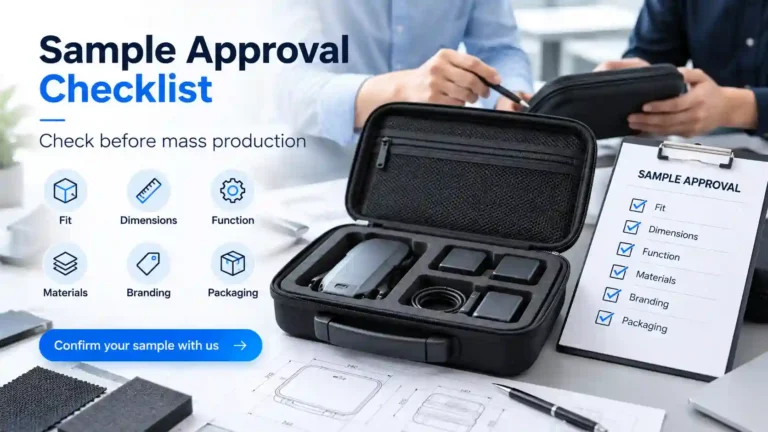
Quick Answer: What Should You Check Before Approving a Custom EVA Case Sample?
Before approving a custom EVA case sample, check the case dimensions, EVA shell thickness, outer fabric, foam insert fit, product clearance, lining, zippers, handles, stitching, logo, functional protection and packaging.
The sample should be tested with the actual product and every accessory that will be included in the final kit.
A written approval should identify the exact sample revision and any requirements that must remain consistent during manufacturing.
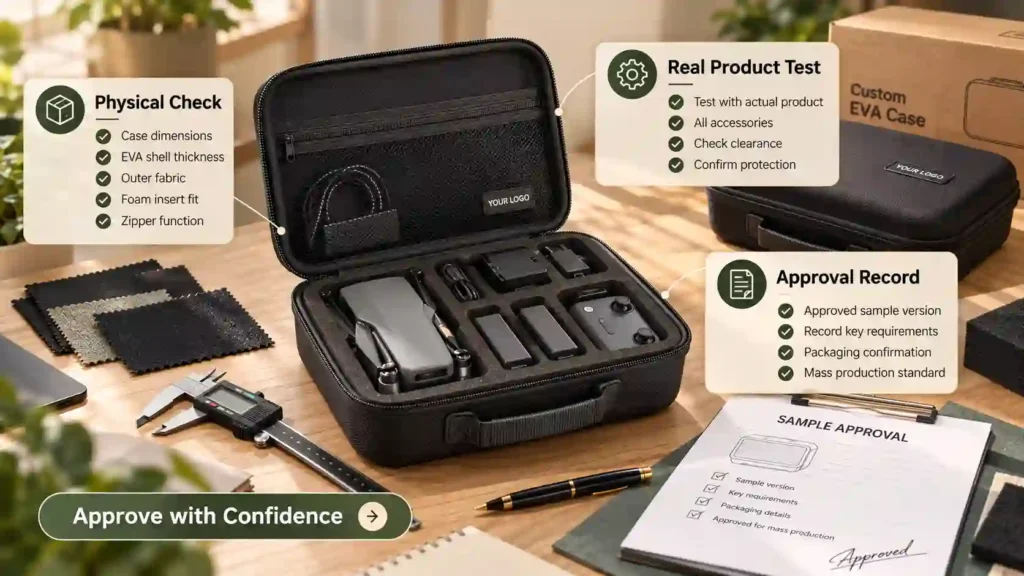
12-Point EVA Case Sample Approval Checklist
| No. | Inspection Item | What Buyers Should Confirm |
|---|---|---|
| 1 | Product and accessory compatibility | The complete product kit fits |
| 2 | Case dimensions and shape | Correct size, depth and molded structure |
| 3 | EVA shell specification | Correct thickness, shape and structural support |
| 4 | Outer fabric and lamination | Approved fabric, finish, color and bonding |
| 5 | Foam insert fit | Secure positioning without excessive pressure |
| 6 | Sensitive component clearance | Screens, lenses, buttons and connectors are protected |
| 7 | Lining and internal organization | Suitable surface protection and accessible storage |
| 8 | Zipper and stitching | Smooth operation and consistent workmanship |
| 9 | Handle and carrying components | Suitable carrying function under intended load |
| 10 | Logo and appearance | Correct artwork, size, color and placement |
| 11 | Functional and protection testing | Performance meets agreed use requirements |
| 12 | Packaging and approval records | Correct packing and documented sample approval |
Each check should be recorded as Pass, Revision Required, or Not Applicable, with supporting notes where necessary.
Why Is Sample Approval Important in EVA Case Manufacturing?
Custom EVA cases are developed around specific products rather than standard dimensions.
A small difference in case depth or foam cavity position can affect how the product fits and how easily the case closes.
For example, a drone case may look correct when empty, but the lid could press against the controller joysticks once the complete kit is installed. Similarly, a medical device case might hold the main device securely while leaving insufficient space for cables or sensors.
These problems are easier to correct during the sample stage than after hundreds or thousands of cases have been produced.
Sample approval therefore has two purposes: confirming that the case works as intended and establishing a reliable reference for bulk production.
It also connects directly to quality management principles such as controlling production requirements and maintaining documented information, which are discussed in the ISO 9001 quality management overview.
1. Confirm the Product Model and Complete Accessory List
The first sample approval check should verify that the case was developed around the correct product version.
Product specifications can change during development. A manufacturer may receive an early drawing, while the buyer later updates the device dimensions or accessory configuration.
Before checking the case, confirm the product model, hardware revision and complete contents of the intended kit.
For example, a camera case may need to accommodate the camera body, lens, battery, charger, filters and cable.
A medical equipment case may require dedicated compartments for the main device, probes, cables, adapters and documentation.
If any required accessory is missing from the sample review, the approved layout may no longer represent the finished product.
Approval rule: Do not approve the final interior design until every required product and accessory has been checked against the intended configuration.
2. Verify External Dimensions, Depth and Molded Shape
The next step is to check whether the case dimensions match the approved drawings or specification.
Buyers should verify:
External length, width and height
Internal usable dimensions
Case depth
Molded shell shape
Opening direction
Closure alignment
Fit when fully loaded
It is important to distinguish between external dimensions and usable internal dimensions.
A case may measure correctly on the outside but still have insufficient room inside because of the EVA shell, lining, foam insert or lid construction.
Where dimensional accuracy is critical, the buyer and manufacturer should agree on acceptable tolerances before production.
Approval rule: The case must meet the agreed dimensions and close correctly with the full product kit installed.
3. Check EVA Shell Thickness and Structural Support
The EVA shell determines much of the case’s shape and structural support.
GAODA commonly works with EVA thicknesses from 2mm to 8mm. For many custom protective cases, 4mm and 5mm are common options, while heavier tools, medical devices and instruments may require a different structure.
During sample approval, buyers should confirm that the shell specification matches the approved design.
They should also inspect whether the shell maintains its intended shape during normal handling.
Pay attention to uneven forming, unexpected soft areas, deformation, visible defects or regions that do not provide sufficient support.
However, buyers should not assume that a thicker EVA shell automatically provides better protection. The final result also depends on geometry, material properties and the internal support system.
Approval rule: Confirm the specified EVA construction and evaluate the complete case under its intended use conditions.
4. Inspect Outer Fabric, Surface Finish and Lamination
The exterior fabric affects the finished case’s appearance, handling and resistance to everyday wear.
GAODA offers materials including 300D, 600D, 900D and 1680D Oxford fabric, PU leather, snowflake fabric, knitted fabric and velvet.
During sample approval, confirm the actual material rather than relying only on photographs.
The material should match the approved specification in texture, color and finish.
Where the fabric is laminated to the EVA shell, inspect for visible bubbling, peeling, uneven bonding or surface wrinkles that fall outside the accepted appearance standard.
Fabric selection should also match the product’s intended use. A lightweight consumer electronics case and a tool case used by field technicians may require different surface materials.
Approval rule: The actual sample material, finish and lamination quality must match the approved reference.
5. Test Foam Insert Fit with the Real Product
Foam insert fit is one of the most important parts of the sample approval process.
An insert may be accurately cut according to a drawing but still create problems when the real product is installed.
A suitable insert should hold the product securely without making insertion or removal unnecessarily difficult.
For CNC-cut foam, inspect the cavity dimensions, depth, edge finish and position of each compartment.
For molded EVA inserts, check the formed structure, contact areas and fit around the product.
Buyers should test the complete kit, not only the main device.
| Insert Problem | Possible Consequence | Recommended Action |
|---|---|---|
| Cavity too loose | Product moves during handling | Review fit and retention |
| Cavity too tight | Product is difficult to remove | Adjust dimensions or removal access |
| Insufficient cavity depth | Lid presses against the product | Recalculate internal clearance |
| Poor accessory layout | Components contact one another | Change compartment arrangement |
| Rough contact surface | Cosmetic wear or scratches | Review lining or surface finish |
If the insert layout is still under development, our CNC-cut foam vs molded EVA insert guide explains how different structures suit different products.
Approval rule: The complete product kit should fit securely, remain accessible and avoid unwanted contact between components.
6. Check Clearance Around Sensitive Components
A product can fit inside an EVA case and still be poorly protected.
Sensitive areas require particular attention.
For electronics, check screens, buttons, connectors and exposed surfaces.
For drones, inspect camera assemblies, gimbals, propellers, batteries and controller joysticks.
For cameras, check lenses, displays, controls and attached accessories.
For medical devices, inspect sensors, probes, cables and any areas requiring careful handling.
An important test is to close the case with everything installed and confirm that the lid or accessories do not apply unintended pressure to sensitive components.
The buyer should also consider how contents might move when the case is carried or placed in different orientations.
Approval rule: Sensitive components must have appropriate clearance and support under the agreed use conditions.
7. Review Lining, Pockets and Internal Organization
The inside of the case should protect the product while making it easy to use.
For devices with delicate surfaces, lining selection may be especially important.
Inspect the lining for visible defects, rough contact areas, loose edges and poor attachment.
Then evaluate the practical arrangement of internal features such as:
Mesh pockets
Elastic straps
Cable holders
Accessory compartments
Document pockets
Functional dividers
The internal layout should make sense when the customer opens the case.
For example, putting a heavy charger in a lid pocket directly above a delicate device screen may create an avoidable risk.
Similarly, a pocket that cannot close properly once the intended accessories are inserted should not be considered ready for production.
Approval rule: All internal compartments must be functional, accessible and compatible with the intended contents.
8. Test Zipper Function and Inspect Stitching
A zipper is one of the most frequently operated parts of an EVA protective case.
During the sample review, open and close the case multiple times under normal handling conditions.
Check whether the zipper moves smoothly around corners and whether any fabric becomes caught during operation.
Inspect the zipper puller, teeth, alignment and attachment.
Stitching also matters. Buyers should look for skipped stitches, loose threads, uneven seams and visible areas that require reinforcement.
The sample should be tested both empty and fully loaded, because the internal contents can affect how the case closes.
Approval rule: The zipper should operate reliably with the complete product kit installed, and visible stitching should meet the agreed workmanship standard.
9. Evaluate Handle Strength and Carrying Comfort
A custom EVA case is often designed to be carried with equipment inside.
The sample therefore needs to be evaluated under the expected carrying load.
Check the handle position, grip, attachment and stitching.
For cases with shoulder straps or additional carrying components, confirm that the attachment points and carrying arrangement suit the intended product weight.
A poorly positioned handle may make the case uncomfortable to carry even if its construction is strong.
For heavier tool or instrument cases, the buyer and supplier should agree on any necessary loading or tensile test before approval.
Approval rule: The carrying system should be suitable for the specified loaded weight and use scenario.
10. Confirm Logo, Color and Cosmetic Appearance
For OEM projects, the EVA case often carries the buyer’s brand identity.
Logo and appearance approval should therefore be treated as part of the product specification.
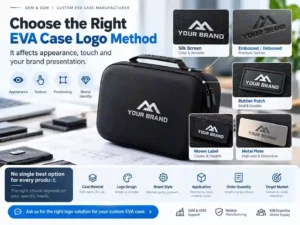
GAODA supports branding methods including silk screen printing, embossing, rubber patches, woven labels and metal plates.
During sample review, compare the finished logo against the approved artwork.
Verify:
Logo design
Size
Position
Color
Application method
Alignment
Surface appearance
Buyers should also confirm the exterior and interior colors against physical references wherever precise color matching is required.
A screen preview alone may not show the final appearance of fabric texture, embossed details or printed colors accurately.
Approval rule: The physical sample should match the approved branding and visual requirements.
11. Confirm Functional and Protection Testing Requirements
Visual inspection cannot prove that a case will protect its contents under every transportation or operating condition.
The required tests should be based on the actual product and its intended use.
Depending on the project, GAODA can support testing such as zipper testing, tensile testing, color difference testing, water resistance testing, UV aging testing, vibration and shock testing, and drop testing.
Not every custom EVA case needs all these tests.
For example, a professional camera case transported frequently may require different performance checks from a small electronics accessory case used mainly indoors.
Buyers should agree on the relevant test conditions, acceptance criteria and reporting requirements before sample approval.
A standard zippered EVA case should not be assumed fully waterproof without suitable construction and supporting test results.
Likewise, a sample passing one agreed drop test does not guarantee protection against every possible impact.
Our EVA case quality control guide explains the inspection and testing categories relevant to custom protective cases.
Approval rule: Confirm the required test scope and review the agreed results before authorizing production.
12. Approve Packaging and Document the Final Sample
The final checkpoint is not only about the case itself.
Packaging, labeling and the approved product specification should also be confirmed.
Depending on the project, buyers may need to review:
Individual packaging
Carton configuration
Product labels
Barcode requirements
Shipping marks
Protection during transit
Retail packaging presentation
Once these details are accepted, the buyer and manufacturer should record the final approved sample revision.
This record should identify the agreed design, materials, colors, internal layout, logo, packaging and any special inspection requirements.
A physical master sample, sometimes called a golden sample, can be retained as the reference for comparing future production.
Approval rule: Mass production should follow a clearly identified and documented approved specification.
Sample Approval vs Final Quality Inspection: What Is the Difference?
Sample approval and final quality inspection are connected, but they serve different purposes.
| Item | Sample Approval | Final Quality Inspection |
|---|---|---|
| Timing | Before bulk production | During or after production |
| Main purpose | Confirm the proposed design and specification | Confirm manufactured goods meet approved requirements |
| Typical focus | Product fit, structure, material, function, appearance | Consistency, workmanship, function, quantity and packaging |
| Reference | Drawings, product requirements and agreed criteria | Approved sample and production specification |
| Main decision | Approve, revise or reject prototype | Accept, rework or reject inspected production |
Sample approval answers: “Is this the right case to manufacture?”
Final inspection answers: “Did the factory manufacture the approved case correctly?”
Buyers need both.
When Should You Reject or Revise an EVA Case Sample?
Not every difference requires the entire project to restart. However, some problems should prevent production approval.
| Finding | Suggested Decision |
|---|---|
| Main product does not fit | Revision required |
| Lid presses against sensitive components | Revision required |
| Incorrect material or EVA thickness | Correction and reconfirmation |
| Zipper cannot close with complete kit | Revision required |
| Handle does not meet agreed loading requirement | Revision required |
| Logo color differs slightly within an agreed tolerance | May be acceptable |
| Minor cosmetic issue outside agreed acceptance criteria | Review with supplier |
| Missing required test result | Hold approval pending evidence |
| All approved criteria are met | Approve for production |
The distinction should be based on agreed requirements, not personal impressions alone.
If an issue changes product function, protection, material specification or safety, it should be resolved before production.
Where a minor deviation is accepted, record it explicitly rather than relying on an informal conversation.
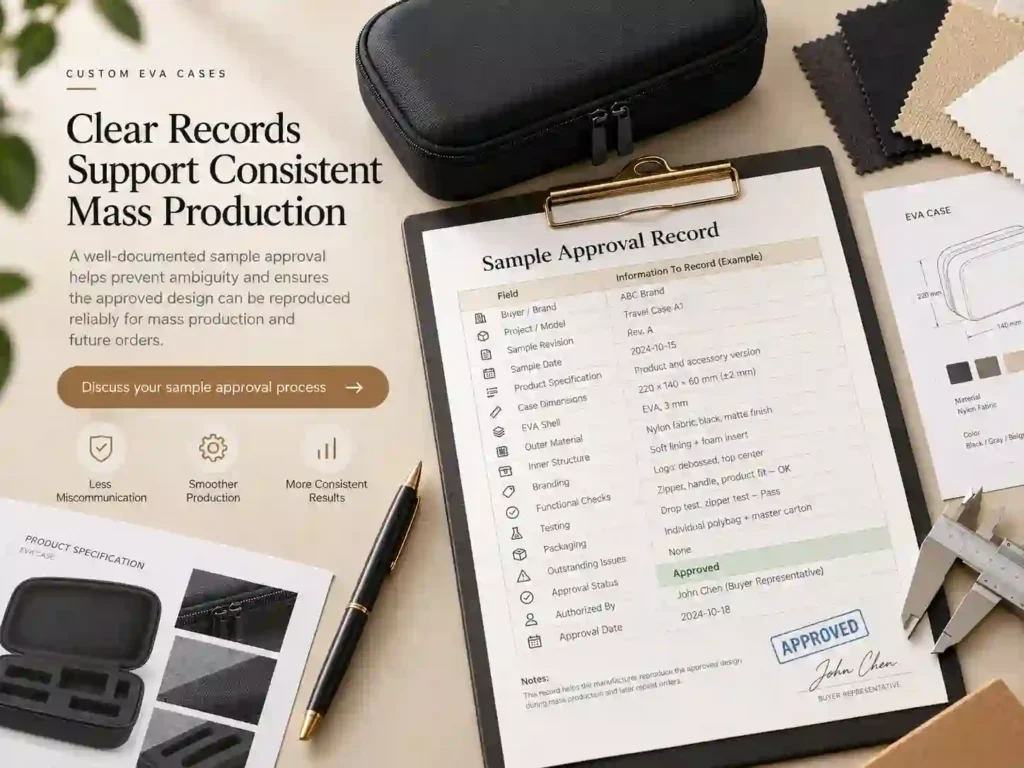
What Documents Should Be Included in a Sample Approval Record?
A good approval record does not need to be complicated, but it should prevent ambiguity.
Custom EVA Case Sample Approval Form
| Field | Information to Record |
|---|---|
| Buyer / Brand | Company name |
| Project / Model | Product model or project number |
| Sample revision | Version or revision number |
| Sample date | Date received or reviewed |
| Product specification | Product and accessory version |
| Case dimensions | Approved dimensions and tolerances |
| EVA shell | Material and thickness |
| Outer material | Fabric type, color and finish |
| Inner structure | Lining and foam insert specifications |
| Branding | Logo artwork, method and placement |
| Functional checks | Zipper, handle and product fit results |
| Testing | Agreed tests and results |
| Packaging | Approved packaging specifications |
| Outstanding issues | Open changes or exceptions |
| Approval status | Approved / Revision Required / Rejected |
| Authorized by | Buyer representative |
| Approval date | Date of final decision |
This documentation can help the manufacturer reproduce the approved design during mass production and later repeat orders.
What Happens After the Sample Is Approved?
After approval, the project moves from design confirmation to production preparation.
The manufacturer should verify that the final specifications, materials and order details are consistent with the approved sample.
Production planning may include material procurement, forming, cutting, sewing, logo application, foam insert production, assembly and inspection.
First article confirmation is especially useful at this stage.
The first completed production unit can be compared against the approved sample before the full order continues.
This creates another opportunity to detect differences between sample development and actual production.
Changes made after sample approval should be documented and evaluated because they may affect cost, fit, protection or delivery time.
How Long Does Custom EVA Case Sampling Take at GAODA?
GAODA EVA CASE was founded in 2007 and provides OEM and ODM custom protective case solutions for international B2B buyers.
The company operates production facilities in Shenzhen, China and Vietnam, serving products including electronics, tools, medical devices, drones, cameras, gaming accessories and portable instruments.
For most GAODA custom EVA case projects:
| Project Detail | Typical Reference |
|---|---|
| Regular MOQ | Starting from 500 pcs |
| Sample development | 7–10 days |
| Bulk production | 25–35 days after sample approval |
| Common EVA thickness | 2mm–8mm |
| Common shell choices | 4mm and 5mm EVA |
| Customization | Size, shape, fabric, lining, handle, zipper, logo and foam inserts |
Actual lead times depend on project specifications, material availability, revisions and production arrangements.
GAODA supports raw material inspection, first article confirmation, in-process inspection, semi-finished product inspection, functional testing, final inspection and pre-shipment sampling inspection.
For brands starting a new project, our custom EVA case manufacturing page provides an overview of OEM and ODM production capabilities.
You can also review the available EVA case customization options when selecting fabrics, shell structures, interior inserts and branding methods.
FAQ About EVA Case Sample Approval
What is EVA case sample approval?
EVA case sample approval is the process of confirming that a custom protective case prototype meets the agreed dimensions, materials, product fit, functional performance, branding and packaging requirements before bulk production begins.
What should I check before approving an EVA case sample?
Check the product and accessory fit, case dimensions, EVA thickness, exterior material, foam insert, sensitive component clearance, lining, zipper, stitching, handle, logo, protection requirements and packaging.
Can I approve an EVA case sample using photographs only?
Photographs are useful for reviewing appearance, but they may not show fit, carrying comfort, zipper operation or material feel. Physical sample testing is recommended when these requirements are important.
Why should I test the EVA case with the real product?
A drawing or empty case cannot fully demonstrate how the finished kit fits. Testing with the real product helps identify tight compartments, insufficient clearance and interference between accessories.
How tight should an EVA foam insert be?
The insert should hold the product securely without causing excessive pressure or making removal difficult. The correct fit depends on the product shape, material and protection requirements.
Who should approve a custom EVA case sample?
Approval should come from an authorized buyer representative. Depending on the project, purchasing, product engineering, quality and branding teams may all need to review relevant requirements.
Can I change the EVA case design after sample approval?
Yes, but changes should be documented and reviewed before implementation. Material, dimension, insert or logo changes may require another sample or additional confirmation.
What is a golden sample in EVA case manufacturing?
A golden sample is a retained, approved physical sample used as a reference for materials, dimensions, appearance, construction and workmanship during production and inspection.
Does sample approval guarantee that every case will be identical?
No. Sample approval establishes the agreed specification. Production inspections and quality controls are still needed to manage variation and confirm consistency.
Is drop testing required for every EVA protective case?
Not necessarily. Testing requirements depend on product sensitivity, intended use, transportation conditions and buyer specifications.
How long does GAODA take to develop an EVA case sample?
For most custom projects, sample development usually takes 7–10 days after key specifications are confirmed. Revisions or special requirements may affect the schedule.
What is GAODA's MOQ for custom EVA cases?
GAODA’s regular MOQ starts from 500 pcs, depending on case size, materials, construction and customization requirements.
Conclusion: Approve the Case, Not Just Its Appearance
A successful custom EVA case sample should do more than match a product photograph.
It should fit the real product, support the intended accessories, close correctly, protect sensitive components, provide reliable carrying functionality and meet the buyer’s approved material and branding requirements.
The most effective sample approval process combines physical inspection, functional testing and clear documentation.
For B2B brands, this helps reduce the risk of approving a design that looks good but creates problems during everyday use or bulk manufacturing.
If you are developing a custom EVA protective case for electronics, tools, medical devices, drones, cameras or gaming accessories, GAODA EVA CASE can help review your product dimensions, interior layout, materials and sample requirements.
Send us your product information, accessory list, target quantity and protection requirements to begin your custom EVA case project.
GAODA — Professional Custom EVA Case Manufacturer | ISO 9001 Certified | Shenzhen + Vietnam Dual Factories | 20+ Years OEM/ODM Experience
 Russian
 English
 Korean
 Japanese
 French
 German
 Spanish
 Arabic
 Italian
 Portuguese
 Turkish
 Thai
 Vietnamese
 Chinese
