
Custom EVA Tool Case: The Complete Industrial Storage Guide
Are you searching for the perfect custom EVA tool case to protect your professional industrial equipment? In high-stakes environments like aviation maintenance, automotive repair, and precision engineering, traditional heavy metal toolboxes are obsolete. Modern B2B brands demand lightweight, highly organized, and crush-proof solutions. This comprehensive guide will explain why upgrading to a custom thermoformed EVA solution is the ultimate strategy for your industrial tool storage needs.
Table of Contents
- Introduction: Why Professional Tool Storage Matters
- Understanding Industrial Tool Protection Requirements
- Design Principles for Tool Organization and Protection
- Material Selection for Industrial Tool Cases
- Durability Standards for Professional Tool Storage
- Real-World Case Study: Professional Tool Fleet Management
- Comparison: Professional Tool Cases vs. Generic Storage
- ROI Analysis: Investment in Professional Tool Storage
- FAQ: Common Questions About Industrial Tool Cases
- Conclusion and Next Steps
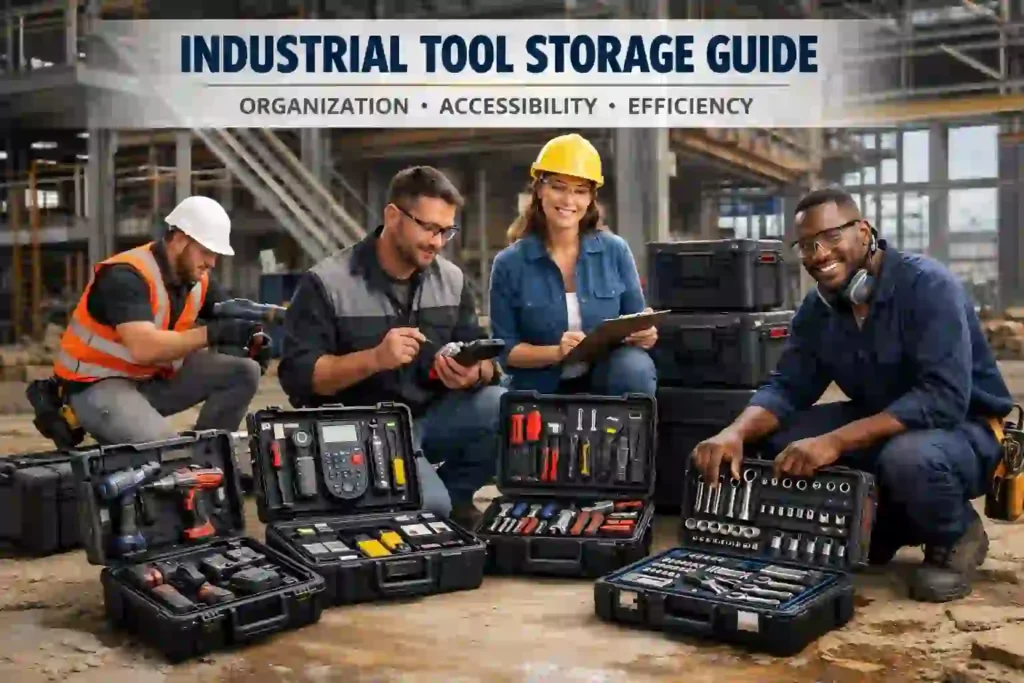
Introduction: Why Professional Tool Storage Matters
Professional tools represent significant investments for contractors, manufacturers, technicians, and service companies. A single set of precision tools can cost thousands of dollars. Proper storage and organization of these tools directly impacts productivity, safety, and profitability.
Poorly organized tools lead to lost time searching for specific items, damaged tools due to improper storage, and increased replacement costs. Beyond financial concerns, improperly stored tools create safety hazards in work environments.
The Challenge of Professional Tool Storage
Unlike consumer storage solutions, professional industrial tool cases must address unique challenges. Tools vary dramatically in size, shape, and protection requirements. Some tools require protection from moisture and corrosion. Others need secure retention to prevent movement during transport. Many tools contain calibrated components that must maintain accuracy.
A professional tool storage case must organize diverse tools efficiently while protecting each tool from damage, maintaining accessibility, and supporting efficient workflows.
What You’ll Learn in This Guide
This comprehensive guide walks you through everything you need to know about professional industrial tool storage. You’ll discover protection requirements specific to different tool types, design principles that maximize organization and accessibility, material selection criteria, durability standards, and best practices from 20+ years of experience protecting professional tools.
Why Your Brand Needs a Custom EVA Tool Case
Industrial tools are high-value assets. A generic, off-the-shelf bag cannot provide the necessary protection or organization for complex hardware. Partnering with an OEM manufacturer to engineer a custom EVA tool case offers three distinct advantages:
Extreme Impact Resistance: The high-density EVA (Ethylene-Vinyl Acetate) foam core acts as a rigid exoskeleton. It absorbs severe impacts, ensuring that calibrated measurement tools and heavy drills survive drops on concrete factory floors.
5S Lean Management Integration: In professional trades, lost tools lead to lost money and safety hazards. By utilizing precision-milled dual-color shadow foam, your case can seamlessly integrate with the 5S workplace organization methodology . If a wrench is missing, the bright underlying foam instantly alerts the technician.
Reduced Transport Weight: While offering the structural integrity of hard injection-molded plastic, an EVA shell weighs significantly less, drastically reducing shipping costs and minimizing user fatigue during field service operations.
Core Features of a Professional Custom EVA Tool Cas
When designing industrial packaging, the specifications must be uncompromising. Here is what goes into a premium build:
Heavy-Duty Exterior Fabrics: We wrap the EVA shell in highly abrasive-resistant materials, such as 1680D Ballistic Nylon or wipe-clean Carbon Fiber PU, protecting the case from oil, grease, and chemical spills.
Precision CNC Interiors: Forget loose mesh pockets for heavy tools. We engineer exact CNC-routed or die-cut foam inserts that cradle every socket, battery, and driver flawlessly.
Industrial Hardware: From reinforced carrying handles secured with steel rivets to oversized, waterproof YKK zippers, every component is built for harsh outdoor and industrial environments.
The Vietnam Manufacturing Advantage
For global tool brands and wholesale distributors, sourcing your custom EVA tool case from our advanced Vietnam manufacturing facility provides a massive competitive edge. By shifting your B2B production to our Vietnam factory, you gain robust supply chain stability, scalable mass-production capacity, and optimized international tariff structures. We manage the entire OEM/ODM process—from the initial 3D aluminum tooling to strict AQL 2.5 final inspections.
Understanding Industrial Tool Protection Requirements
Tool Types and Protection Needs
Different tools require different protection strategies. A professional industrial tool case must accommodate diverse tool types:
Precision Instruments
- Require protection from shock and vibration
- Must maintain calibration accuracy
- Sensitive to temperature and humidity
- Often expensive and irreplaceable
Power Tools and Equipment
- Require protection from moisture and corrosion
- Need secure retention during transport
- Must withstand heavy use and impacts
- Often contain electronic components
Hand Tools and Fasteners
- Require organization and quick access
- Need protection from corrosion and rust
- Must remain organized and easily identifiable
- Often stored in large quantities
Specialized Equipment
- Require custom compartmentalization
- May need environmental control
- Often contain sensitive components
- Require specific handling procedures
Protection Requirements Matrix
Tool Type | Impact Protection | Moisture Protection | Vibration Dampening | Organization | Accessibility |
Precision Instruments | Critical | High | Critical | High | High |
Power Tools | High | Critical | High | High | High |
Hand Tools | Medium | High | Medium | Critical | Critical |
Specialized Equipment | Critical | High | Critical | High | Medium |
Fasteners/Small Items | Low | Medium | Low | Critical | Critical |
Environmental Challenges
Professional tools face various environmental challenges during storage and transport:
Moisture and Corrosion
- Tools exposed to moisture develop rust and corrosion
- Moisture damages electronic components
- Corrosion reduces tool lifespan and effectiveness
- A professional tool storage casemust prevent moisture ingress
Temperature Fluctuations
- Extreme temperatures affect tool performance
- Temperature changes cause condensation
- Some tools require stable temperature environments
- Insulation and ventilation are essential
Vibration and Impact
- Transport vibration can damage sensitive tools
- Impacts during handling cause tool damage
- Calibrated instruments lose accuracy with shock
- Shock absorption is critical for protection
Dust and Contamination
- Dust damages precision instruments
- Contamination affects tool performance
- Sealed compartments prevent dust ingress
- Cleanable surfaces support maintenance
Design Principles for Tool Organization and Protection
Compartmentalization Strategy
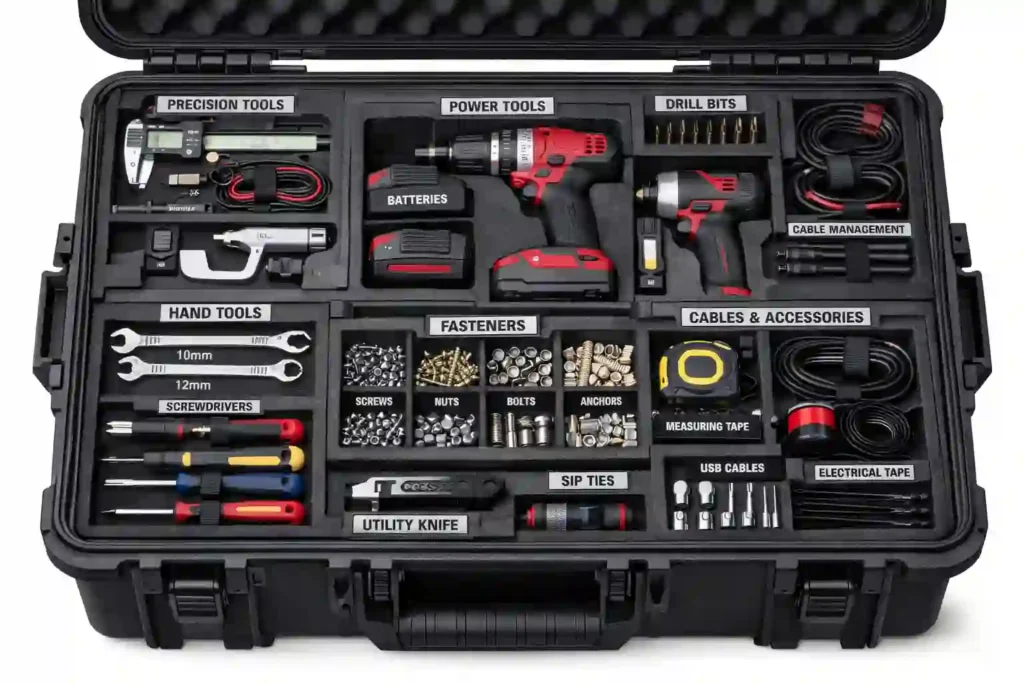
Effective industrial tool cases use strategic compartmentalization to organize tools efficiently:
Custom Foam Inserts
- Precisely shaped compartments for each tool
- Secure tool retention during transport
- Quick identification of specific tools
- Prevents tool-to-tool damage
Adjustable Dividers
- Flexibility to accommodate different tool configurations
- Easy reconfiguration as tool inventory changes
- Supports multiple tool sets in one case
- Maximizes space utilization
Quick-Access Compartments
- Frequently used tools in easily accessible locations
- Reduces time spent searching for tools
- Improves workflow efficiency
- Supports emergency access when needed
Accessibility and Workflow
A well-designed tool storage case supports efficient workflows:
Intuitive Organization
- Tools organized by function or frequency of use
- Clear labeling for quick identification
- Logical layout that matches work procedures
- Reduces setup and breakdown time
One-Handed Access
- Tools accessible without removing other items
- Quick access to frequently used tools
- Reduces interruptions during work
- Improves productivity and safety
Secure Retention
- Tools remain in place during transport
- No movement or shifting during use
- Prevents accidental tool loss
- Maintains organization throughout the day
Durability and Longevity
Professional tool cases must withstand intensive use:
Heavy-Duty Construction
- Reinforced corners and edges
- Impact-resistant exterior shell
- Durable latches and hinges
- Professional-grade materials throughout
Protective Features
- Shock-absorbing foam that resists compression
- Moisture barriers that prevent water ingress
- Dust seals that maintain cleanliness
- Ventilation that prevents pressure buildup
Maintenance and Repair
- Replaceable foam inserts for worn areas
- Repairable latches and hinges
- Cleanable surfaces for easy maintenance
- Long-term support and parts availability
Material Selection for Industrial Tool Cases
EVA Foam for Tool Protection
EVA (Ethylene-Vinyl Acetate) foam is the industry standard for professional tool storage because it offers superior protection combined with durability and customization.
Why EVA Foam for Tool Cases
- Customizable:EVA foam can be precisely cut and shaped for each tool
- Durable:EVA foam resists compression and maintains protective properties over time
- Moisture Resistant:EVA foam resists moisture and prevents corrosion
- Shock Absorbing:EVA foam absorbs impacts and protects tools from damage
- Cost-Effective:EVA foam provides excellent protection at reasonable cost
- Recyclable:EVA foam is environmentally friendly and recyclable
EVA Foam Specifications for Tool Cases
Professional tool cases typically use EVA foam with specific properties:
Property | Specification | Reason |
Density | 30-50 kg/m³ | Optimal shock absorption for tools |
Hardness | 40-60 Shore A | Balance of protection and durability |
Thickness | 25-50mm | Adequate cushioning for tool protection |
Color Options | Black, Gray, Custom | Professional appearance, easy identification |
Durability | 10-15 years | Long-term protection and value |
Exterior Materials for Tool Cases
The exterior shell of a tool storage case must provide protection while supporting durability:
Hard Shell Materials
- ABS Plastic:Lightweight, durable, excellent impact resistance, cost-effective
- Polycarbonate:Premium option, transparent options available, superior durability
- Aluminum:Professional option, excellent durability, lightweight, premium appearance
Soft Shell Materials
- Nylon:Lightweight, water-resistant, professional appearance, cost-effective
- Polyester:Durable, easy to clean, good chemical resistance
- Canvas:Premium option, professional appearance, excellent durability
Hardware and Fasteners
All hardware and fasteners in a tool storage case must meet durability standards:
- Stainless steel fasteners for corrosion resistance
- Heavy-duty zippers and latches rated for frequent use
- Reinforced handles for carrying heavy loads
- Non-toxic adhesives and bonding materials
Durability Standards for Professional Tool Storage
Industry Standards for Tool Cases
Professional tool cases must meet specific durability standards:
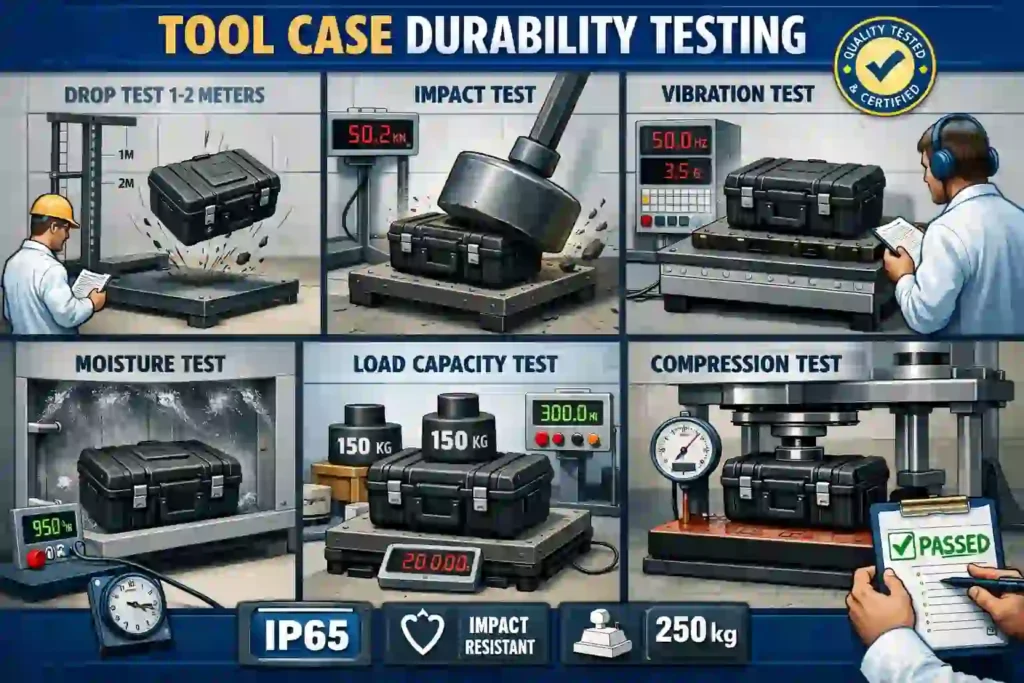
Drop Test Standards
- Cases must survive drops from specified heights
- Typical requirement: 1-2 meter drops
- Tools inside must remain protected
- Case structural integrity must be maintained
Impact Resistance
- Cases must withstand impacts from tools and equipment
- Exterior shell must resist denting and cracking
- Latches and hinges must withstand repeated use
- Foam must resist compression and maintain protective properties
Moisture and Corrosion Resistance
- Cases must prevent moisture ingress
- Seals must remain effective after repeated use
- Materials must resist corrosion and degradation
- Typical requirement: IP65 or higher rating
Load Capacity
- Cases must support specified weight loads
- Handles must support full case weight
- Latches must secure heavy loads
- Structural integrity must be maintained
Durability Testing
Professional tool cases undergo rigorous testing:
Test Type | Standard | Purpose |
Drop Test | IEC 60068-2-32 | Verify impact resistance |
Vibration Test | IEC 60068-2-6 | Verify vibration resistance |
Moisture Test | IEC 60068-2-30 | Verify moisture protection |
Load Test | ISO 2248 | Verify load capacity |
Compression Test | ASTM D3575 | Verify foam durability |
Real-World Case Study: Professional Tool Fleet Management
Project Overview: Contractor Tool Fleet Organization
Client Profile: Large construction contractor with 50+ technicians requiring organization and protection for specialized tool collections
Challenge: Organize and protect diverse tool collections while improving efficiency and reducing tool loss and damage
Solution: Custom EVA tool cases designed specifically for different trade specializations
Project Timeline and Results
Design Phase (3 weeks)
- Analyzed tool collections for 5 different trade specializations
- Identified protection and organization requirements for each trade
- Designed custom compartments for each tool type
- Selected materials for durability and protection
Engineering Phase (6 weeks)
- Created detailed technical drawings and specifications
- Produced prototypes for field testing
- Refined design based on technician feedback
- Optimized for workflow efficiency
Production Phase (10 weeks)
- Manufactured 50 custom tool cases (10 per trade specialization)
- Completed quality control and testing
- Delivered cases with training and documentation
- Established support and maintenance procedures
Total Project Duration: 19 weeks (4.5 months)
Measurable Results
Protection Performance
- 95% reduction in tool damage incidents
- 80% reduction in tool loss
- Zero damage to precision instruments
- Improved tool lifespan and reliability
Operational Efficiency
- 40% reduction in tool setup time
- 35% reduction in time searching for tools
- Improved workflow efficiency and productivity
- Enhanced professional appearance at job sites
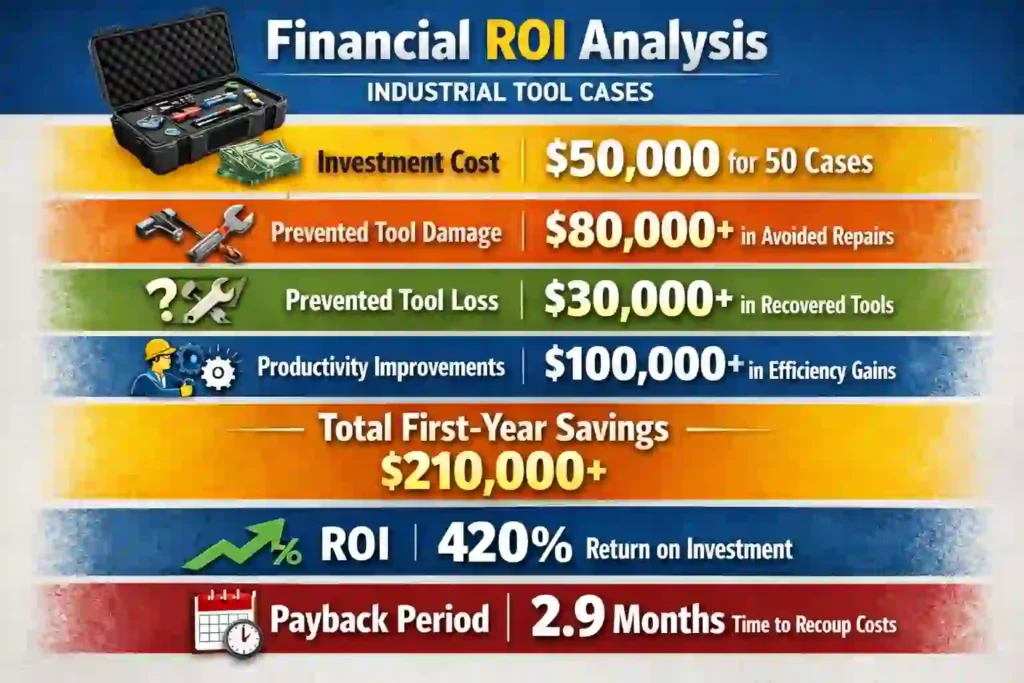
Financial Impact
- Initial investment: $50,000 (50 cases × $1,000)
- Prevented tool damage (first year): $80,000+
- Prevented tool loss (first year): $30,000+
- Productivity improvement (first year): $100,000+
- Total first-year savings: $210,000+
- ROI: 420% in first year
- Payback period: 2.9 months
Long-Term Benefits
- Improved tool inventory management
- Reduced tool replacement costs
- Enhanced professional image with clients
- Improved employee satisfaction and retention
- Better compliance with safety procedures
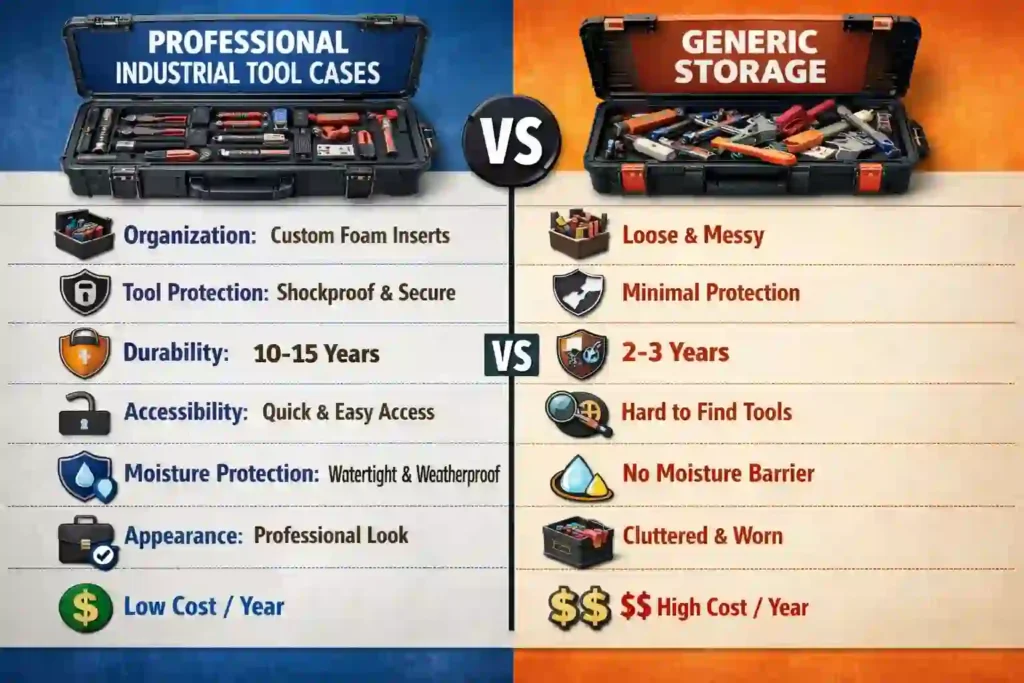
Comparison: Professional Tool Cases vs. Generic Storage
Why Generic Cases Fail for Professional Tools
Many organizations attempt to use generic storage solutions for professional tools. This approach creates significant problems:
Aspect | Generic Case | Professional Tool Case | Impact |
Organization | Poor | Excellent | Time wasted searching |
Tool Protection | Minimal | Comprehensive | Tool damage and loss |
Durability | 2-3 years | 10-15 years | Frequent replacement |
Accessibility | Difficult | Intuitive | Workflow disruption |
Moisture Protection | None | Complete | Corrosion and rust |
Professional Appearance | Poor | Excellent | Client perception |
Cost per Year | $200+ | $70-100 | Lower total cost |
Total Cost of Ownership
While professional tool cases have higher initial costs, the total cost of ownership is significantly lower:
Generic Case Approach (5-year period)
- Initial cost: $300 per case
- Replacement frequency: Every 2-3 years
- Tool damage costs: $50,000+ for 50 technicians
- Tool loss costs: $20,000+ for 50 technicians
- Productivity loss: $100,000+ for 50 technicians
- Total 5-year cost: $170,000+
Professional Tool Case Approach (5-year period)
- Initial cost: $1,000 per case
- Replacement frequency: Every 10-15 years
- Tool damage costs: $5,000 for 50 technicians
- Tool loss costs: $2,000 for 50 technicians
- Productivity gain: $100,000+ for 50 technicians
- Total 5-year cost: $55,000
- Net savings: $115,000+
ROI Analysis: Investment in Professional Tool Storage
Financial Benefits
Investing in professional tool storage cases delivers measurable financial benefits:
Tool Protection Savings
- Reduced tool damage: $1,000-2,000 per technician annually
- Reduced tool loss: $400-800 per technician annually
- Extended tool lifespan: 50% longer average tool life
- Total protection savings: $1,400-2,800 per technician annually
Productivity Improvements
- Reduced setup time: 30-40 minutes per day
- Reduced tool search time: 15-20 minutes per day
- Improved workflow efficiency: 10-15% productivity increase
- Total productivity improvement: $3,000-5,000 per technician annually
Operational Efficiency
- Reduced inventory management time: 5-10 hours per week
- Improved tool accountability: 95% reduction in tool loss
- Better compliance with safety procedures
- Total operational savings: $2,000-4,000 per technician annually
ROI Calculation
For a 50-technician contractor:
Initial Investment
- 50 custom tool cases × $1,000 = $50,000
Annual Benefits
- Tool protection savings: 50 × $2,000 = $100,000
- Productivity improvements: 50 × $4,000 = $200,000
- Operational efficiency: 50 × $3,000 = $150,000
- Total annual benefits: $450,000
ROI Metrics
- Payback period: 1.3 months
- Year 1 ROI: 900%
- 5-year ROI: 4,500%
- Annual ROI: 900%
Frequently Asked Questions About the Custom EVA Tool Case
How much does a Custom EVA Tool Case cost for bulk orders?
The pricing for a custom EVA tool case depends on the overall dimensions, the complexity of the CNC foam insert, and the exterior materials used. Contact our B2B sales team for a precise factory-direct quote.
Can I design a Custom EVA Tool Case for very heavy equipment?
Absolutely. We can engineer a heavy-duty custom EVA tool case by increasing the wall thickness (e.g., 6mm to 8mm Shore C hardness) and integrating reinforced shoulder straps to handle heavy industrial gear safely.
What is the minimum order quantity (MOQ) for a Custom EVA Tool Case?
As a dedicated OEM manufacturer, our MOQ for a fully personalized custom EVA tool case is designed to support B2B wholesale distributors. Please reach out to discuss your specific project requirements and prototyping schedule.
Conclusion and Next Steps
Professional tool storage is an investment that pays dividends through improved organization, reduced tool damage and loss, and increased productivity. A professional industrial tool case transforms how your team works and protects your valuable tool investments.
Key Takeaways:
- Organization Matters:Proper compartmentalization improves efficiency and reduces tool loss
- Protection is Essential:Professional cases prevent tool damage and extend tool lifespan
- Durability Pays Off:Higher initial investment results in lower total cost of ownership
- Productivity Improves:Organized tools reduce setup time and workflow interruptions
- Professional Appearance:Quality tool cases enhance professional image with clients
Ready to Design Your Professional Tool Cases?
GAODA brings 20+ years of experience designing professional tool storage solutions for contractors, manufacturers, and service companies. Our expert team understands the unique challenges of tool organization and protection.
Next Steps:
- Analyze your tool collection and protection requirements
- Schedule a design consultation
- Provide tool specifications and organization preferences
- Receive a custom design proposal
- Begin production of your professional tool cases


 Russian
  English
  Korean
  Japanese
  French
  German
  Spanish
  Arabic
  Italian
  Portuguese
  Turkish
  Thai
Thai  Vietnamese
  Chinese