
Custom EVA Case Design: The Complete 2026 OEM/ODM Guide From First Sketch to Production-Ready Spec
If you’re reading this, you probably have a product that needs high-level protection — and you need to figure out how to design a custom EVA case around it. Maybe it’s a new consumer electronic device, a sensitive medical instrument, or a heavy-duty tool set that ships to industrial job sites.
Whatever it is, the protective packaging design process is the same. Most people approach it backwards: they pick a case first, then try to make their product fit. The professional approach is to start with your product, understand its precise vulnerabilities, and engineer the thermoformed hard shell around those needs.
This guide walks through the entire OEM EVA case manufacturing process from the factory’s perspective. We’ve developed these B2B protective solutions thousands of times over 20 years. Here’s what actually matters when taking a concept to mass production.
Step 1: Define Your Product's Protection Requirements
Before you think about brand colors, logos, or zipper types, you need to answer three engineering questions about your product.
What Are the Exact Dimensions?
Not the dimensions from your 3D CAD file. We need the dimensions from a physical production unit, measured with a caliper, in millimeters.
CAD files show nominal dimensions. Real products vary. A Bluetooth speaker might be 150mm × 80mm × 45mm on paper but measure 152mm × 81mm × 46mm in production. That 2mm difference means the difference between a custom molded case that fits perfectly and one that damages your product.
What to measure:
Length, width, height at the widest points.
Any protrusions (buttons, connectors, RF antennas, optical lenses).
Weight (this dictates the required shock attenuation and drop protection level).
Pro tip: If your product has moving parts (folding arms on a drone, rotating screens), measure it in both the stored and operating positions. The travel case must be designed for the stored position.
What Happens If It's Dropped? (Fragility Assessment)
This determines the Ethylene-Vinyl Acetate (EVA) shell hardness and wall thickness. Be honest about your product’s fragility:
Low fragility (earbuds, cables): Can survive a 0.5m drop without damage.
Medium fragility (tablets, power banks): Can survive a 0.8m drop, but the housing may crack.
High fragility (cameras, drones, medical instruments): Damage occurs at drops below 0.5m.
Extreme fragility (precision optical and calibration devices): Must achieve zero movement during transit.
The more fragile your product, the harder and thicker your EVA foam shell needs to be, requiring a precision CNC-routed interior fit.
Where Will It Be Used? (Environmental Factors)
The environment determines the exterior textile, closure type, and weatherproofing requirements:
Office/daily carry: Standard protection, 600D Oxford exterior.
Travel/commute: Enhanced drop protection, water-resistant exterior.
Outdoor/field use: Maximum abrasion resistance, waterproof zippers (aiming for high IP Ratings for dust and water resistance).
Shipping container: Must pass strict ISTA (International Safe Transit Association) testing standards, requiring specific wall thickness and corner reinforcement.
Step 2: Choose Your Case Architecture
A custom molded EVA case relies on four main architectural decisions.
Decision 1: Shell Size and Shape
The EVA material is heat-pressed into an aluminum mold. Its shape is defined by your product’s profile plus required clearance.
Clamshell (book-style): Most common. Two halves connected by a hinge.
Top-load (box-style): Good for heavy items needing vertical support.
Sleeve/pouch: Slim profile, best for flat electronics (laptops, displays).
Decision 2: Wall Thickness
2.5-3mm: Small accessories, light pouches.
3.5-4mm: Standard electronics organizers (The sweet spot for most consumer tech).
4.5-5mm: Heavy-duty tool cases, camera gear.
5.5-6mm+: Heavy industrial equipment and freight shipping cases.
Decision 3: Opening Style & Zippers
Full-perimeter zipper: 180-degree opening. The industry standard for 95% of OEM projects.
Clasp/latch or Magnetic: Higher tooling cost, best for luxury premium presentation boxes.
Step 3: Design the Interior Layout
The exterior protects against the world; the interior protects the product against itself.
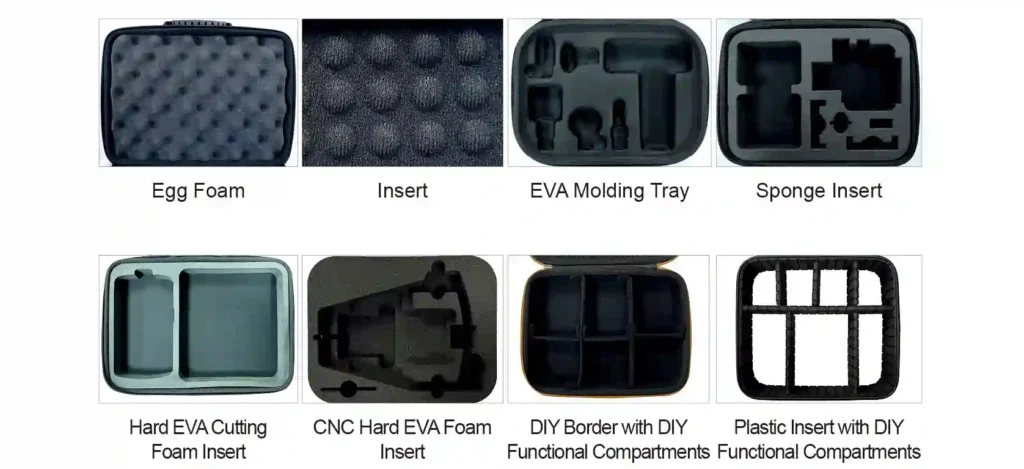
Option A (Flat Base + Mesh Pocket): Lowest cost, basic protection.
Option B (Elastic Straps): Moderate protection, great for multi-accessory cable kits.
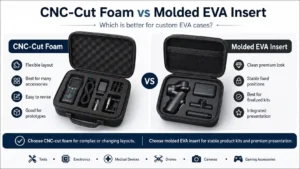
Option C (CNC-Cut Foam Insert): Maximum protection. Precision-cut cavities cradle each component. Ideal for high-value electronics and medical devices.
Option D (Double-Layer Divider): Separates fragile screens from hard chargers.
Layout Principle: Always place the most fragile item in the geometric center of the case (away from impact edges), and keep heavy items (like battery packs) on the bottom to prevent gravity-induced crushing.
Step 4: Select Manufacturing Materials
EVA Shell Hardness (Measured in Shore C)
We utilize the Shore durometer scale to measure material hardness:
40-50° Shore C: Soft, flexible (Cosmetics, small tech).
60° Shore C (The Sweet Spot): Semi-rigid. Perfect for 80% of consumer electronics.
75°+ Shore C: Highly rigid. Used for heavy power tools and precision instruments.
Exterior Fabrics & Zippers
Our B2B manufacturing facility offers multiple laminations:
High-Density 600D Oxford: Our default recommendation. Excellent durability-to-cost ratio.
1680D Ballistic Nylon: Maximum abrasion resistance.
PU Leather: Premium tactile feel, high water resistance.
Pair these with reliable closures, ranging from standard nylon coils for daily use to TPU waterproof zippers for marine or tactical environments.
Step 5: OEM Branding and Customization
Transform a generic box into a brand asset. Our custom packaging solutions include:
Silk Screen Printing: Cost-effective for 1-3 color flat logos.
Heat Transfer: Perfect for complex gradients.
Embossing/Debossing: Creates a premium, tactile 3D effect permanently stamped into the EVA shell.
Custom Rubber Patches & Woven Labels: Adds a rugged or vintage aesthetic.
Step 6: Create the Design Specification Sheet
A detailed spec sheet is your insurance policy. It eliminates miscommunication and becomes the master document for our Quality Control (QC) inspections. (Include your spec sheet template here).
Step 7: The Prototyping & Sampling Process
First Physical Sample: Produced via express tooling. You test the fit, zipper function, and logo placement with your actual product.
Revisions: Adjusting clearances (+2-3mm) or modifying pocket sizes based on real-world testing.
Approval: Once approved, the master aluminum mold is finalized for mass production.
Step 8: Mass Production and Quality Control
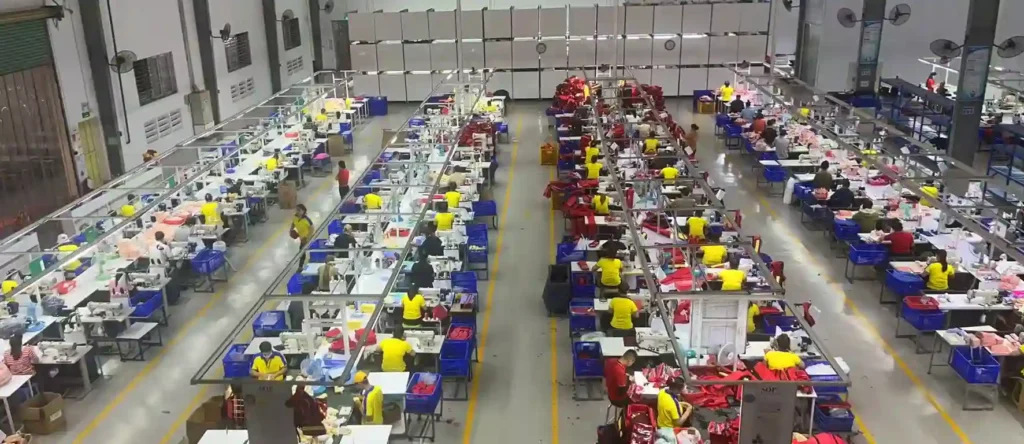
Once the sample is approved, we move to high-volume production. Leveraging our dual-factory setup across Shenzhen and our advanced Vietnam EVA case factory, we ensure supply chain stability, scalable output, and tariff-optimized global shipping.
Every batch undergoes strict AQL 2.5 standard inspections, checking dimensional accuracy, stitch density, zipper glide, and performing random drop tests.
Frequently Asked Questions About Custom EVA Case Design
What is the most important step in Custom EVA Case Design?
The most critical step in Custom EVA Case Design is taking precise physical measurements of your product. A successful Custom EVA Case Design relies on physical prototypes rather than just nominal CAD dimensions to ensure a perfect fit.
How does tooling affect Custom EVA Case Design?
In any Custom EVA Case Design project, creating the aluminum mold is a primary step. Our engineering team optimizes your Custom EVA Case Design to ensure the tooling process is cost-effective, especially for high-volume B2B wholesale orders.
Can I modify a Custom EVA Case Design later?
Once the mold is machined, structural changes to a Custom EVA Case Design are difficult and costly. This is why we provide a detailed specification sheet during the initial Custom EVA Case Design phase to eliminate any errors before mass production begins.
Ready to Engineer Your Custom EVA Case?
Stop guessing and start building. Fill out your spec requirements, send us a photo of your product with a ruler for scale, and our B2B engineering team will respond within 24 hours with material recommendations and a factory-direct wholesale quote.
Request an OEM Quote: Include your specifications for the fastest response.
Direct Contact: Reach out via WhatsApp or email through gaodaeva.com.
OEM projects requiring a new aluminum mold have a one-time mold fee of 300–300–800 depending on case size and complexity. The mold is reusable for future orders and you own it. ODM projects using existing molds have no mold fee.
GAODA — Professional Custom EVA Case Manufacturer | ISO 9001 Certified | Shenzhen + Vietnam Dual Factories | 20+ Years OEM/ODM Experience


 Portuguese
  English
  Korean
  Japanese
  French
  German
  Spanish
  Russian
  Arabic
  Italian
  Turkish
  Thai
Thai  Vietnamese
  Chinese