
Custom EVA Electronics Case: How to Get the Right Protection for Your Products
The Problem Most Electronics Brands Don't See Until It's Too Late
Here’s a scenario we see repeatedly: a brand spends months perfecting their electronic product — industrial design, firmware, certifications — then treats the carrying case as an afterthought. They grab the cheapest option on Alibaba, ship 5,000 units, and three months later their customer reviews look like this:
“Case fell apart after two weeks.” “My screen cracked inside this case.” “Zipper broke on day one.”
The carrying case is the first thing your customer touches and the last line of defense for your product. When it fails, your brand takes the hit — not the factory that made it.
This guide covers everything you need to know about designing and sourcing a custom EVA electronics case that actually protects your product and reinforces your brand. Written from the factory floor, not a marketing desk.
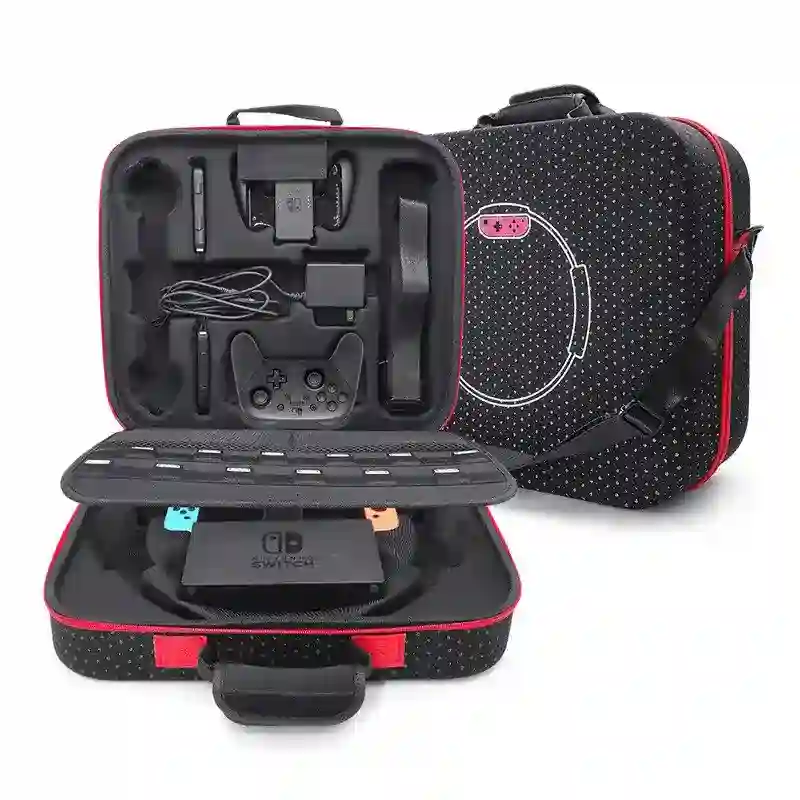
Why EVA for Electronics Protection
EVA (ethylene-vinyl acetate) is the standard material for consumer electronics carrying cases for a reason: it absorbs impact, resists water, holds its shape, and costs significantly less than injection-molded hard plastic cases.
How EVA Compares to Other Case Materials
| Material | Shock Absorption | Weight | Water Resistance | Cost | Best For |
|---|---|---|---|---|---|
| EVA molded shell | High | Light | Good | Medium | Most consumer electronics |
| Hard plastic (PP/ABS) | High | Heavy | Excellent | High | Industrial/military equipment |
| Neoprene sleeve | Low | Very light | Moderate | Low | Laptop sleeves, low-impact use |
| Leather/PU pouch | Minimal | Light | Poor | High | Premium accessories, low protection needs |
The honest answer: If your product sells for under 500andneedsportableprotection,EVAisalmostalwaystherightchoice.Ifit′sa500andneedsp또는tableprotection,EVAisalmostalwaystherightchoice.Ifit′sa3,000 precision instrument that gets thrown into truck beds, go with hard plastic.
Protection Standards: What Your Custom EVA Electronics Case Should Actually Handle Drop Protection
-
The most common damage scenario. Here’s what different EVA configurations actually deliver:
EVA Shell Hardness Typical Drop Protection Suitable Products 40°–55° (Shore C) Up to 0.8m on concrete Earbuds, USB drives, small accessories 55°–70° (Shore C) Up to 1.2m on concrete Tablets, power banks, cameras, cable organizers 70°–80° (Shore C) Up to 1.5m on concrete Precision instruments, medical electronics, measuring devices Key factor: Drop protection isn’t just about the EVA hardness. It’s the combination of shell thickness + interior lining + device fit. A 70° EVA shell with a sloppy interior fit protects less than a 60° shell with a precision-cut foam cavity that holds the device snugly.
Water Resistance
EVA itself is waterproof. The water resistance of a finished case depends on the exterior fabric and zipper:
- Oxford fabric (600D): Water-resistant. Handles light rain and brief splashes. Not submersible.
- Oxford fabric + waterproof zipper: Water-repellent for sustained rain exposure. Still not submersible.
- Full TPU-coated exterior with sealed zipper: Near-waterproof. Survives being set in a puddle. Significantly higher cost.
Reality check for electronics brands: If your product isn’t rated IP67, your case probably doesn’t need to be either. Oxford + standard zipper covers 95% of real-world consumer use. Don’t over-engineer the case and double your cost for a scenario your customer will never encounter.
Pressure Resistance
Stacked in a backpack, stuffed in an overhead bin, or piled under other luggage — your case needs to hold its shape under pressure.
- Standard EVA shell (3mm wall): Withstands approximately 30kg of distributed pressure before deformation
- Thick EVA shell (5mm wall): Withstands approximately 50kg of distributed pressure
- Reinforced EVA (5mm wall + internal rib structure): Withstands 70kg+
For most consumer electronics, standard 3mm wall thickness is sufficient. If the case will be stacked in warehouse pallets or shipped via freight, go with 5mm.
ISTA Transit Testing
If your case is also the shipping container (ship-in-own-container), it may need to pass ISTA (International Safe Transit Association) testing:
- ISTA 1A: Basic drop test simulation for packages under 150 lbs — minimum standard
- ISTA 2A: Enhanced testing including vibration, impact, and compression — standard for e-commerce
We can engineer custom EVA electronics cases to pass ISTA 1A or 2A standards. This requires specific wall thickness, interior cushioning design, and corner reinforcement. Let us know during the requirements discussion if ISTA compliance is required — it affects the entire design approach.
Interior Design: The Part That Actually Protects Your Electronics
-
The exterior gets all the attention, but the interior does the real work. Here are the common interior configurations for a custom EVA electronics case, and when each makes sense.
Configuration 1: Mesh Pocket + Flat EVA Base
What it is: A mesh pocket on one side, flat EVA surface on the other. The device sits between them.
Best for: Single-device cases (earbuds, small chargers, portable drives)
Protection level: Basic. Device can shift during transport.
Cost: Lowest.
Configuration 2: Mesh Pocket + Elastic Straps
What it is: Mesh pocket on one side, elastic straps on the other. Straps hold the device in place.
Best for: Multi-accessory organizers (charger + cable + adapter combos)
Protection level: Moderate. Device stays in place but has no shock cushioning beyond the EVA shell.
Cost: Low.
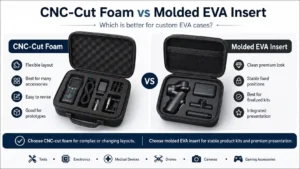
Configuration 3: CNC-Cut Foam Insert
What it is: Precision-cut EVA foam cavities that hold each device component exactly. Cut on CNC machines from a digital model of your product.
Best for: High-value electronics, multi-device kits, professional equipment
Protection level: High. Zero device movement. Foam absorbs impact. Each component has its own cavity.
Cost: Higher (CNC programming + foam material), but worth it for products over $100 retail.
Configuration 4: Double-Layer with Divider
What it is: Two separate compartments divided by a fabric or EVA panel. Each side has its own interior configuration (mesh on one side, foam on the other).
Best for: Electronics organizer pouches, cable management kits, travel tech organizers
Protection level: High. Separates fragile screens from cables and adapters. Prevents device-to-device contact.
Cost: Medium. Standard construction, no CNC required if using mesh/strap interiors.
Which Interior Should You Choose?
| Your Product | Retail Price | Recommended Interior |
|---|---|---|
| Earbuds / USB drives | Under $30 | Mesh pocket + flat base |
| Power bank / portable charger | 30–30–80 | Mesh + elastic straps |
| Camera lens / drone battery | 80–80–200 | CNC foam insert |
| Tablet / measurement tool | 200–200–500 | CNC foam insert + reinforced shell |
| Professional equipment kit | $500+ | Full CNC foam + thick shell + ISTA-rated |
Exterior Customization for Electronics Brands
Fabric and Color
- Standard stock colors: Black, navy, grey, red — available immediately, no MOQ surcharge
- Custom colors: Pantone matching available. Minimum 500 pcs per color for fabric dyeing.
- Common exterior materials for electronics:
- 600D Oxford (standard for most electronics cases — good durability, good price)
- 300D Oxford (lighter, for small accessory pouches)
- PU leather (premium consumer electronics — cosmetics, high-end audio)
Logo and Branding
| Method | Durability | Detail Level | Cost | Best For |
|---|---|---|---|---|
| Silk screen printing | 2–3 years | Medium | Low | Simple logos, 1–3 colors |
| Heat transfer | 3–5 years | High | Medium | Complex logos, gradients |
| Embossing | Permanent | Low | Higher (tooling) | Minimalist brand marks |
| Rubber patch | Permanent | Medium | Higher (tooling) | 3D brand logos, premium feel |
| Woven label | Permanent | Medium | Low | Fabric-tag style branding |
Note: Embossing and rubber patches require a custom mold. Cost is a one-time tooling fee of approximately 80–80–200 depending on logo size. The mold is reusable for future orders.
Zipper and Hardware Options
- Standard nylon coil zipper: #3 or #5 size. Reliable, smooth, cost-effective.
- Waterproof zipper (TPU-coated): Adds water resistance. Noticeably stiffer feel. Higher cost.
- Metal zipper: Premium look. Heavier. Higher cost. Better for cases that will be opened/closed frequently.
- Custom zipper puller: Your logo on the puller tab. Minimum 500 pcs for custom tooling.
Common Mistakes When Designing a Custom EVA Electronics Case
Mistake 1: Designing the Case Before Finalizing the Product Dimensions
We see this often: a brand sends us their product’s CAD dimensions, we design the case, then the product changes by 2mm in final production. Now the case doesn’t fit properly.
Fix: Wait until you have a final production unit (not a prototype) before ordering cases. If timelines don’t allow this, share both the CAD dimensions and the expected tolerance range (+/- Xmm) so we can build in clearance.
Mistake 2: Over-Specifying Protection
Not every electronic product needs a military-grade case. If your Bluetooth speaker is rated IPX5 and sells for $40, a 70° EVA shell with CNC foam is overkill. The case should match the product’s value and use case.
Our recommendation: Match the case protection level to your product’s retail price and customer use scenario. A 30productina30productina8 case is a bad ratio. A 300productina300productina3 case is worse.
Mistake 3: Ignoring the Unboxing Experience
For DTC brands and Amazon sellers, the case IS the packaging. If your customer opens a shipping box and finds a case wrapped in a plastic bag with no branding, you’ve missed an opportunity.
Fix options:
- Custom printed interior lining (logo pattern on velvet)
- Branded zipper puller
- Retail-ready packaging with barcode and hang tag
- Custom insert card inside the case
These add 0.30–0.30–1.00 per unit but significantly increase perceived value.
Mistake 4: Ordering Cases Without Testing With the Actual Product
Photos and CAD files can’t tell you whether the zipper closes smoothly when the device is inside, or whether the foam cavity is too tight for easy removal.
Fix: Always approve a physical sample with your actual product inside it. The 3-day wait is cheaper than a 2,000-unit reorder.
Mistake 5: Not Planning for Product Line Expansion
If you have three product sizes now and plan to launch two more next year, tell us during the initial design. We can engineer the case with slight dimensional flexibility or design a modular interior that accommodates future SKUs — saving you from ordering entirely new cases later.
Manufacturing Your Custom EVA Electronics Case with GAODA Factory Capabilities
| Capability | Detail |
|---|---|
| EVA heat-pressing machines | 12 units (Shenzhen + Vietnam) |
| CNC foam cutting | Available at both facilities |
| Production lines | 16 total across dual factories |
| Quality testing equipment | 30+ devices |
| Certifications | ISO 9001 |
| Factory area | 10,000+ sqm (Shenzhen) + 6,000+ sqm (Vietnam) |
| Experience | 20+ years in EVA case manufacturing |
Production Flow for Custom EVA Electronics Cases
- Share your product specs — dimensions, weight, fragility level, retail price, branding needs
- We recommend materials and protection level — within 24 hours
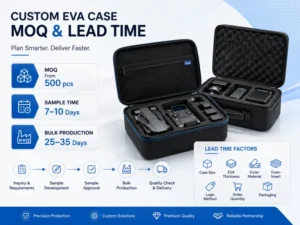
- Sample production — 3 days (ODM) or 5–7 days (OEM with new mold)
- Physical sample approval — you test with your actual product
- Bulk production — 7 working days after sample approval
- Quality inspection — AQL 2.5 standard on every order
- Shipping — sea, air, or express with full documentation
Why Dual-Factory Matters for Electronics Brands
Shenzhen (China): R&D center. Fast prototyping, complex mold engineering, first-sample iteration. Best for new product development and design-intensive projects.
Long An (Vietnam): Volume production. Lower labor cost for sewing-intensive electronics cases. Local Certificate of Origin for tariff management. Same ISO 9001 quality system.
The result: Develop your custom EVA electronics case in Shenzhen, scale production in Vietnam. Same quality system, same engineering team, two manufacturing options.
Pricing Indicators
Every project is different, but here are realistic ranges for custom EVA electronics cases:
| Product Type | Typical Order | Estimated Unit Cost | Protection Level |
|---|---|---|---|
| Small accessory pouch (earbuds, USB) | 500 pcs | 1.50–1.50–3.00 | Basic (mesh + flat base) |
| Cable organizer (multi-pocket) | 500 pcs | 2.50–2.50–4.50 | Moderate (double-layer) |
| Tablet / e-reader case | 300 pcs | 4.00–4.00–7.00 | High (CNC foam) |
| Professional electronics kit | 200 pcs | 6.00–6.00–12.00 | Maximum (CNC foam + thick shell) |
Factors that increase cost: Custom Pantone colors, metal zippers, retail packaging, ISTA-rated construction, low-quantity orders under 200 pcs.
What’s included at no extra charge: Mold storage, AQL 2.5 inspection, standard export packaging, commercial documentation.
Ready to Design Your Custom EVA Electronics Case?
Tell us what you’re protecting, and we’ll recommend the right protection level, materials, and interior configuration.
Three ways to start:
- Request a Quote — share your product specs and we’ll respond within 24 hours with recommendations and a cost estimate
- Start Customization — browse our existing designs and tell us how to adapt them for your product
- Direct contact — WhatsApp, email, or the contact form at gaodaeva.com
문의를 기다리겠습니다. 48시간 이내에 연락드리겠습니다!
FAQ: Custom EVA Electronics Case
What protection level does a custom EVA electronics case provide?
A standard custom EVA electronics case with 55–70 degree hardness EVA shell and Oxford fabric exterior provides shock absorption from drops up to 1.2 meters, water resistance for light rain and spills, and pressure resistance up to 50kg. For higher protection requirements, we can engineer cases to pass ISTA 1A or ISTA 2A transit testing protocols.
Can a custom EVA electronics case be designed for multiple devices?
Yes. We design multi-compartment custom EVA electronics cases with mesh pockets, elastic straps, and CNC-cut foam cavities to hold multiple devices simultaneously — such as a tablet, charger, cables, and accessories in one case. Interior layout is fully customizable based on your product dimensions.
What is the lead time for a custom EVA electronics case order?
Sample production takes 3–5 business days depending on complexity. Bulk production takes 7 business days after sample approval. For orders from our Vietnam facility, add 2–3 days for logistics coordination. Express shipping is available worldwide.
How do I specify the right EVA hardness for my electronics?
For lightweight consumer electronics (earbuds, cables, small accessories), 40–55 degree EVA provides sufficient protection with a lighter feel. For laptops, tablets, and fragile instruments, 55–70 degree EVA offers better impact resistance. For precision or medical electronics, 70–80 degree rigid EVA provides maximum structural protection. Our engineering team recommends hardness based on your product’s weight, fragility, and drop-risk environment.
Do you offer custom EVA electronics case manufacturing in Vietnam?
Yes. GAODA operates a 6,000+ sqm factory in Long An, Vietnam with full EVA heat-pressing, CNC foam cutting, and sewing capabilities. Products manufactured in Vietnam receive a local Certificate of Origin, which can help North American buyers manage tariff exposure. Both our China and Vietnam facilities follow the same ISO 9001 quality management system.
GAODA — Professional Custom EVA Case Manufacturer | ISO 9001 Certified | Shenzhen + Vietnam Dual Factories | 20+ Years OEM/ODM Experience


 Korean
  English
  Japanese
  French
  German
  Spanish
  Russian
  Arabic
  Italian
  Portuguese
  Turkish
  Thai
Thai  Vietnamese
  Chinese