
EVA Case vs Hard Plastic Case: Which Is Better for Your Product?
If you are choosing between an EVA case and a hard plastic case, the better option depends on how your product will be used, carried, stored and presented to customers.
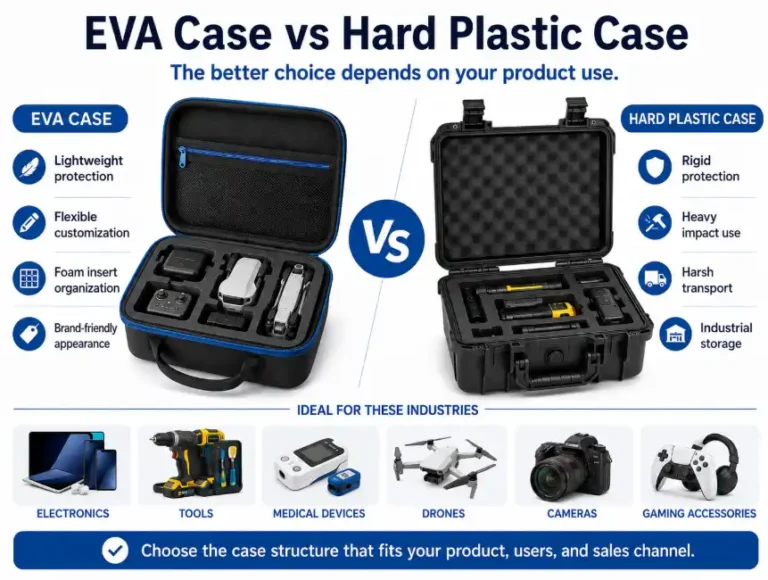
For many B2B product kits, an EVA case is the better choice when you need lightweight protection, flexible customization, foam insert organization and a brand-friendly appearance. A hard plastic case is usually better when the product needs stronger rigid protection for harsh transport, heavy impact, industrial storage or rough outdoor use.
So the real question is not simply “Which case is stronger?” The better question is: which case structure fits your product, your users and your sales channel?
This guide compares EVA Case vs Hard Plastic Case from a practical OEM and ODM perspective, especially for electronics, tools, medical devices, drones, cameras, gaming accessories and other portable product kits.
Quick Answer: Should I Choose an EVA Case or a Hard Plastic Case?
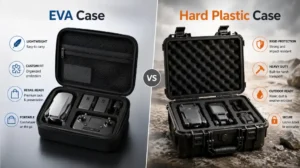
Choose an EVA case if your product needs a lightweight, semi-rigid, customizable and retail-friendly carrying solution. EVA cases are suitable for products that need daily protection, organized accessories, custom branding and a better opening experience.
Choose a hard plastic case if your product needs stronger external rigidity, better crush resistance and protection in rougher conditions, such as industrial transport, heavy stacking, outdoor storage or harsh logistics environments.
For most branded product kits, EVA cases provide a practical balance of protection, weight, appearance and customization. For products that may face strong impact or heavy pressure, a hard plastic case may be more suitable.
What Is an EVA Case?
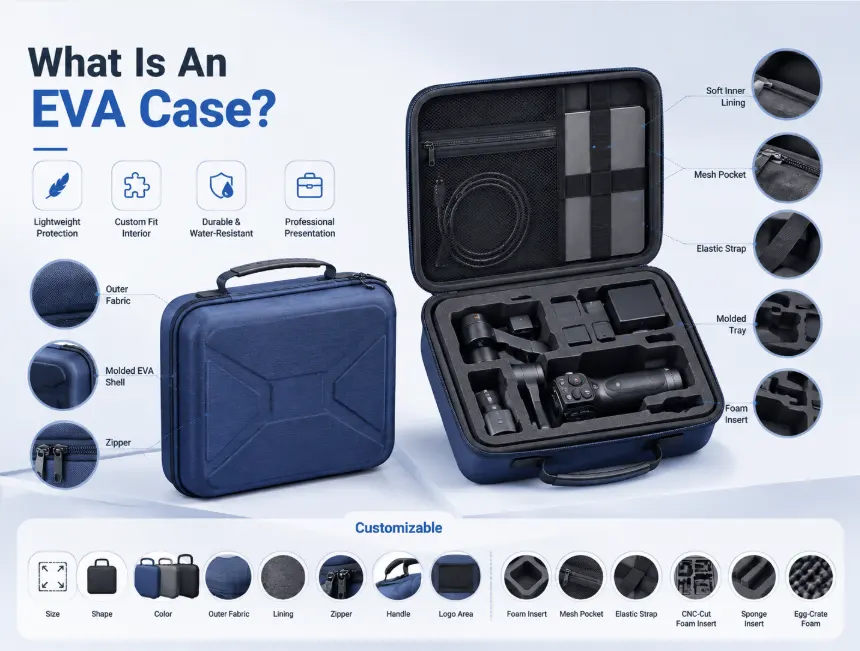
An EVA case is a semi-rigid protective carrying case made with molded EVA material, outer fabric, inner lining, zipper, handle and optional internal structures such as foam inserts, mesh pockets, elastic straps or molded trays.
The shell of an EVA case is commonly made from <a href=”https://www.sabic.com/en/products/polymers/ethylene-vinyl-acetate-eva” target=”_blank” rel=”noopener”>EVA material</a>, which is suitable for lightweight molded protective case structures.
Unlike a soft pouch, an EVA case can hold a defined shape. Unlike many hard plastic cases, it can also be covered with different fabrics and customized with a softer, more branded appearance.
A custom EVA case can be adjusted in many details, including:
- Size
- Shape
- Color
- Outer fabric
- Inner lining
- Handle
- Zipper
- Logo
- Foam insert
- Mesh pocket
- Elastic strap
- EVA molded tray
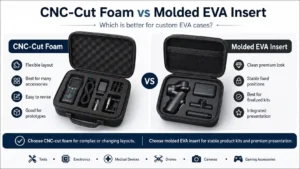
- CNC-cut foam insert
- Sponge insert
- Egg-crate foam
This flexibility makes EVA cases popular for OEM and ODM projects where the case must protect the product while also supporting brand presentation.
What Is a Hard Plastic Case?
A hard plastic case is a rigid protective case made from plastic materials. Its main advantage is structural strength. It is designed to resist stronger external pressure and provide more rigid protection than semi-rigid or soft cases.
Hard plastic cases are often used for heavy tools, industrial instruments, outdoor equipment, transport containers and products that may face rough handling.
However, a hard plastic case is not always the best solution for every product. It can be heavier, bulkier and less flexible in terms of fabric appearance, soft lining, zipper style and retail-friendly branding.
For consumer electronics, medical kits, drones, cameras, headphones, gaming devices and branded product bundles, many buyers choose EVA cases because they want protection, organization and presentation in one solution.
EVA Case vs Hard Plastic Case: Main Comparison
The table below gives a practical comparison for B2B buyers.
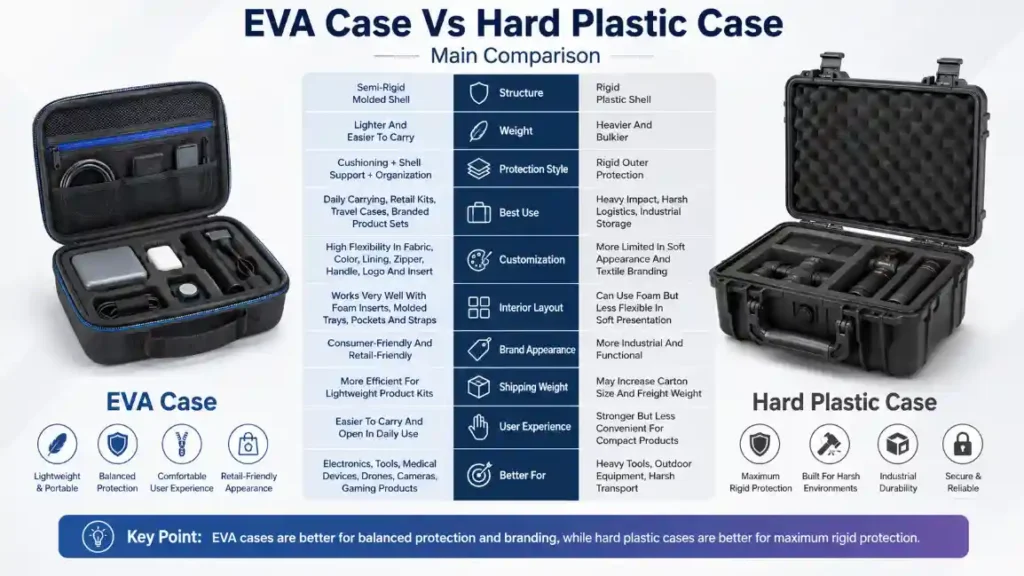
| Factor | EVA Case | Hard Plastic Case |
|---|---|---|
| Structure | Semi-rigid molded shell | Rigid plastic shell |
| Weight | Usually lighter and easier to carry | Usually heavier and bulkier |
| Protection style | Combines shell support, cushioning and internal organization | Focuses more on rigid outer protection |
| Best use | Daily carrying, retail kits, travel cases, branded product sets | Heavy impact, harsh logistics, industrial storage |
| Customization | High flexibility in fabric, color, lining, zipper, handle, logo and insert | More limited in soft appearance and textile-based branding |
| Interior layout | Works well with foam inserts, molded trays, pockets and straps | Can use foam, but usually less flexible in soft presentation |
| Brand appearance | More consumer-friendly and retail-friendly | More industrial and functional |
| Shipping weight | Often more efficient for lightweight product kits | May increase carton size and freight weight |
| User experience | Easier to carry and open in daily use | Stronger but less convenient for compact products |
| Better for | Electronics, tools, medical devices, drones, cameras, gaming products | Heavy tools, outdoor equipment, harsh transport |
The key point is simple: an EVA case is usually better for balanced protection and branding, while a hard plastic case is better for maximum rigid protection.
Will an EVA Case Protect My Product as Well as a Hard Plastic Case?
An EVA case can protect many products very well, but it protects them in a different way from a hard plastic case.
A hard plastic case protects mainly through its rigid shell. This is useful when a product may face strong external pressure, heavy stacking or rough transport.
An EVA case protects through a combined system. The molded shell helps the case keep its shape. The foam insert or molded tray holds the product in position. The lining reduces surface scratches. Pockets and straps help organize accessories so they do not collide with the main device.
For many portable products, the biggest risk is not only outside impact. The risk often comes from movement inside the case. A charger may scratch a device. A battery may press against a camera. A controller may damage a screen. Small accessories may move freely and create friction.
This is why a well-designed EVA case can work very well for electronics, medical devices, drones, cameras, gaming accessories and tool kits. The protection comes from the full structure, not only the outer shell.
When Is an EVA Case the Better Choice?
An EVA case is usually the better choice when your product needs protection, portability and branding at the same time.
For electronics, an EVA case can protect screens, buttons, cables and chargers while keeping the product kit compact. For medical devices, it can create a clean and organized layout. For drones and cameras, it can separate batteries, controllers, lenses and small accessories. For gaming devices, it can protect screens, joysticks, game cards and cables.
An EVA case is also useful when your product needs custom appearance. The outer fabric, inner lining, logo method, zipper, handle and insert can all be developed around your product and brand.
For example:
- A headphone brand may need a compact EVA case with soft lining.
- A drone brand may need battery compartments and a controller position.
- A medical device company may need clean internal organization and a professional logo.
- A tool brand may need thicker EVA, stronger outer fabric and CNC-cut foam.
- A gaming brand may need a lightweight case with accessory storage and custom color.
For buyers who need more customization details, our <a href="/it/”/eva-case-customization-options/”/">EVA case customization options</a> page explains available choices for size, shape, fabric, lining, zipper, handle, logo and foam insert.
When Is a Hard Plastic Case the Better Choice?
A hard plastic case is usually better when strong rigid protection is the main priority.
This may include products used in industrial environments, outdoor work, heavy-duty transport or situations where the case may face rough stacking and strong impact.
A hard plastic case may be more suitable for:
- Heavy industrial tools
- Large testing instruments
- Outdoor equipment
- Field service equipment
- Products transported in rough logistics conditions
- Products that need stronger crush resistance
However, if the product is sold as a branded kit, carried by users, photographed for e-commerce or used as part of a retail package, a hard plastic case may feel too bulky or industrial. In that situation, an EVA case may create a better balance between protection and user experience.
Is an EVA Case Lighter and Easier to Customize Than a Hard Plastic Case?
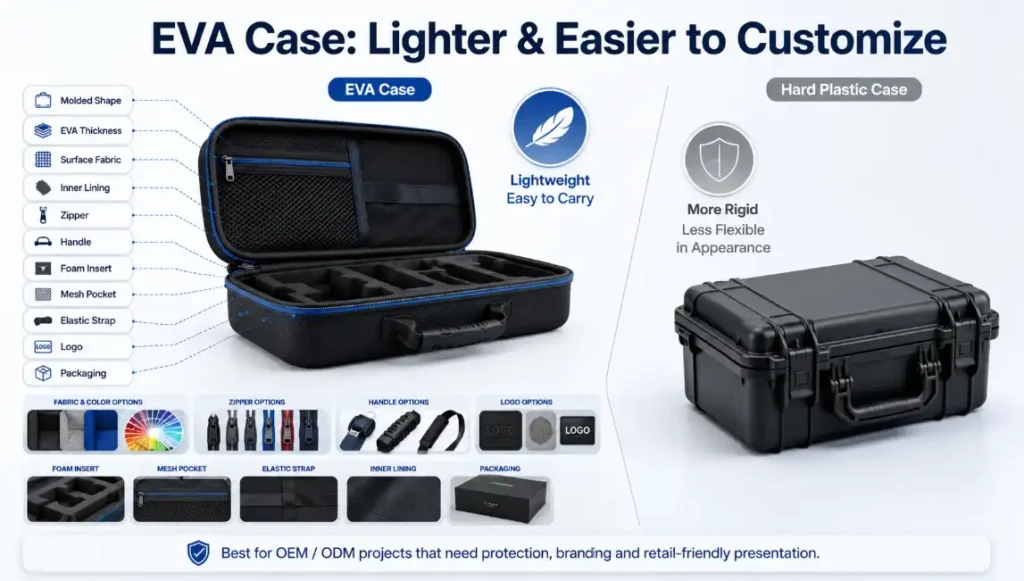
In most product-kit applications, yes. EVA cases are usually lighter and easier to customize than hard plastic cases.
A custom EVA case can be customized in:
- Molded case shape
- EVA thickness
- Surface fabric
- Fabric color
- Inner lining
- Zipper type
- Handle style
- Foam insert
- Mesh pocket
- Elastic strap
- Logo method
- Packaging method
GAODA commonly works with outer materials such as 300D, 600D, 900D and 1680D Oxford fabric, PU leather, snowflake fabric, knitted fabric and velvet. Different materials can be selected according to the product position, durability requirement and visual style.
Logo options can include silk screen printing, embossing, debossing, rubber patches, woven labels and metal plates. These options make EVA cases suitable for OEM and ODM projects where branding matters.
Hard plastic cases can also be customized, but they usually offer less flexibility in fabric texture, soft lining and retail-style appearance.
Which Case Is Better for Different Products?
Different products need different protection logic. The best choice depends on the product weight, value, accessory layout and use scenario.
| Product Type | Better Starting Option | Reason |
| Headphones | EVA case | Lightweight, soft lining, compact travel protection |
| Game consoles | EVA case | Screen protection, game card storage, cable organization |
| VR headsets | EVA case | Lens clearance, controller compartments, lighter carrying |
| Drones | EVA case or hard plastic case | EVA for retail/travel kits; hard plastic for rough outdoor transport |
| Cameras | EVA case or hard plastic case | EVA for accessory kits; hard plastic for extreme field use |
| Medical devices | EVA case | Clean appearance, organized accessories, professional presentation |
| Light tools | EVA case | Foam insert organization and better portability |
| Heavy tools | Hard plastic case or thicker EVA case | Depends on weight and transport conditions |
| Industrial instruments | Hard plastic case | Stronger rigid protection may be needed |
| Beauty devices | EVA case | Premium appearance and lightweight protection |
This table should be used as a starting point, not a fixed rule. A professional case manufacturer should review the product size, weight, accessories and target use before recommending the final structure.
How EVA Thickness Affects Protection
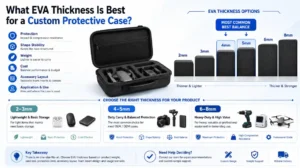
EVA thickness is one of the key factors in case performance. Common EVA thickness for custom protective cases usually ranges from 2mm to 8mm. For many custom EVA cases, 4mm and 5mm are commonly used because they provide a practical balance of protection, shape stability, weight and cost.
For heavier products such as tools, medical devices and instruments, thicker EVA material may be selected to improve compression resistance and protective performance.
However, thicker EVA is not always better. If the product is lightweight and compact, too much thickness may make the case bulky and more expensive. If the product is heavy or the case is large, thinner EVA may not provide enough structure.
The right EVA thickness should be chosen together with the outer fabric, lining, insert design, handle strength and product layout.
How Foam Inserts Improve EVA Case Protection
A foam insert can make a major difference in how well an EVA case protects the product. The shell protects from outside pressure, but the insert controls movement inside the case.
GAODA supports different insert options, including EVA molded trays, CNC-cut foam inserts, sponge inserts, egg-crate foam, DIY grid foam, elastic foam and functional compartments.
| Insert Type | Best For | Main Benefit |
| EVA molded tray | Branded kits and clean presentation | Stable shape and neat layout |
| CNC-cut foam insert | Tools, electronics, medical devices, drones, cameras | Precise compartments |
| Sponge insert | Lightweight devices | Soft cushioning |
| Egg-crate foam | General protection | Flexible pressure absorption |
| DIY grid foam | Adjustable layouts | Easy modification |
| Elastic foam | Irregular product shapes | Flexible holding |
| Functional compartments | Multi-accessory kits | Better organization |
For buyers comparing EVA Case vs Hard Plastic Case, the insert is an important factor. A hard plastic shell may be stronger outside, but if the inside is poorly organized, the product can still move and get damaged. A well-designed EVA case with a precise insert can often provide better practical protection for portable product kits.
How to Choose Between EVA Case and Hard Plastic Case
The best way to choose is to start from the real use scenario, not from the material alone.
Ask these questions before making a decision:
| Question | If Yes | Recommended Option |
| Will the user carry the case often? | Weight matters | EVA case |
| Is the case part of a branded product kit? | Appearance matters | EVA case |
| Does the product include many accessories? | Organization matters | EVA case with foam insert |
| Will the case face heavy stacking or rough logistics? | Rigid protection matters | Hard plastic case |
| Does the product need retail or e-commerce presentation? | Opening experience matters | EVA case |
| Is the product very heavy or industrial? | Shell strength matters | Hard plastic case or thicker EVA case |
| Do you need custom fabric, lining and logo options? | Branding matters | EVA case |
For many B2B brands, the final answer is not simply “EVA is better” or “hard plastic is better.” The best solution is the one that matches the product’s real environment and customer expectations.
You can also visit the <a href="/it/”/”/">GAODA EVA CASE homepage</a> to learn more about our OEM and ODM EVA case manufacturing service.
How GAODA Supports OEM/ODM EVA Case Projects
GAODA was founded in 2007 and has production facilities in Shenzhen, China and Vietnam. We provide OEM and ODM EVA case services for tools, electronics, medical devices, drones, cameras, gaming accessories and other portable products.
A typical custom EVA case project can include:
- Product size review
- Product weight evaluation
- Case structure recommendation
- EVA thickness selection
- Outer material selection
- Inner lining selection
- Foam insert design
- Logo method confirmation
- Sample development
- Bulk production
- Quality inspection
- Export packaging
For most custom EVA case projects, sample development usually takes 7–10 days. Bulk production normally takes 25–35 days after sample approval. The regular MOQ starts from 500 pcs, depending on case size, material, structure and customization requirements.
For more product guides, check our <a href="/it/”/blog/”/">custom EVA case blog</a> for articles about foam inserts, electronics cases, medical cases, drone cases and tool cases.
Quality Control for Custom EVA Cases
A protective case must look good, fit correctly and perform reliably. This is why quality control matters in OEM and ODM projects.
GAODA supports quality checks such as material inspection, zipper testing, tensile testing, color difference testing, waterproof testing, UV aging testing, vibration shock testing and drop testing.
Depending on the product type and customer requirements, the quality process can include:
- Raw material inspection
- First article confirmation
- Production process inspection
- Semi-finished product inspection
- Functional testing
- Final product inspection
- Pre-shipment sampling inspection
These checks help buyers confirm the case appearance, zipper function, handle strength, insert accuracy and overall product consistency before shipment.
For B2B buyers, this is important because the case often carries the buyer’s own brand. A poor zipper, weak handle, color difference or inaccurate insert can affect the customer’s impression of the full product.
Common Mistakes When Choosing Between EVA and Hard Plastic
Many case problems happen because buyers choose only by price, appearance or one simple protection claim.
Common mistakes include:
- Choosing a hard plastic case when the product mainly needs lightweight retail packaging
- Choosing a thin EVA case for a product that is too heavy
- Ignoring the full accessory list
- Designing the case before confirming product dimensions
- Making the case too small to reduce cost
- Placing hard accessories against screens, lenses or sensitive parts
- Forgetting foam insert design
- Choosing logo method after the sample is finished
- Approving the sample without testing the real product
- Describing a standard zippered EVA case as fully waterproof without testing
A good protective case should be tested with the real product and accessories. It should close smoothly, hold the product securely and remain practical for the end user.
What Information Should You Send for a Case Recommendation?
To receive a faster and more accurate recommendation, buyers should prepare:
- Product dimensions
- Product weight
- Product photos
- 2D or 3D drawings, if available
- Full accessory list
- Required case size, if available
- Target use scenario
- Required protection level
- Preferred outer material
- Preferred lining
- Foam insert requirements
- Logo artwork
- Packaging requirements
- Order quantity
- Target market
- Delivery schedule
- Destination country or region
If you are not sure whether an EVA case or hard plastic case is better, send your product details first. A professional case manufacturer can evaluate the protection needs, product layout, user scenario and customization requirements before recommending a suitable solution.
FAQ About EVA Case vs Hard Plastic Case
Should I choose an EVA case or a hard plastic case for my product?
Choose an EVA case if you need lightweight protection, flexible customization, foam insert organization and a branded appearance. Choose a hard plastic case if your product needs stronger rigid protection for rough transport, heavy impact or harsh outdoor use.
Will an EVA case protect my product as well as a hard plastic case?
An EVA case can protect many products very well in daily carrying, storage, retail packaging and normal transport. A hard plastic case is better for stronger crush resistance and rough handling. The actual result depends on the product weight, shell structure, insert design and use scenario.
Is an EVA case lighter than a hard plastic case?
In most product-kit applications, yes. EVA cases are usually lighter and easier to carry than hard plastic cases, making them suitable for travel kits, retail bundles and portable product packaging.
Is an EVA case easier to customize than a hard plastic case?
Yes. EVA cases can be customized in size, shape, color, outer fabric, lining, handle, zipper, logo and foam insert. This makes them suitable for OEM and ODM branded product projects.
What products are best suited for EVA cases?
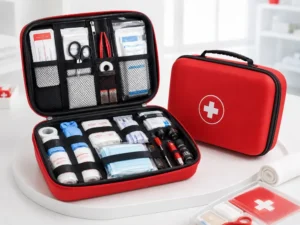
EVA cases are commonly used for electronics, headphones, game consoles, VR headsets, drones, cameras, medical devices, tools, beauty devices, first aid kits and other portable product kits.
When should I choose a hard plastic case?
Choose a hard plastic case when the product needs stronger rigid protection, heavy-impact resistance, rough transport protection or outdoor industrial use.
Can an EVA case include a custom foam insert?
Yes. EVA cases can include EVA molded trays, CNC-cut foam inserts, sponge inserts, egg-crate foam, DIY grid foam, elastic foam and functional compartments.
Can I add my logo to an EVA case?
Yes. Logo options include silk screen printing, embossing, debossing, rubber patches, woven labels and metal plates. The best method depends on the surface material, brand style and budget.
What is the MOQ for a custom EVA case?
GAODA’s regular MOQ starts from 500 pcs, depending on case size, material, structure and customization requirements.
How long does a custom EVA case project take?
For most projects, sample development usually takes 7–10 days. Bulk production normally takes 25–35 days after sample approval.
Is an EVA case waterproof?
A standard zippered EVA case may resist light moisture depending on the selected material and structure, but it should not be described as fully waterproof unless the full case has been designed and tested for that requirement.
Conclusion
EVA cases and hard plastic cases both have value, but they are designed for different needs. A hard plastic case is better when rigid protection is the top priority. An EVA case is often better when the product needs lightweight protection, accessory organization, flexible customization and stronger brand presentation.
For B2B brands in electronics, tools, medical devices, drones, cameras, gaming accessories and other portable products, EVA cases can provide a strong balance of protection, portability, appearance and cost.
The best decision starts with your product itself. Confirm the product size, weight, accessory list, protection level, sales channel and branding needs. Then choose the case structure that supports the real use scenario.
If you are comparing EVA Case vs Hard Plastic Case for your next OEM or ODM project, GAODA EVA CASE can help evaluate your product and recommend a suitable custom protective case solution.
Contact us today with your product details, accessory list and target quantity to start your custom EVA case project.
GAODA — Professional Custom EVA Case Manufacturer | ISO 9001 Certified | Shenzhen + Vietnam Dual Factories | 20+ Years OEM/ODM Experience
 Italian
  English
  Korean
  Japanese
  French
  German
  Spanish
  Russian
  Arabic
  Portuguese
  Turkish
  Thai
Thai  Vietnamese
  Chinese