
Custom EVA Pouch OEM/ODM Manufacturing Guide 2026
If you’re sourcing a custom EVA pouch for your brand, you’ve probably noticed something: most supplier websites show you finished product photos and a contact form, but nobody walks you through what actually happens after you click “send inquiry.”
We think that’s backwards. You’re about to spend real money and commit real timeline on a product that carries your brand name. You deserve to know the full process before you sign anything.
This guide comes from GAODA — a custom EVA pouch manufacturer with 20+ years of OEM/ODM experience. We’ll walk you through every step from initial concept to bulk shipment, including the decisions, tradeoffs, and timeline realities that most factories won’t tell you upfront.
OEM vs. ODM: Which Path for Your Custom EVA Pouch?
These two terms get thrown around a lot. Here’s what they actually mean for your project.
OEM — You Design, We Build
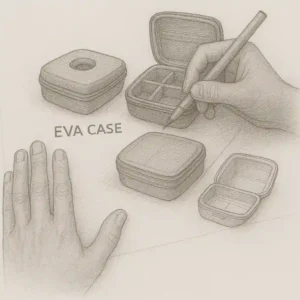
You come to us with a complete product spec: dimensions, materials, interior layout, logo placement, packaging. We execute it precisely.
When OEM makes sense:
- You have a finalized design or tech pack
- Your product has unique structural requirements (custom foam cavity shapes, specific hinge angles, non-standard dimensions)
- Brand differentiation through packaging is critical to your strategy
What you provide: Tech pack or 3D CAD file, material specifications, color Pantone codes, logo files (vector format)
What we do: Engineer the tooling, produce the sample, run bulk production
ODM — You Pick, We Customize
You select from our existing EVA pouch designs and customize the branding, dimensions, colors, zipper types, or interior configuration.
When ODM makes sense:
- You need to get to market fast
- Your product is a standard shape (earbuds case, cable organizer, small electronics pouch)
- Budget is tight and you want to skip tooling costs
What you provide: Reference to an existing design, custom branding details, any dimensional adjustments
What we do: Adapt the base design, produce sample with your modifications, run bulk production
Quick Comparison
Factor OEM ODM Design control Full Partial (within existing framework) Sample lead time 5–7 days 3 days Tooling cost Yes (mold fee applies) Usually none MOQ 100 pcs 100 pcs Best for Unique products, brand differentiation Speed, budget efficiency Bottom line: If your custom EVA pouch needs to look like nothing else on the market, go OEM. If you need 500 branded organizer pouches for a product launch next month, go ODM.
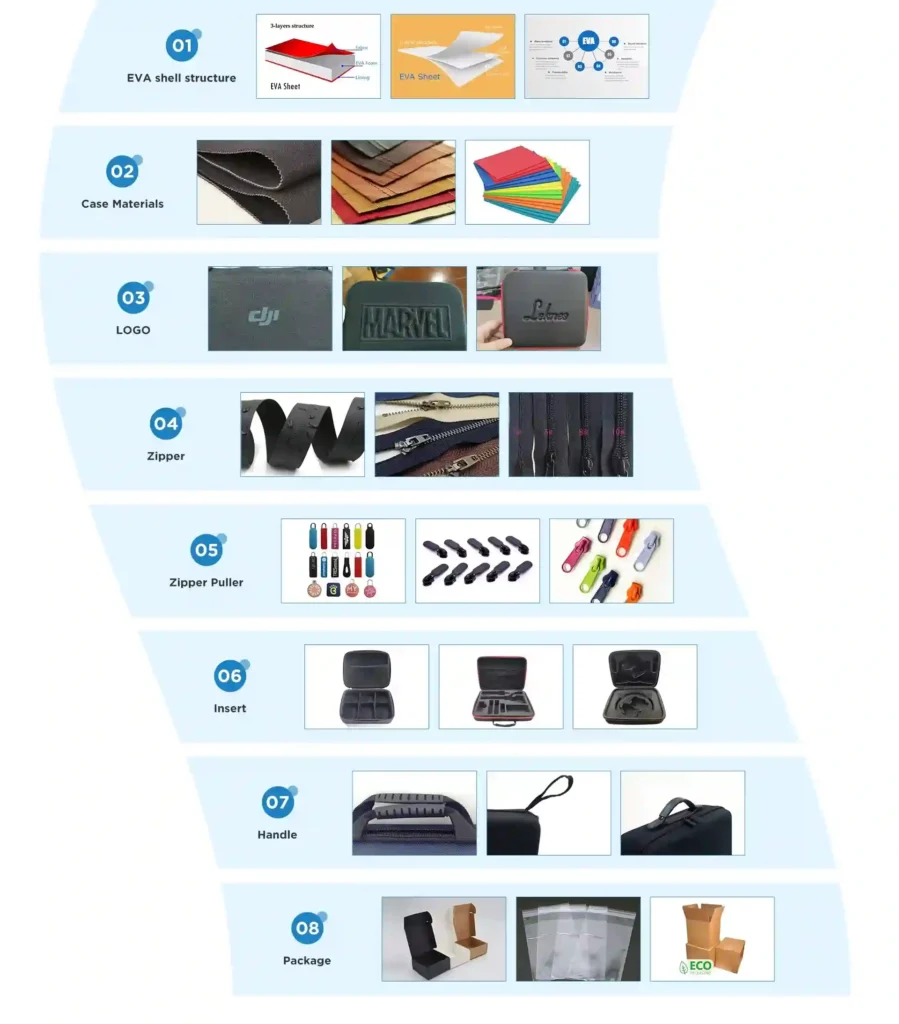
Material Selection: What Actually Goes Into a Custom EVA Pouch
This is where most buyers make expensive mistakes — choosing materials based on price alone, without understanding how each component affects protection, durability, and perceived quality.
EVA Shell — The Structural Core
EVA (ethylene-vinyl acetate) foam is molded under heat and pressure to form the hard shell. Key spec:
- Hardness range: 40°–80° (Shore C scale)
- 40°–55°: Soft, flexible — good for lightweight pouches (cosmetics, small accessories)
- 55°–70°: Standard — the sweet spot for most electronics organizer pouches
- 70°–80°: Rigid — maximum protection for fragile items (optical instruments, precision tools)
We stock EVA in standard densities. If your project needs a specific hardness outside the range, we can source it — but expect +2 days on sampling.
Exterior Fabric
| Material | Weight | Water Resistance | Durability | Common Use |
|---|---|---|---|---|
| 600D Oxford | Medium | Good | High | Electronics, tools |
| 300D Oxford | Light | Good | Medium | Small accessories |
| Polyester | Light | Moderate | Medium | Budget lines |
| PU leather | Medium | Moderate | Medium | Premium cosmetics |
Honest note: If a supplier tells you their 300D Oxford is “just as good” as 600D for a tool case, they’re cutting corners. 600D has a tighter weave and higher tear resistance. For a custom EVA pouch that needs to survive daily use, it matters.
Interior Lining
- Velvet/velour: Premium feel, scratch protection — standard for electronics and optics
- Mesh pocket: Organizational visibility — standard for cable organizer pouches
- Nylon taffeta: Smooth, durable — standard for tool cases
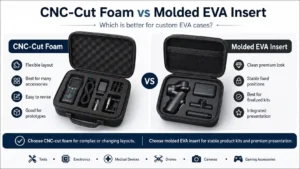
- Custom foam insert: CNC-cut precision cavities — for high-value equipment
Zippers and Hardware
- Nylon coil zipper: Standard, reliable, cost-effective
- Metal zipper: Premium look, heavier, higher cost
- Zipper puller: Custom pullers with your logo — minimum 500 pcs for custom tooling

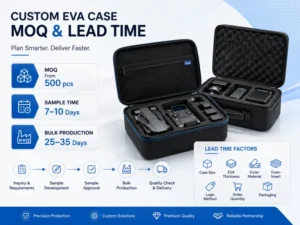
The Custom EVA Pouch Manufacturing Process: Step by Step
Here’s what actually happens after you submit your inquiry. No sugarcoating.
Step 1: Requirements Discussion (Day 1–2)
You share what you need. We ask specific questions:
- What product goes inside? (exact dimensions and weight)
- Target retail price range? (this drives material decisions)
- Intended use environment? (outdoor/travel/indoor/medical)
- Branding requirements? (logo type, placement, packaging)
- Order volume and frequency?
Pro tip: The more detail you share upfront, the fewer sample rounds you’ll need. A photo of the product next to a ruler saves two days of back-and-forth emails.
Step 2: Design Confirmation and Material Selection (Day 2–4)
Based on your requirements, we propose:
- EVA shell hardness and thickness
- Exterior fabric type and color (from Pantone matching)
- Interior lining and layout
- Zipper type and puller design
- Any additional features (wrist strap, handle, carabiner clip)
For OEM projects, we review your tech pack or CAD file and confirm manufacturability. For ODM projects, we show you the base design with your requested modifications.
Output: A confirmed specification sheet that both sides sign off on before any tooling begins.
Step 3: Mold Making (OEM only, Day 3–5)
If your custom EVA pouch requires a new mold (most OEM projects do):
- CNC machining of aluminum mold based on your CAD file
- Mold cost depends on pouch size and complexity
- Mold ownership: you own the mold, always. We store it at no charge for active accounts.
ODM projects skip this step — we use existing molds.
Step 4: Sample Production (Day 3–5 for ODM, Day 5–7 for OEM)
We produce a physical sample using the confirmed materials and specifications.
What you get:
- Functional sample with all specified materials
- Logo and branding applied (if applicable)
- Interior layout as designed
What we check before shipping the sample:
- Dimensional accuracy (±2mm tolerance)
- Zipper function (50 open/close cycles)
- EVA shell integrity (no warping or surface defects)
- Print quality and color accuracy
Sample shipping via express (DHL/FedEx) — typically 2–3 days to most markets.
Step 5: Sample Review and Approval (Day 7–10)
You receive the sample. You check it against your product. Two outcomes:
Approval: We proceed to bulk production.
Revisions: You send feedback. We adjust. A second sample ships within 3 days.
Reality check: About 60% of projects are approved on the first sample. The other 40% need minor adjustments — usually zipper type, interior pocket size, or logo color. Major structural changes are rare if Step 1–2 were done properly.
Step 6: Bulk Production (Day 7–14 after approval)
Our production floor runs your order:
- EVA molding — Heat-pressing EVA shells on hydraulic machines (12 units in our Shenzhen facility)
- Fabric cutting — Precision cutting of exterior fabric and interior lining
- Assembly and sewing — Stitching exterior fabric to EVA shell, adding zipper, lining, and accessories
- Logo application — Silk screen, heat transfer, or embossing per specification
- Quality inspection — Every unit checked against the approved sample (AQL 2.5 standard)
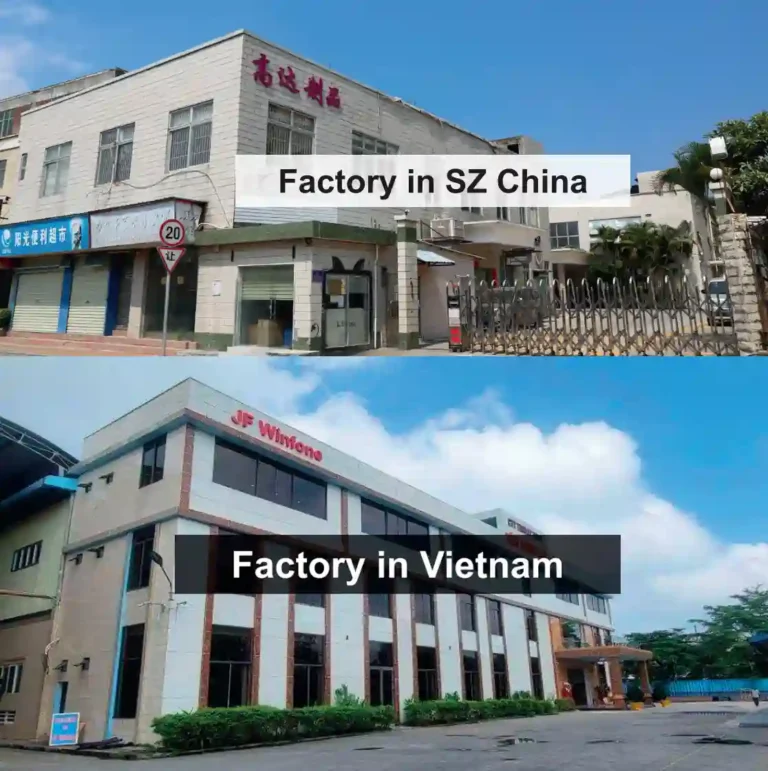
Production capacity: 16 production lines across Shenzhen and Vietnam facilities. A 1,000-piece order typically completes in 5–7 working days.
Step 7: Packaging and Shipping (Day 14–18)
- Standard packaging: Individual polybag, bulk carton
- Custom packaging: Retail box, insert card, branded tissue — available at additional cost
- Shipping options: Sea freight (18–30 days), air freight (5–7 days), express (3–5 days)
We provide full documentation: commercial invoice, packing list, Certificate of Origin.
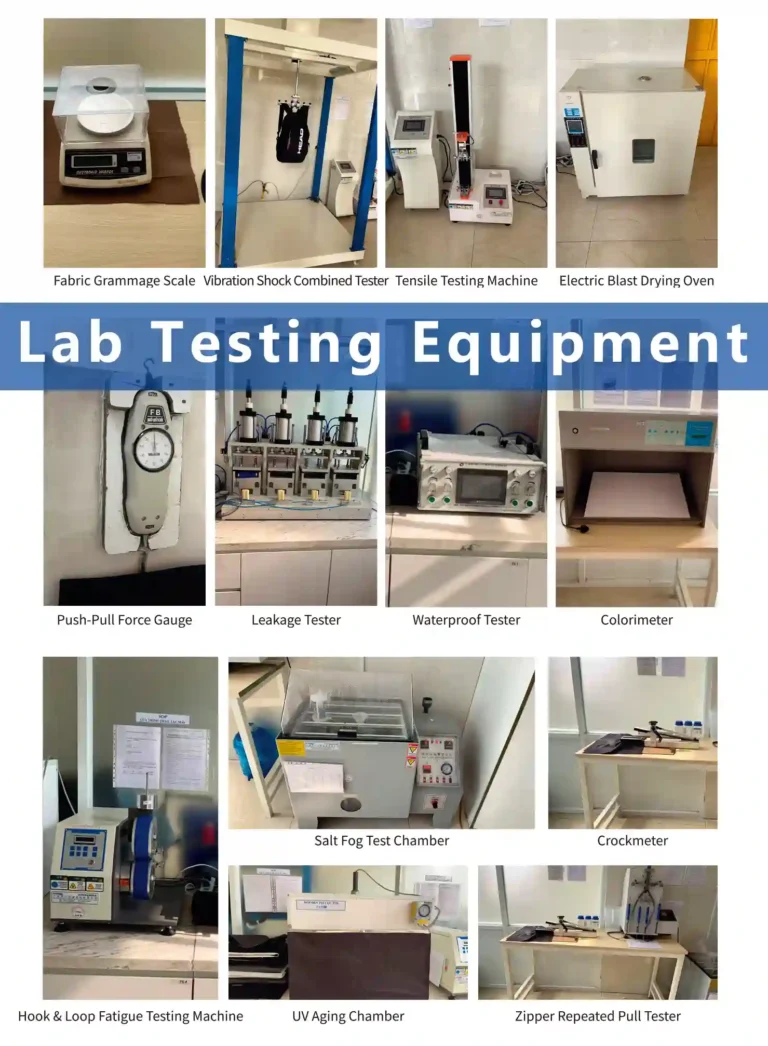
Quality Control: What We Actually Check
Not all EVA pouch factories inspect the same way. Here’s what our QC process covers:
Incoming Material Inspection
- EVA foam density and hardness (durometer test)
- Fabric weight and color (Pantone comparison under D65 light)
- Zipper functionality (50-cycle test)
In-Process Inspection
- EVA shell dimensions after molding (±2mm)
- Sewing stitch count per 3cm (minimum 8 stitches)
- Logo placement accuracy (±1mm from specified position)
Final Inspection (AQL 2.5)
- Visual defects (scratches, color inconsistency, loose threads)
- Functional test (zipper smoothness, closure alignment)
- Dimensional check against approved sample
- Packaging integrity
Honest note: We reject approximately 3–5% of units during final inspection. These don’t ship. This is normal for a factory that actually inspects — if a supplier claims 0% rejection, they’re not inspecting.
Common Mistakes When Sourcing a Custom EVA Pouch
We’ve seen these mistakes repeatedly over 20 years. Learn from others’ experience.
Mistake 1: Specifying Dimensions Without Accounting for Product Tolerances
Your product might be 150mm × 80mm on paper, but manufacturing tolerances mean it can vary ±2mm. If your pouch cavity is cut to exactly 150mm × 80mm, some units won’t fit.
Fix: Add 3–5mm clearance on each dimension.
Mistake 2: Choosing the Cheapest EVA Hardness to Save Cost
Lower hardness EVA is cheaper, but it won’t protect your product from a 1.2m drop onto concrete. If your product costs 50+retail,don′tsave50+retail,don′tsave0.10 on the shell.
Mistake 3: Skipping the Physical Sample
Some buyers approve production based on photos alone. We strongly advise against this. Colors look different on screens, and material feel is impossible to judge from a photo.
Fix: Always get a physical sample. The 3-day wait is worth it.
Mistake 4: Not Clarifying Packaging Requirements Upfront
If you need retail-ready packaging with barcode stickers and insert cards, tell us during Step 1 — not after bulk production is done. Adding packaging late increases cost by 15–20% because it requires a separate production run.
Mistake 5: Ignoring MOQ Implications for Custom Components
Custom zipper pullers with your logo require a separate mold (minimum 500 pcs). If you only need 100 pouches, you’ll have 400 extra pullers. Either increase your pouch order, use standard pullers, or accept the waste.
Pricing Factors for Custom EVA Pouch Orders
We don’t publish a price list because every project is different. But here are the factors that drive cost:
| Factor | Impact on Price |
|---|---|
| Order quantity | Higher volume = lower unit cost (material purchasing efficiency, production run optimization) |
| EVA hardness/thickness | Higher density and thicker walls = higher material cost |
| Exterior fabric | PU leather > Oxford > Polyester |
| Interior complexity | Custom CNC foam insert > Mesh pockets > Simple lining |
| Logo method | Embossing (tooling required) > Heat transfer > Silk screen |
| Packaging | Retail box with insert > Simple polybag |
| Zipper type | Metal > Custom branded nylon > Standard nylon |
Typical range for a standard EVA organizer pouch: 2.50–2.50–6.00 per unit at 500-piece volume, depending on the above factors.
What’s always included at no extra charge:
- Mold storage
- AQL 2.5 quality inspection
- Standard export packaging (polybag + carton)
- Commercial documentation
Why GAODA
We’re not the only factory making custom EVA pouches. Here’s what’s genuinely different about working with us:
Dual-factory capability. Shenzhen (China) handles R&D, rapid prototyping, and complex orders. Long An (Vietnam) handles volume production with tariff advantages for North American buyers. Both factories run the same ISO 9001 quality system.
Low MOQ. 100 pieces. We know you might be testing a new product line. We’d rather earn your trust on a small order and grow together.
Fast sampling. 3 days for ODM, 5–7 days for OEM. We keep standard EVA densities and common fabrics in stock specifically to turn samples around quickly.
Transparent process. You get a specification sheet before we cut any material. You approve a physical sample before we run bulk. No surprises.
20+ years, real clients. Phillips, Tissot, Ferrari, Smiggle. These aren’t logos we put on our website for decoration — they’re active accounts with products shipping on production schedules.
Ready to Start Your Custom EVA Pouch Project?
The fastest way to move forward:
- Share your requirements — product dimensions, target quantity, and any reference images
- We’ll respond within 24 hours with material recommendations and a rough cost estimate
- Confirm specs and we’ll start your sample within 48 hours
Or reach us directly:
- WhatsApp: Available on our website
- Email: Through the contact form at gaodaeva.com
- Response time: Within 24 hours (48 hours max during peak season)
FAQ: Custom EVA Pouch
What is the minimum order quantity for custom EVA pouches?
Our MOQ is 100 pieces per order. This low minimum allows brands to test market response before committing to larger volumes.
How long does it take to get a custom EVA pouch sample?
Sample production takes 3 business days for ODM projects and 5–7 days for OEM projects after design confirmation. Bulk production follows 7 business days after sample approval.
What is the difference between OEM and ODM for EVA pouches?
OEM (Original Equipment Manufacturing): You provide the complete design, specifications, and tech pack — the factory executes exactly to your requirements. ODM (Original Design Manufacturing): You select from the factory’s existing designs and modify branding, dimensions, colors, or interior layout. OEM offers maximum design control; ODM offers faster time-to-market with lower development costs.
What materials are used in custom EVA pouches?
Common materials include EVA foam (hardness range 40–80 degrees) for the shell, Oxford fabric or polyester for the exterior, velvet or mesh for interior lining, and nylon or metal zippers. Material selection depends on the product’s protection requirements and target price point.
Can I get a custom EVA pouch made in Vietnam for tariff advantages?
Yes. GAODA operates a 6,000+ sqm factory in Long An, Vietnam with full heat-pressing and sewing capabilities. Products manufactured in Vietnam qualify for local Certificate of Origin (COO), helping North American buyers manage tariff exposure under current trade regulations.
GAODA — Professional Custom EVA Case Manufacturer | ISO 9001 Certified | Shenzhen + Vietnam Dual Factories | 20+ Years OEM/ODM Experience


 Italian
  English
  Korean
  Japanese
  French
  German
  Spanish
  Russian
  Arabic
  Portuguese
  Turkish
  Thai
Thai  Vietnamese
  Chinese