
How to Choose the Right EVA Case Handle: Types, Materials and Load Requirements
When developing a custom EVA protective case, buyers often focus on the outer shell, foam insert, fabric and zipper. However, one important component directly affects how customers use the finished product: the carrying handle.
A poorly designed handle can make a case uncomfortable to carry, difficult to balance or unreliable under repeated loading. Even when the EVA shell and internal foam are well designed, an unsuitable handle or weak attachment structure can affect the performance of the entire carrying case.
For B2B brands developing cases for electronics, tools, medical devices, drones, cameras and professional instruments, handle selection should be considered during the initial product design stage.
Different applications require different carrying solutions. A lightweight headphone case may only need a compact fabric handle, while a larger equipment case may benefit from reinforced carrying points or a detachable shoulder strap.
This guide explains the main types of custom EVA case handles, their material options, load requirements and inspection methods to help buyers choose a suitable solution before sample development and mass production.

Quick Answer: Which Handle Is Best for a Custom EVA Case?
The best EVA case handle depends on the case size, total loaded weight, carrying frequency and intended use.
For many compact products, a fixed fabric handle is a practical option. Rubber handles can provide a different grip feel, while detachable shoulder straps are useful when customers need hands-free carrying.
Larger equipment cases may require two carrying points or a different load distribution design.
The most important consideration is not simply the handle material. Buyers should evaluate the complete carrying structure, including the handle, attachment points, reinforcement, stitching and case shell.
A reliable EVA case handle should support the intended loaded weight, remain comfortable during normal use and maintain its attachment integrity under the agreed testing conditions.
1. What Are the Main Types of EVA Case Handles?
Custom EVA cases can use different handle structures according to product dimensions and carrying requirements.
Common options include:
Fixed fabric handles
Webbing handles
Rubber handles
Reinforced carrying handles
Detachable shoulder straps
Side carrying handles
D-ring and buckle attachment systems
Each option serves a different purpose.
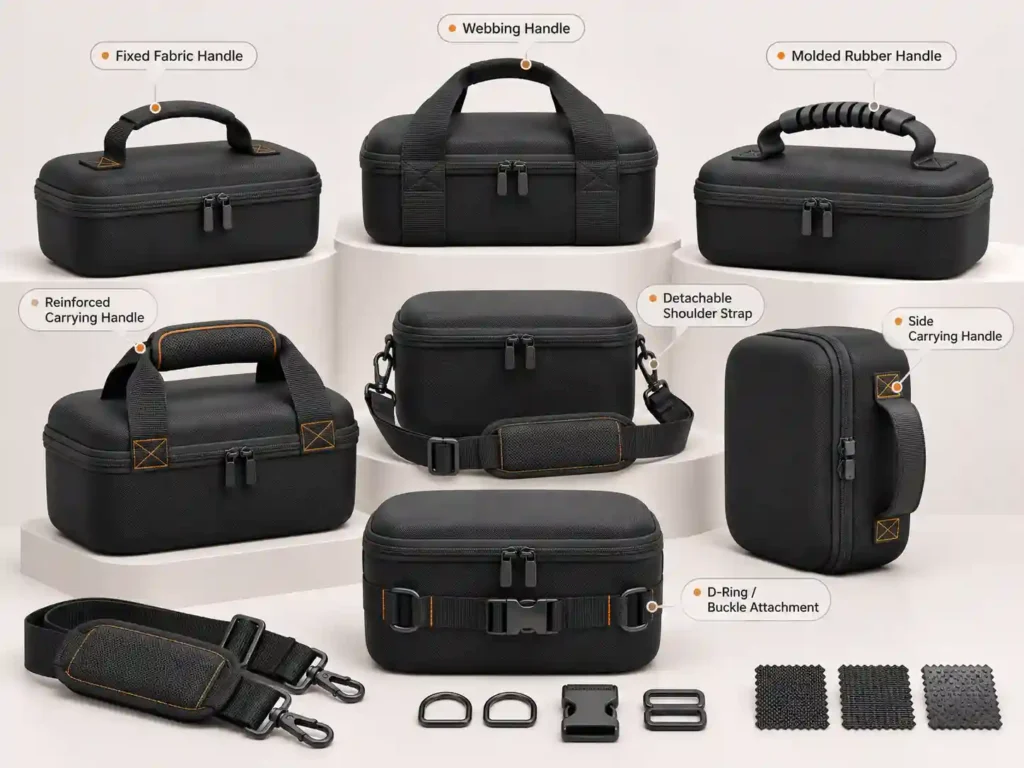
1. Fixed Fabric Handle
A fixed fabric handle is attached directly to the case and is commonly used for products that are carried by hand.
It can be developed to match the case’s exterior fabric and overall appearance.
Advantages include:
Simple carrying design
Lightweight construction
Flexible shape and size options
Easy coordination with case colors
Suitable for many compact products
Typical applications include electronics cases, headphone cases, gaming accessories and small medical equipment cases.
The attachment area should be designed according to the expected loaded weight rather than relying only on the appearance of the handle.

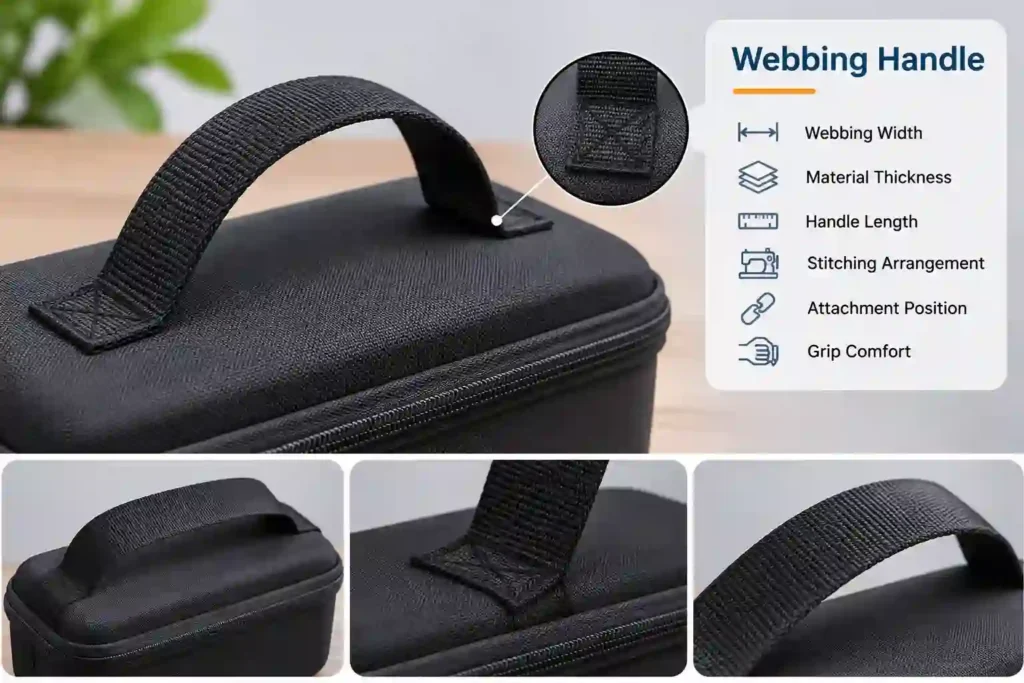
2. Webbing Handle
A webbing handle uses a woven textile strap as the main carrying component.
It can be considered when buyers want a defined strap width, flexible handling and a functional carrying design.
Important design factors include:
Webbing width
Material thickness
Handle length
Stitching arrangement
Attachment position
Grip comfort
Webbing handles are suitable for many portable equipment cases and larger carrying products, provided the complete attachment structure is designed for the intended load.
3. Rubber Handle
A rubber handle provides a different grip surface from a conventional fabric handle.
Depending on its construction, it may offer a more substantial grip and can complement industrial or professional product designs.
Potential advantages include:
Distinctive appearance
Comfortable grip design
Different surface textures
Good coordination with rugged product styling
Branding and color customization possibilities
Rubber handles may be considered for tool cases, professional equipment and products carried frequently.
However, the handle material alone does not determine load capacity. The attachment structure and connection to the case are equally important.

4. Reinforced Carrying Handle
For cases carrying heavier products, reinforcement around the handle attachment area may be necessary.
The design may use additional fabric layers, reinforced stitching or other suitable attachment structures.
The objective is to distribute carrying forces across an appropriate area instead of concentrating the load on a small section of the outer fabric.
This is particularly relevant for:
Professional tools
Medical equipment
Testing instruments
Large electronics kits
Industrial accessories
The reinforcement method should be selected according to the case construction and the actual load requirements.

5. Detachable Shoulder Strap
A shoulder strap allows users to carry a case without holding it continuously by hand.
It can be useful when the product is relatively large, when users need both hands free or when the case is carried over longer distances.
Common design considerations include:
Strap length
Adjustable range
Strap width
Shoulder contact area
D-ring position
Buckle construction
Detachment mechanism
A detachable strap should be designed around the loaded case weight and intended carrying position.
The attachment points should be evaluated as carefully as the strap itself.

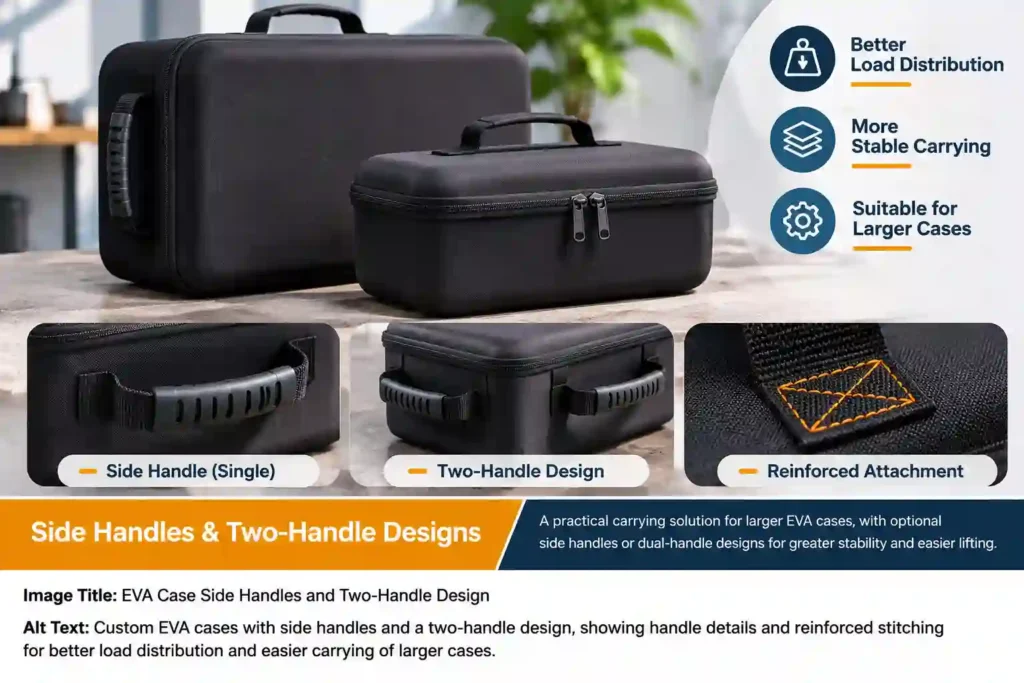
6. Side Handles and Two-Handle Designs
Some larger cases are easier to handle when they have two carrying points instead of one central handle.
This arrangement can improve load distribution and make lifting more manageable when the case dimensions or weight make single-handed carrying inconvenient.
For example, a large instrument case may benefit from two side handles when it is moved between storage, transportation and working locations.
The appropriate configuration depends on the case dimensions, center of gravity and user handling requirements.
2. Rubber Handle vs Fabric Handle: Which Should You Choose?
Rubber and fabric handles are two common options worth comparing during product development.
| Comparison Factor | Fabric Handle | Rubber Handle |
|---|---|---|
| Grip feel | Textile surface | Depends on rubber texture |
| Appearance | Matches fabric construction | More distinctive |
| Design flexibility | Different shapes and strap styles | Depends on molding and design |
| Weight | Generally lightweight | Depends on material and size |
| Branding | Fabric colors and labels | Can be coordinated with product design |
| Typical applications | Electronics and portable cases | Tools and professional equipment |
| Main consideration | Stitching and attachment | Handle structure and attachment |
Neither option is automatically stronger.
A well-designed fabric handle with suitable reinforcement may outperform a poorly attached rubber handle.
Likewise, a rubber handle may provide a preferred grip experience for certain applications.
The final decision should be based on physical samples and agreed performance requirements.

3. What Materials Are Suitable for EVA Case Handles?
Handle material selection should consider the case’s intended use, appearance and carrying requirements.
Common material directions include:
Fabric and Webbing
Fabric-based handles can be coordinated with the case exterior and are suitable for many everyday carrying applications.
Buyers should confirm the strap construction, width, thickness and stitching quality.
Rubber
Rubber handles can provide a different grip texture and visual appearance.
The material formulation, shape and attachment method should be reviewed during sample development.
Combined Handle Designs
Some projects may combine different materials to balance appearance, flexibility and grip comfort.
For example, a textile-based carrying structure may incorporate a separate grip component.
The best combination depends on the complete case design.
When requesting a quotation, buyers should provide a reference image or preferred handle style if they already have a specific design in mind.
4. How Much Weight Should an EVA Case Handle Support?
This is one of the most important questions for buyers developing protective cases.
There is no universal load capacity that applies to every EVA case handle.
The required performance depends on:
Total product weight
Weight of accessories
Case dimensions
Handle construction
Attachment method
Frequency of carrying
Transportation conditions
Expected service life
For example, a small electronics case may carry a relatively light device, while a professional tool case may contain several heavy components.
These two products should not use identical handle specifications simply because they have similar external dimensions.
Static Load vs Dynamic Load
Buyers should also understand the difference between static and dynamic loading.
Static loading refers to a load applied under relatively controlled conditions.
Dynamic loading occurs when the case is lifted, lowered, carried or moved, creating changing forces on the handle and attachment points.
A handle that supports a certain weight under a static test should not automatically be assumed to perform equally well under repeated carrying.
For this reason, the manufacturer and buyer should agree on the appropriate testing conditions.
Define the Required Load Before Production
A useful starting point is to record:
Empty case weight
Product weight
Accessory weight
Total loaded weight
Intended carrying method
Expected carrying frequency
The handle structure can then be evaluated against the complete loaded case rather than an estimated product weight alone.
5. Why Does Handle Position Matter?
Handle position affects how a case feels when it is carried.
If the handle is positioned too far from the case’s center of gravity, the case may tilt or rotate during carrying.
This can make the product less comfortable to handle and may place uneven forces on the attachment points.
For many compact cases, a centrally positioned top handle is a practical arrangement.
For larger cases, two handles may provide better handling and load distribution.
ISO 11228-1:2021 covers ergonomic considerations for manual lifting, lowering and carrying. Its informative guidance discusses suitable gripping arrangements and the positioning of handles in relation to an object’s center of gravity.
It is a useful ergonomic reference, although it is not a specific EVA case handle strength-testing standard.
Official reference: ISO 11228-1:2021 – Ergonomics: Manual Handling.
6. How Should the Handle Be Attached to an EVA Case?
The handle attachment is often more important than the handle material itself.
A strong handle can still fail if the surrounding fabric, stitching or reinforcement is inadequate.
Depending on the case construction, the attachment may involve:
Reinforced fabric attachment areas
Sewn handle loops
Additional stitching
D-ring connections
Buckle and strap connections
Other project-specific reinforcement structures
The appropriate method depends on the EVA shell, exterior fabric, handle type and intended loaded weight.
Pay Attention to Stress Concentration
When a case is lifted, the carrying force is transferred from the handle to its attachment points and then into the case structure.
If the attachment area is too small or insufficiently reinforced, the load may concentrate in a limited area.
Possible problems include:
Stitching failure
Fabric tearing
Handle detachment
Deformation around the attachment point
Damage to surrounding case materials
The manufacturer should review the entire load path rather than inspecting only the handle itself.
7. One Handle or Two Handles: Which Is Better?
The choice depends on the size, weight and shape of the case.
| Case Design | Possible Handle Arrangement | Main Consideration |
|---|---|---|
| Small electronics case | One top handle | Compact and convenient |
| Medium portable equipment case | One reinforced handle | Loaded weight and balance |
| Large instrument case | Two handles | Load distribution |
| Heavy tool case | Reinforced carrying structure | Handle attachment strength |
| Equipment used over longer distances | Shoulder strap | Carrying comfort and stability |
For large objects, two handles may make handling more practical.
However, simply adding a second handle does not guarantee better performance. Both attachment points must be positioned appropriately relative to the center of gravity and intended lifting direction.
8. How to Choose an EVA Case Handle for Different Industries
Different products have different carrying requirements.
Electronics and Gaming Accessories
Electronics cases are often compact and lightweight.
A fabric handle may be sufficient for headphone cases, gaming accessories and portable electronic products.
Buyers should prioritize:
Comfortable grip
Suitable handle length
Visual coordination
Secure attachment
Compact construction
Medical Device Cases
Medical equipment may contain a main device, cables, sensors and other accessories.
The total loaded weight should be calculated before selecting the handle.
For products carried between hospitals, clinics and field locations, handle comfort and attachment reliability are important considerations.
Tool and Industrial Equipment Cases
Tool cases may carry multiple components and experience frequent handling.
The design should consider:
Total loaded weight
Carrying frequency
Handle width
Reinforcement
Stitching
Attachment testing
A more substantial handle construction may be appropriate depending on the application.
Drone and Camera Cases
Drone and camera cases may contain several valuable components.
Buyers should consider how the loaded case balances when carried and whether a shoulder strap or reinforced handle would improve usability.
The carrying structure should also avoid interfering with the zipper, case opening and external accessories.
9. How to Test EVA Case Handle Strength Before Mass Production
A custom EVA case handle should be tested as part of the complete case.
A practical inspection process may include the following checks.
1. Visual Inspection
Check the handle surface, stitching, edges, attachment points and surrounding fabric.
Look for visible defects, loose threads or uneven construction.
2. Static Load Test
Apply the agreed representative load to the completed case under controlled conditions.
Inspect whether the handle, attachment points or surrounding case structure show unexpected deformation or damage.
3. Tensile or Attachment Strength Test
Where required, use an appropriate tensile testing method to evaluate the handle attachment.
The test should define the loading direction, test configuration and acceptance criteria.
4. Repeated Carrying Test
For products that will be carried frequently, consider repeated lifting and carrying checks.
This helps evaluate whether the construction remains functional after repeated use.
5. Post-Test Inspection
After testing, inspect:
Handle condition
Stitching
Attachment points
Fabric around the handle
Case deformation
Overall functionality
The manufacturer and buyer should agree on the test method and acceptance requirements before sample approval.
An Example of Handle Attachment Testing
The Japanese KAKEN Test Center publishes a bag handle and shoulder strap attachment strength test.
Its example method uses a tensile testing machine to pull the handle attachment and measure the load at which damage or abnormality occurs.
This provides a useful reference for understanding how handle attachment strength can be evaluated.
See: KAKEN – Bag Handle and Shoulder Strap Attachment Strength Test.
The specific test method and acceptance requirements should be selected according to the product and target market. A result from one test configuration should not automatically be treated as a universal load rating.
10. What Should Buyers Include in an EVA Case Handle RFQ?
When requesting a quotation, buyers should provide more than a photograph of the preferred handle.
A clear specification helps manufacturers recommend a suitable structure.
| RFQ Item | Information to Provide |
|---|---|
| Product | Product name and model |
| Case dimensions | Length, width and height |
| Empty case weight | Estimated or confirmed |
| Product weight | Main product and accessories |
| Total loaded weight | Complete carrying weight |
| Handle type | Fabric, rubber, webbing or shoulder strap |
| Handle position | Top, side or detachable |
| Handle dimensions | Length and width |
| Attachment method | Preferred design or supplier recommendation |
| Carrying frequency | Occasional or frequent |
| Test requirements | Static load, tensile or repeated carrying |
| Quantity | Initial order quantity |
| Reference | Photos, drawings or existing sample |
If the design is not finalized, the manufacturer c
How GAODA Supports Custom EVA Case Handle Development
GAODA EVA CASE was founded in 2007 and provides OEM and ODM custom EVA protective case manufacturing services.
With production facilities in Shenzhen, China and Vietnam, GAODA develops protective cases for electronics, tools, medical devices, drones, cameras, gaming accessories and other portable products.
The customization range includes:
Custom case size and shape
EVA shell structure and thickness
Outer fabrics and lining
CNC-cut foam and molded EVA inserts
Fabric and rubber handle options
Carrying straps and related accessories
Zippers and zipper pullers
Logo and branding
Custom packaging
Handle design can be considered together with the case dimensions, total loaded weight, product application and carrying requirements.
GAODA’s quality inspection process can include raw material inspection, first article confirmation, in-process inspection, tensile testing, functional testing, final inspection and pre-shipment sampling inspection.
For most custom projects:
| Production Detail | GAODA Reference |
|---|---|
| Established | 2007 |
| Production facilities | Shenzhen, China and Vietnam |
| Regular MOQ | Starting from 500 pcs |
| Sample development | 7–10 days |
| Bulk production | 25–35 days after sample approval |
Actual specifications and lead times depend on the case structure, handle design, materials, order quantity and testing requirements.
You can explore our EVA case customization options to review available carrying and accessory solutions.
FAQ About Custom EVA Case Handles
What type of handle is best for an EVA case?
A fabric handle is a practical option for many lightweight cases. Rubber handles can provide a different grip design, while shoulder straps are useful when hands-free carrying is required. The best option depends on the case weight and application.
Are rubber handles stronger than fabric handles?
Not necessarily. Handle strength depends on the material, construction, attachment method and reinforcement. Both rubber and fabric handles need to be evaluated as part of the complete case.
How much weight can an EVA case handle support?
There is no universal load rating for all EVA case handles. The required capacity depends on the complete case construction, product weight, accessory weight and intended carrying conditions. Buyers should agree on a test requirement with the manufacturer.
Should a heavy EVA case have two handles?
Two handles may improve handling and load distribution for larger or heavier cases. The final arrangement should consider the case dimensions and center of gravity.
Can I add a shoulder strap to a custom EVA case?
Yes. A shoulder strap can be incorporated into a custom design where the case structure supports suitable attachment points. Strap length, hardware and loaded weight should be confirmed during development.
Can I customize the color and shape of the handle?
Handle appearance and dimensions can be considered as part of an OEM or ODM project. Available options depend on the material, construction and design requirements.
How do you test EVA case handle strength?
Testing may include static load checks, tensile testing of attachment points, repeated carrying checks and post-test inspection. The test method and acceptance criteria should be agreed before production.
Does a stronger handle guarantee a stronger EVA case?
No. The complete carrying structure must be evaluated. A strong handle may still fail if its attachment points or surrounding case materials are inadequate.
What is the MOQ for custom EVA cases at GAODA?
GAODA’s regular MOQ starts from 500 pcs, depending on case dimensions, materials, structure and customization requirements.
How long does it take to develop a custom EVA case sample?
For most projects, sample development usually takes 7–10 days after the main specifications are confirmed. Special handle structures or design revisions may affect the schedule.
Conclusion: Choose the Handle According to the Complete Carrying Requirement
The handle is not just an accessory added to an EVA case. It is part of the structure that transfers the weight of the product and determines how comfortably and reliably customers can carry it.
Fabric handles, rubber handles, reinforced carrying handles and detachable shoulder straps each offer different design possibilities.
For B2B buyers, the most important steps are to calculate the complete loaded weight, consider the center of gravity, select a suitable handle structure and verify the attachment through sample inspection and appropriate testing.
A well-designed EVA case should integrate its handle, outer shell, zipper and internal structure into one functional carrying solution.
Contact GAODA EVA CASE with your product dimensions, total loaded weight, preferred handle style and target quantity to discuss your next OEM or ODM protective case project.
GAODA — Professional Custom EVA Case Manufacturer | ISO 9001 Certified | Shenzhen + Vietnam Dual Factories | 20+ Years OEM/ODM Experience


 Italian
 English
 Korean
 Japanese
 French
 German
 Spanish
 Russian
 Arabic
 Portuguese
 Turkish
 Thai
 Vietnamese
 Chinese
