
300D vs 600D vs 1680D Oxford Fabric: Which Is Best for Custom EVA Cases?
Choosing the right Oxford fabric for a custom EVA case affects more than appearance. The outer fabric influences surface durability, hand feel, weight, branding and how the finished case fits its intended use.
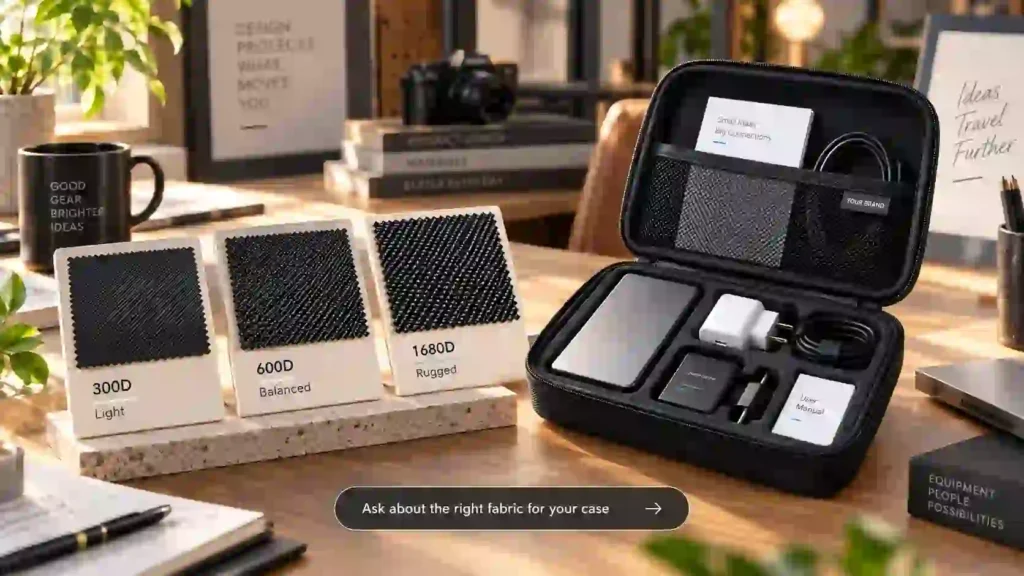
For most B2B projects, 300D Oxford fabric is suitable when a lighter and cleaner outer surface is preferred, 600D is a versatile option for many everyday protective cases, and 1680D is commonly considered for heavier-duty products that need a more rugged exterior.
However, a higher denier does not automatically mean a better EVA case.
The correct material depends on the product weight, use environment, case size, required appearance, EVA shell thickness, internal insert and target price level.
This guide compares 300D, 600D and 1680D Oxford fabric for electronics, tools, medical devices, drones, cameras, gaming accessories and other custom EVA case projects.
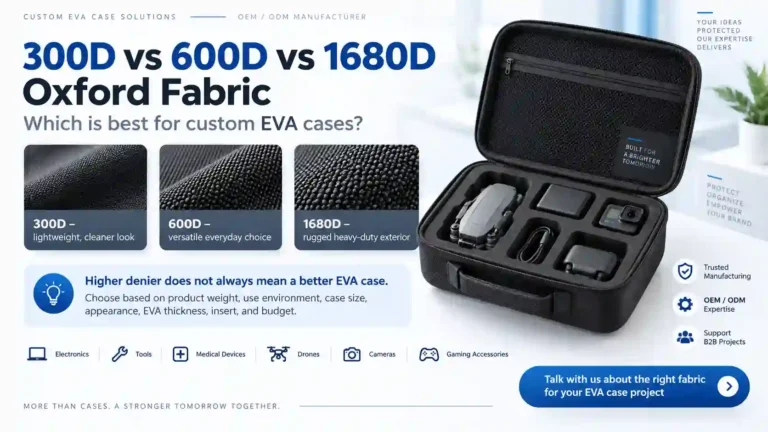
Quick Answer: 300D, 600D or 1680D Oxford Fabric?
For many custom EVA case projects:
| Fabric | General Character | Often Suitable For |
|---|---|---|
| 300D Oxford | Lighter, finer-looking surface | Small electronics, headphones, gaming accessories, lightweight consumer products |
| 600D Oxford | Balanced appearance and durability | Electronics, medical devices, drones, cameras, general-purpose EVA cases |
| 1680D Oxford | Heavier, more rugged appearance | Tools, instruments, larger devices, heavier professional equipment |
If you are unsure where to start, 600D Oxford is often a practical middle option because it can balance appearance, handling and protection for a broad range of EVA cases.
For heavier tools or equipment, 1680D may be worth considering. For compact consumer products where low weight and a cleaner appearance matter more, 300D may be sufficient.
The final choice should always be tested together with the complete EVA case structure.
What Does 300D, 600D or 1680D Mean?
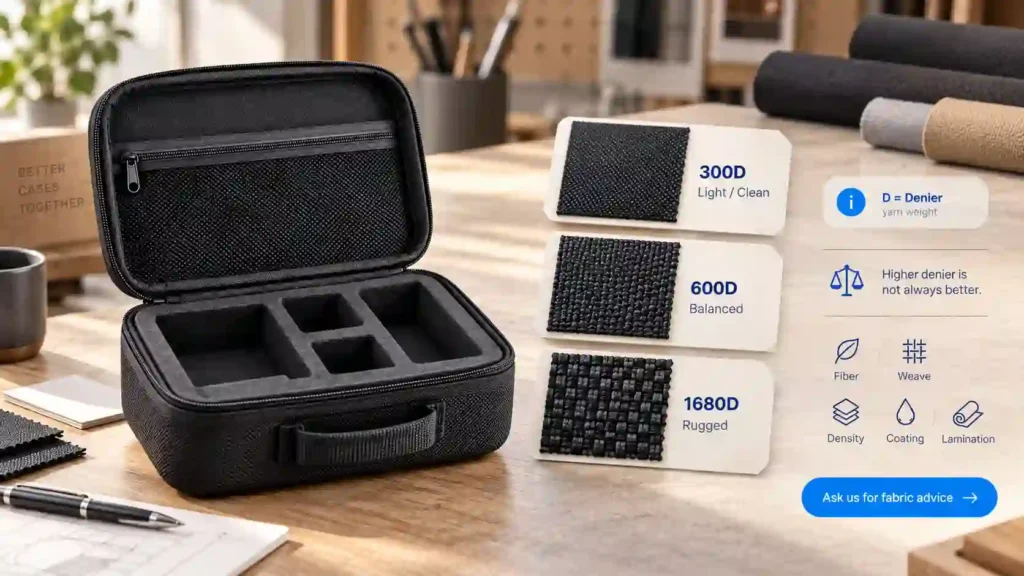
The “D” refers to denier, a measurement of yarn linear density.
Denier is defined by the mass in grams of 9,000 meters of yarn. A higher denier generally describes a heavier yarn. Cornell University’s textile sourcing materials also note that fabric construction—including yarn size and weave—affects the final functional and aesthetic properties of the fabric.
This distinction is important for EVA case buyers.
A 1680D fabric uses heavier yarn than a 300D fabric, but denier alone does not tell you everything about the finished fabric.
Actual performance also depends on factors such as:
- Fiber material
- Weave construction
- Fabric density
- Coating or lamination
- Surface finish
- Manufacturing quality
- How the fabric is laminated to the EVA shell
That means buyers should not select an EVA case material only because one number is higher.
What Is Oxford Fabric Used for in an EVA Case?
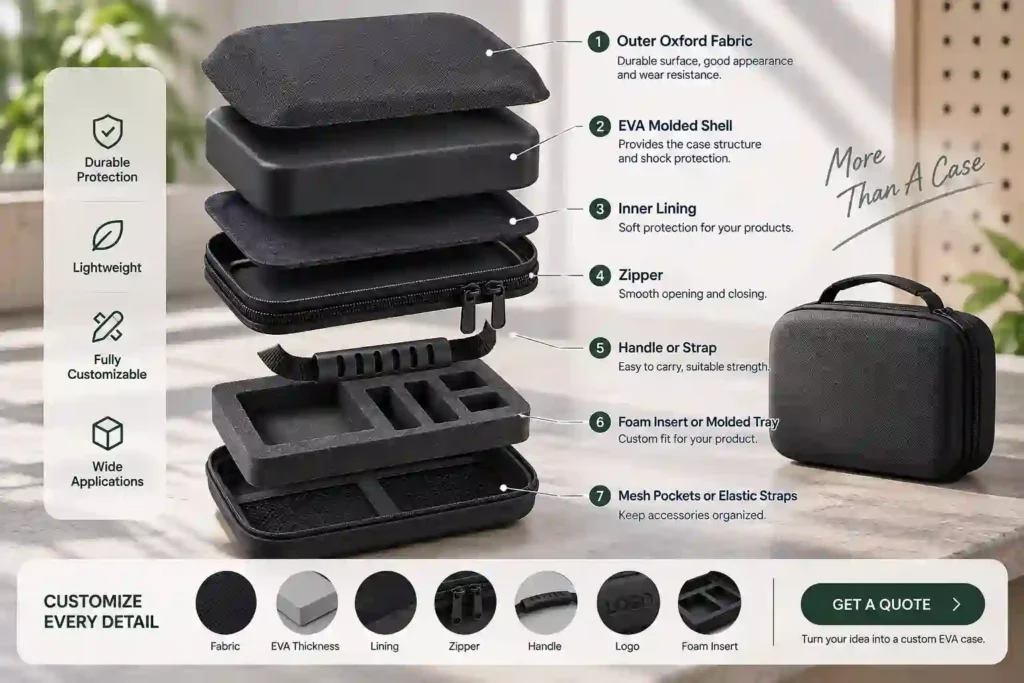
In a custom EVA case, Oxford fabric is normally laminated to the outside of the molded EVA shell.
The complete case may include:
- Outer Oxford fabric
- EVA molded shell
- Inner lining
- Zipper
- Handle or strap
- Logo
- Foam insert or molded tray
- Mesh pockets or elastic straps
The EVA shell provides much of the case’s molded structure, while the outer fabric helps determine surface appearance, handling and resistance to everyday wear.
This is why the outer fabric and EVA thickness should be selected together rather than separately.
For example, using a rugged 1680D outer fabric does not automatically compensate for an unsuitable shell structure or poorly designed internal insert.
Buyers comparing shell thickness can also read our EVA thickness guide.
300D vs 600D vs 1680D Oxford Fabric: Main Differences
Here is the practical comparison B2B buyers usually need:
| Factor | 300D Oxford | 600D Oxford | 1680D Oxford |
|---|---|---|---|
| Surface appearance | Finer and lighter | Balanced | More rugged and substantial |
| Relative yarn weight | Lower | Medium | Higher |
| Case weight | Helps keep the exterior lighter | Moderate | May add more material weight |
| Flexibility | Good | Good balance | Heavier feel |
| Typical application | Lightweight consumer products | General-purpose EVA cases | Heavy-duty and professional products |
| Branding appearance | Clean and simple | Versatile | Rugged/premium industrial appearance |
| Small electronics | Very suitable | Suitable | Often unnecessary |
| Medical devices | Suitable for lighter devices | Strong general option | Suitable for heavier equipment |
| Tools | Light-duty kits | Medium-duty kits | Often useful for heavier tools |
| Drones/cameras | Compact kits | Very common design direction | Larger professional kits |
| Gaming accessories | Very suitable | Suitable | Usually only when rugged styling is needed |
This table should be treated as a selection guide, not a fixed rule.
The actual fabric specification should be confirmed based on the complete case.
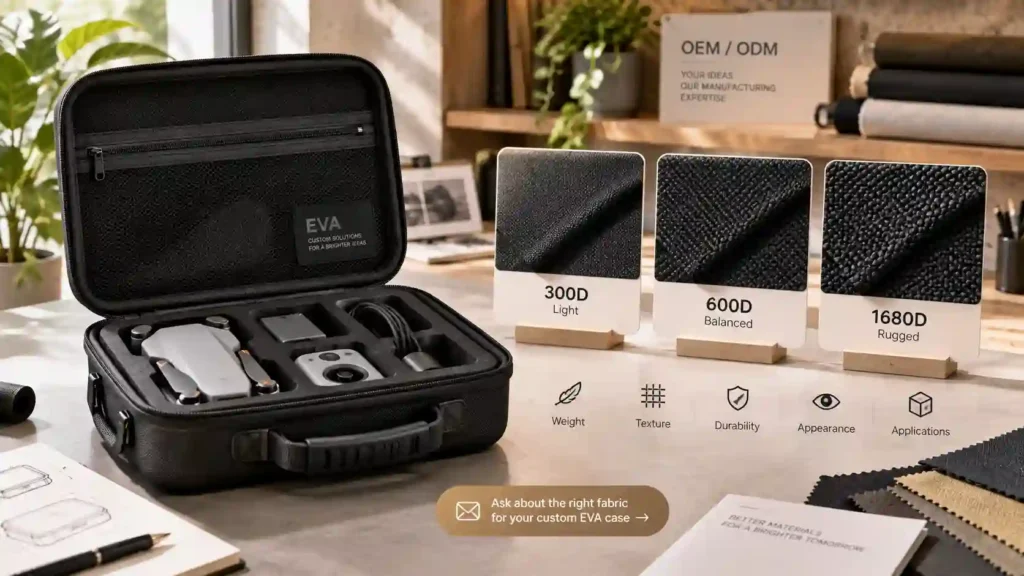
When Should You Choose 300D Oxford Fabric?
300D Oxford fabric can be a good choice for smaller and lighter products.
Its relatively lighter yarn construction can help create a cleaner outer appearance without making the case feel unnecessarily heavy.
Typical applications may include:
- Earphones and headphones
- Small electronic accessories
- Portable gaming devices
- Cables and chargers
- Compact healthcare devices
- Beauty devices
- Small consumer products
300D can also work well when the buyer’s priority is:
- Lightweight carrying
- Clean surface appearance
- Compact case size
- Consumer-facing product presentation
- Everyday indoor use
For example, a small headset case does not necessarily need the same outer fabric specification as a case carrying several kilograms of tools.
Using the heaviest available material on every product may increase bulk without adding meaningful value for the application.
When Should You Choose 600D Oxford Fabric?
600D Oxford fabric is one of the most versatile options for custom EVA cases.
It sits between lightweight and heavy-duty fabric choices, making it suitable for many B2B applications.
It may be considered for:
- Consumer electronics
- Medical devices
- Drone accessories
- Camera equipment
- Gaming products
- Small tools
- Testing equipment
- Portable instruments
For a buyer who does not have a strong reason to use either a very lightweight or particularly heavy outer material, 600D is often a sensible starting point for sample development.
It can also work well with common custom EVA shell thicknesses such as 4mm or 5mm, depending on the product.
The important point is not that 600D is universally “best.” It is that its balance makes it useful across a broad range of products.
When Should You Choose 1680D Oxford Fabric?
1680D Oxford fabric is commonly considered when the finished EVA case needs a heavier, more rugged exterior.
It can be particularly relevant for products such as:
- Power tools
- Hand tool sets
- Industrial instruments
- Larger medical equipment
- Professional camera equipment
- Testing devices
- Heavy electronic equipment
- Field-service kits
These products may be carried frequently, placed in work environments or loaded with heavier accessories.
For this type of application, buyers often look at the complete protection system:
1680D outer fabric + suitable EVA thickness + reinforced carrying structure + accurately designed foam insert.
That combination is more meaningful than evaluating 1680D alone.
For heavier products, GAODA can also evaluate thicker EVA options within the commonly used 2mm–8mm range based on the case structure and product requirements.
Is 1680D Always More Durable Than 600D?
Not necessarily in every real-world comparison.
1680D describes a higher yarn denier, but durability is affected by more than denier alone.
Fabric construction, fiber type, weave, coating and manufacturing quality can all influence abrasion, tear and tensile performance.
This is why a properly specified 600D fabric may be more appropriate for one product than a poorly matched 1680D fabric.
Performance fabrics from manufacturers such as CORDURA also illustrate this point: their technical materials list several different denier weights alongside different constructions, finishes and applications rather than treating denier as the only performance factor.
For EVA case procurement, the better question is:
What fabric specification provides enough protection and the right appearance for this specific product?
Which Oxford Fabric Is Better for Electronics?
For most electronics, 300D or 600D Oxford fabric is usually a more natural starting point than 1680D.
Electronic products often prioritize:
- Low carrying weight
- Clean appearance
- Scratch protection
- Organized accessories
- Brand presentation
A typical electronics case may hold:
- Main device
- Charger
- Cable
- Battery
- Adapter
- Manual
- Small accessories
If the product is compact and lightweight, 300D may be enough.
If the device is larger, travels more frequently or needs a slightly more substantial exterior, 600D can be considered.
The internal lining and foam insert are often just as important as the outer fabric because they directly contact the device.
Which Oxford Fabric Is Better for Tools?
Tool cases often have different requirements.
Tools may be heavier, have hard edges and place more load on the handle, shell and foam insert.
For lightweight tool kits, 600D may be suitable.
For heavier professional tools and instruments, 1680D may provide the more rugged exterior buyers expect from an industrial carrying case.
However, the outer material should be evaluated together with:
- Product weight
- EVA thickness
- Handle reinforcement
- Zipper structure
- Foam insert
- Carrying method
A heavy tool case with strong fabric but a poorly reinforced handle is still a weak design.
This is why GAODA’s EVA case quality control process can include material inspection, zipper testing, tensile testing and other checks according to project requirements.
Which Oxford Fabric Is Better for Medical Devices?
Medical device cases often need to balance professional appearance, cleanliness, organization and protection.
For compact medical or home healthcare devices, 300D or 600D can provide an appropriate outer surface.
For larger medical equipment or instruments, 600D or 1680D may be evaluated depending on:
- Device weight
- Carrying frequency
- Number of accessories
- Target use environment
- Required case structure
The internal layout is particularly important for medical equipment.
Cables, probes, sensors, chargers and other components should have clearly defined storage positions.
In many cases, a 600D exterior combined with a suitable EVA shell and accurately designed insert may be more useful than simply choosing the heaviest outer fabric.
Which Oxford Fabric Is Better for Drones and Cameras?
For drones and cameras, 600D is often a useful starting point because these cases need a balance between portability and protection.
A drone kit may contain:
- Drone body
- Controller
- Batteries
- Charger
- Propellers
- Cables
A camera kit may contain:
- Camera body
- Lens
- Battery
- Charger
- Filters
- Cables
For smaller consumer kits, 300D may also work.
For larger professional camera or field equipment, 1680D may be considered if the buyer wants a more rugged outer surface.
The more important issue is whether the internal insert prevents the drone, lens, controller or batteries from moving during transportation.
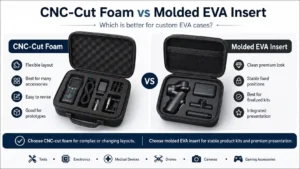
For insert selection, see our CNC-cut foam vs molded EVA insert guide.
Which Oxford Fabric Is Better for Gaming Accessories?
Gaming products usually do not require an extremely heavy exterior.
For:
- Handheld consoles
- Controllers
- VR accessories
- Gaming headphones
- Chargers
- Game cards
300D or 600D Oxford fabric will often fit the product positioning better.
These products tend to emphasize:
- Compact size
- Lightweight carrying
- Clean design
- Logo presentation
- Soft lining
- Organized accessory storage
1680D can still be used when the brand deliberately wants a rugged visual style, but it should not be selected only because the denier number is higher.
Where Does 900D Oxford Fabric Fit?
GAODA also works with 900D Oxford fabric.
900D can be considered as another middle-to-heavy option when a buyer wants something more substantial than 600D without moving directly to 1680D.
It may be useful for:
- Professional equipment
- Tool cases
- Larger electronics
- Camera kits
- Instrument cases
Whether 900D makes sense depends on available fabric specifications, target appearance and the complete protective structure.
If the buyer is comparing 600D, 900D and 1680D, the most effective approach is often to review physical material samples rather than judging only from product photos.
Does Higher Denier Mean a Heavier EVA Case?
In general, higher-denier yarn is heavier per unit length, but final case weight cannot be determined from denier alone.
The complete EVA case weight also depends on:
- Case dimensions
- Fabric construction
- EVA thickness
- Lining
- Foam insert
- Zipper
- Handle
- Pockets
- Accessories
A large 300D case may still weigh more than a small 1680D case.
For OEM development, buyers should therefore compare complete samples rather than predicting finished case weight from fabric denier only.
Does Oxford Fabric Make an EVA Case Waterproof?
Oxford fabric should not automatically be described as waterproof.
Depending on the fabric coating, lamination and complete case construction, the outer surface may provide some resistance to light moisture.
But a standard zippered EVA case contains potential water-entry points such as:
- Zipper areas
- Stitching
- Seams
- Handle attachment areas
Therefore, a standard EVA case should not be marketed as fully waterproof unless the full construction has been designed and tested for that claim.
Where water resistance matters, the buyer should define the actual usage scenario before sample development.
How Should B2B Buyers Choose the Right Oxford Fabric?
Instead of beginning with “I want 1680D because it is stronger,” start with the product.
Ask these questions:
| Buyer Question | Why It Matters |
|---|---|
| How heavy is the product? | Heavier equipment may need a more robust overall case |
| How often will the case be carried? | Frequent use can change material priorities |
| Is it a consumer or professional product? | Appearance expectations differ |
| Will it be used indoors or in the field? | Environment affects material selection |
| What EVA thickness is required? | Shell and surface fabric should work together |
| What type of foam insert is needed? | Internal protection affects overall performance |
| Is low weight important? | Lighter fabrics may be preferable |
| Is a rugged appearance important? | Higher-denier options may fit the brand better |
| Is the logo printed or embossed? | Surface material can affect branding method |
| What is the target price level? | Material selection affects the complete project cost |
This approach creates a better specification than selecting material from a denier number alone.
Oxford Fabric vs EVA Thickness: Which Matters More?
They serve different purposes.
The Oxford fabric is the outer surface material.
The EVA layer provides much of the molded structure and compression resistance of the case.
For many custom EVA cases, EVA thickness ranges from 2mm to 8mm, with 4mm and 5mm commonly used across a variety of applications.
A heavier product may require a thicker EVA shell regardless of whether the outer surface uses 600D or 1680D Oxford.
This is why material selection should be considered as a system:
Outer fabric + EVA shell + lining + foam insert + zipper + handle.
Changing only one component does not automatically create a better case.
How Does the Foam Insert Affect Fabric Choice?
The internal insert helps determine how much movement the product experiences inside the case.
Available options can include:
- CNC-cut foam
- Molded EVA tray
- Sponge insert
- Egg-crate foam
- DIY grid foam
- Elastic foam
- Functional compartments
For heavy tools, a strong insert may reduce movement and keep components separated.
For electronics, softer or more precisely shaped structures may help protect delicate surfaces.
This means a well-designed 600D EVA case with the correct foam insert can sometimes be a more appropriate solution than simply specifying 1680D outside and ignoring the internal structure.
Common Mistakes When Selecting Oxford Fabric
One common mistake is assuming the highest denier is automatically the best.
Other mistakes include:
- Choosing material only from online photos
- Ignoring product weight
- Ignoring EVA shell thickness
- Selecting outer fabric before confirming the use scenario
- Using heavy material for a small consumer product without a reason
- Focusing on fabric but ignoring zipper and handle quality
- Not checking material color under real lighting
- Changing fabric after the sample is approved
- Assuming all fabrics with the same denier perform identically
- Using “waterproof” claims without confirming the complete case structure
B2B buyers should request physical material samples when appearance, texture or color is important.
What Information Should You Send an EVA Case Manufacturer?
To recommend the right fabric, the manufacturer needs more than a product name.
For a useful quotation, provide:
- Product dimensions
- Product weight
- Product photos
- 2D or 3D drawings if available
- Complete accessory list
- Target use scenario
- Preferred case size
- Required protection level
- Preferred fabric, if known
- EVA thickness preference
- Foam insert requirement
- Logo artwork
- Target quantity
- Packaging requirement
- Target market
- Delivery schedule
For example, instead of saying:
“We need a 1680D tool case.”
A better request is:
“The tool set weighs approximately X kg, contains these components, will be carried daily by technicians, and we need 500 pieces with a CNC-cut foam insert.”
That gives the EVA case manufacturer enough context to evaluate whether 600D, 900D or 1680D is actually suitable.
How GAODA Supports Oxford Fabric Selection
GAODA EVA CASE was founded in 2007 and provides OEM and ODM custom EVA case manufacturing for tools, electronics, medical devices, drones, cameras, gaming accessories and other portable products.
Available outer material options include:
- 300D Oxford
- 600D Oxford
- 900D Oxford
- 1680D Oxford
- PU leather
- Snowflake fabric
- Knitted fabric
- Velvet
Customization can also include:
- Case size
- Case shape
- Color
- EVA thickness
- Inner lining
- Zipper
- Handle
- Logo
- Foam insert
- Internal compartments
GAODA operates production facilities in Shenzhen, China and Vietnam.
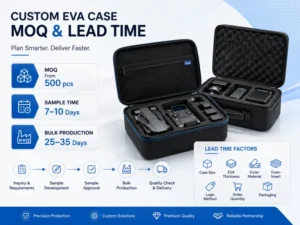
For most custom projects, the regular MOQ starts from 500 pcs, sample development usually takes 7–10 days, and bulk production normally takes 25–35 days after sample approval.
You can review our EVA case customization options for more information about available structures and materials.
How Should Fabric Quality Be Checked Before Production?
Before mass production, buyers should confirm the actual fabric specification and approved sample.
Quality checks can include:
- Material type
- Color
- Surface appearance
- Fabric consistency
- Lamination condition
- Approved sample matching
- Logo appearance
- Finished case appearance
GAODA’s quality process can also include raw material inspection, first article confirmation, in-process inspection, semi-finished product inspection, functional testing, final inspection and pre-shipment sampling inspection.
This is especially important for repeat orders because the bulk material should remain consistent with the approved project specification.
FAQ: 300D vs 600D vs 1680D Oxford Fabric
What is the difference between 300D, 600D and 1680D Oxford fabric?
The numbers describe yarn denier. 300D uses lighter yarn than 600D, while 1680D uses heavier yarn. However, actual fabric performance also depends on construction, fiber, coating and manufacturing quality.
Is 600D Oxford fabric good for EVA cases?
Yes. 600D is a versatile option for many custom EVA cases, including electronics, medical devices, drones, cameras, gaming products and general equipment.
Is 1680D better than 600D?
Not automatically. 1680D provides a heavier, more rugged material direction, but 600D may be more suitable for products that need lower weight or a cleaner appearance. The choice should be based on the complete case requirements.
Is 300D Oxford fabric strong enough for electronics?
For many lightweight electronic products and accessories, 300D can be suitable. Larger or heavier devices may benefit from 600D or another material depending on the full case design.
Which Oxford fabric is best for tools?
For lightweight tool kits, 600D may be sufficient. For heavier professional tools and instruments, 900D or 1680D may be considered together with suitable EVA thickness, handle reinforcement and foam inserts.
Which Oxford fabric is best for medical device cases?
600D is often a useful starting point for many medical device cases. Smaller devices may use 300D, while heavier equipment may require 900D or 1680D depending on product weight and use environment.
Is 1680D Oxford fabric waterproof?
Denier does not determine waterproof performance. Water resistance depends on fabric coating, lamination and the complete case construction. A standard zippered EVA case should not be described as fully waterproof without appropriate design and testing.
Does higher denier make an EVA case heavier?
Higher-denier yarn is heavier per unit length, but finished case weight also depends on case dimensions, fabric construction, EVA thickness, lining, foam insert and hardware.
Can I use 1680D for a small EVA case?
Yes, but it may not always be necessary. For compact consumer electronics or gaming accessories, 300D or 600D may create a lighter and more appropriate finished product.
What is the most common Oxford fabric for a custom EVA case?
There is no single fabric that is best for every project. GAODA commonly works with 300D, 600D, 900D and 1680D Oxford fabric depending on product size, weight, appearance and use scenario.
Can I see fabric samples before placing a bulk order?
Material confirmation should be part of the sample development process. For projects where color, texture or hand feel matters, physical material samples are more reliable than selecting from screen images alone.
What is GAODA's MOQ?
GAODA’s regular MOQ starts from 500 pcs, depending on the case size, materials, structure and customization requirements.
How long does an EVA case sample take?
For most GAODA custom EVA case projects, sample development usually takes 7–10 days after the main specifications are confirmed.
Conclusion
There is no single “best” Oxford fabric for every custom EVA case.
300D is useful for lighter consumer products, 600D provides a versatile balance for many general EVA case applications, and 1680D is worth considering for heavier professional equipment and more rugged product positioning.
But the fabric denier should never be evaluated alone.
The final case performance depends on the complete structure: outer fabric, EVA thickness, lining, zipper, handle, foam insert and product fit.
For B2B buyers, the best approach is to start with the actual product weight, dimensions, accessories, target use environment and branding requirements. From there, the manufacturer can compare 300D, 600D, 900D or 1680D material options during sample development.
If you are developing a custom EVA case, send GAODA your product dimensions, product weight, photos, accessory list and target quantity. We can evaluate the case structure and recommend a suitable outer fabric for your OEM or ODM project.
GAODA — Professional Custom EVA Case Manufacturer | ISO 9001 Certified | Shenzhen + Vietnam Dual Factories | 20+ Years OEM/ODM Experience


 Italian
  English
  Korean
  Japanese
  French
  German
  Spanish
  Russian
  Arabic
  Portuguese
  Turkish
  Thai
Thai  Vietnamese
  Chinese