
How to Choose the Right EVA Foam Density for Custom Inserts: A Professional Guide
When designing custom packaging or industrial components, many engineers focus primarily on the dimensions and color. However, if you are a procurement manager or a product designer, there is one technical metric that outweighs almost everything else: Density.
Choosing the wrong density for your EVA inserts can be a costly mistake. If the foam is too soft, your expensive product may bottom out and break during shipping. If it’s too hard, the foam itself could scratch delicate surfaces or transmit too much vibration.
In this comprehensive EVA foam density guide, we will break down the science of foam density, its relationship with hardness, and how to select the perfect grade for your specific application.
When using this EVA foam density guide, engineers should remember that density directly impacts the product’s lifespan. Our EVA foam density guide is designed to simplify your procurement process. Follow this EVA foam density guide to avoid common mistakes in material selection.
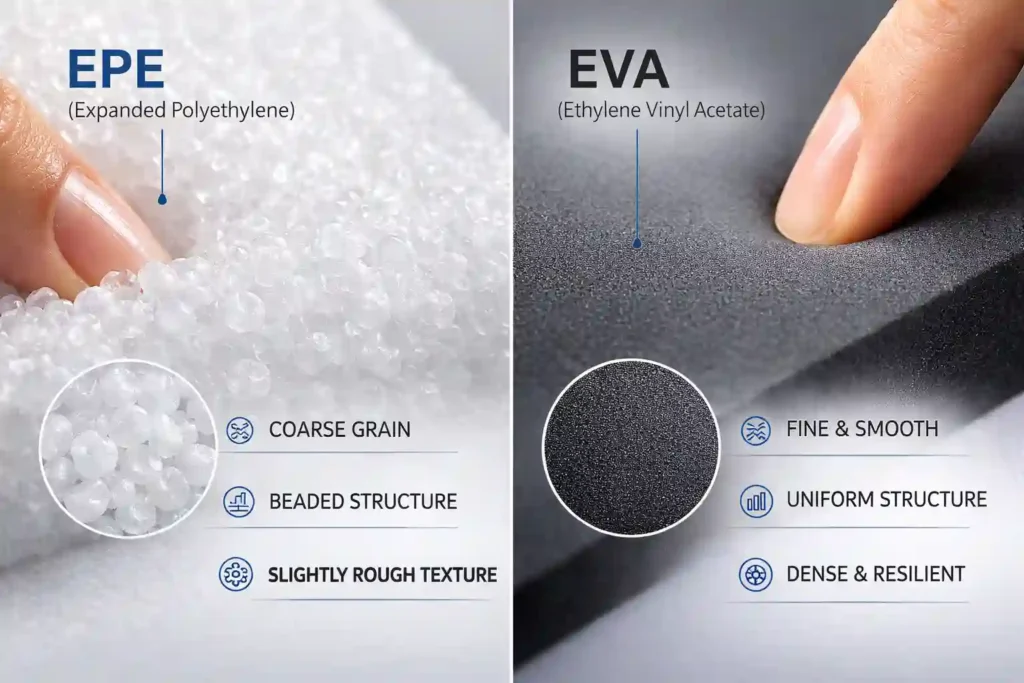
1. Understanding Density: More Than Just Weight
In the world of polymer science, density is defined as the mass per unit volume, typically measured in kg/m ³ (kilograms per cubic meter) ou lb/ft³ (pounds per cubic foot).
Density vs. Hardness (Shore Hardness)
One common misconception in the EVA foam density guide is that density and hardness are the same thing. While they are closely related, they are distinct properties:
Density ( kg/m ³): Refers to how much material is packed into the foam structure. Higher density usually means more polymer and less air.
Hardness (Shore C): Refers to how resistant the surface is to indentation.
In most cases, as the density of EVA foam increases, its Shore hardness also increases. However, by adjusting the chemical formula, manufacturers like Gaoda EVA can create “soft-touch” high-density foams or “stiff” low-density foams. Understanding this distinction is key for engineers who need specific compression sets for mechanical parts.
When using this EVA foam density guide, engineers should remember that density directly impacts the product’s lifespan. Our EVA foam density guide is designed to simplify your procurement process. Follow this EVA foam density guide to avoid common mistakes in material selection.
2. Low Density EVA Foam (38kg/m³ - 45kg/m³)
Low-density EVA is the most common choice for consumer-facing products where “feel” and “light weight” are more important than heavy-duty protection.
Ideal Applications:
Lightweight Gift Packaging: Ideal for cosmetics, perfumes, and jewelry boxes where the unboxing experience should feel soft and premium.
Yoga Blocks and Mats: Provides the necessary “give” for comfort during exercise.
Apparel Inserts: Used in shoe insoles or shoulder pads where weight must be kept to a minimum.
Why Choose It?
If your product is lightweight (under 500g) and doesn’t face extreme shipping conditions, low-density foam is a cost-effective solution. It is easy to die-cut and offers a high degree of flexibility.
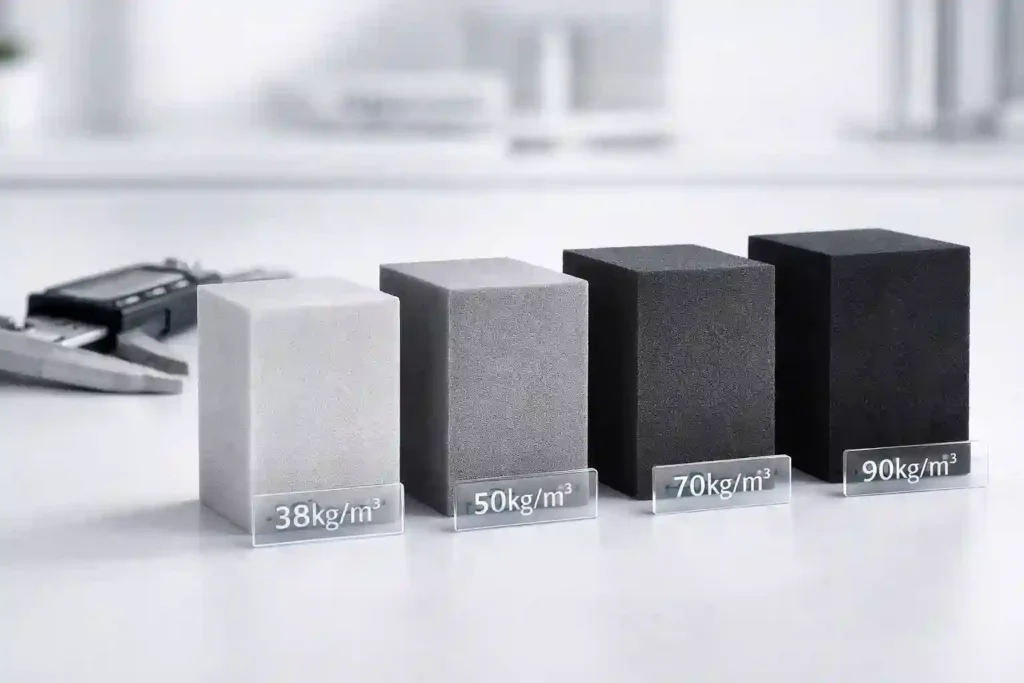
3. Medium Density EVA Foam (50kg/m³ - 70kg/m³)
This is often referred to as the “industry standard” or the “sweet spot” in any EVA foam density guide. Medium-density EVA offers a perfect balance between cushioning and structural support.
Ideal Applications:
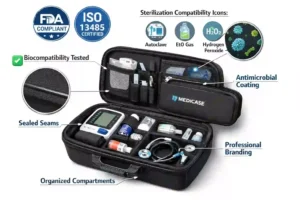
Consumer Electronics: Perfect for drones, cameras, and handheld medical devices. It provides enough resistance to prevent the device from moving while absorbing significant impact.
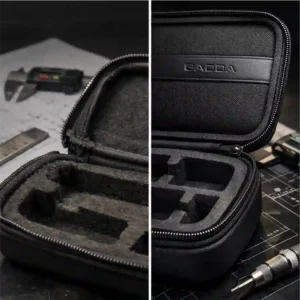
Tool Box Inserts: Professionals use this density for “shadow boards” to keep wrenches and precision tools organized.
Branded Carrying Cases: Most semi-rigid “EVA cases” use this density as the core material.
Why Choose It?
Medium-density foam is incredibly durable. It won’t lose its shape after repeated use (taking the tool in and out), making it the go-to for products with a long lifecycle.
4. High Density EVA Foam (80kg/m³ and Above)
When you move into high-density territory, the EVA foam begins to behave more like rubber than a sponge. This is where industrial-grade performance happens.
Ideal Applications:
Industrial Gaskets and Seals: Used in automotive and HVAC systems where air and water-tight seals are required under pressure.
Heavy Machinery Cushioning: Used to support heavy equipment that would simply crush lower-density foams.
Acoustic Insulation: High-density materials are much better at blocking sound transmission in construction and automotive floors.
Why Choose It?
High-density EVA is nearly indestructible. It has high tear strength and can withstand significant environmental stress. If your project involves a 20kg piece of industrial equipment, high-density is your only safe option.
5. Factors That Affect Your Procurement Costs
As a procurement specialist using this EVA foam density guide, you should be aware that density isn’t the only factor affecting your quote.
The Role of Color
Standard black and white EVA are the most affordable. If your brand requires a custom Pantone color, expect the price to increase by 10-20%. Why? Because the manufacturer must stop production to clean the machines and calibrate the dye pigments.
Special Additives: Anti-Static (ESD) Foam
For the electronics industry, standard EVA isn’t enough. You may need Anti-Static EVA. This is treated with carbon additives to prevent static electricity from frying sensitive circuit boards. Always specify if you need ESD protection during the RFQ (Request for Quote) stage.
When using this EVA foam density guide, engineers should remember that density directly impacts the product’s lifespan. Our EVA foam density guide is designed to simplify your procurement process. Follow this EVA foam density guide to avoid common mistakes in material selection.
6. Common Mistakes to Avoid When Choosing EVA Density
Mistake #1: Choosing Based on Price Alone
Low-density foam is cheaper, but if it fails to protect a $1,000 product, the “savings” are lost in returns and damaged reputation. Always perform a “drop test” with the recommended density before mass production.
Mistake #2: Ignoring the “Compression Set”
If you are designing a product that will sit in the foam for years (like an emergency medical kit), you need a density that won’t permanently deform. Medium-to-high density is required for long-term “memory” retention.
Mistake #3: Over-Specifying
Don’t use 100kg/m³ foam for a pair of sunglasses. It will be too heavy and unnecessarily expensive. Use a guide like this to find the minimum density required for safety to optimize your margins.
7. How to Test EVA Density: The Sample Process
When using this EVA foam density guide, engineers should remember that density directly impacts the product’s lifespan. Our EVA foam density guide is designed to simplify your procurement process. Follow this EVA foam density guide to avoid common mistakes in material selection.
Before placing a bulk order, you should always request a sample kit. At Gaoda EVA, we provide engineers with a “Density Sample Pack” containing 38kg, 50kg, and 80kg swatches.
How to test your sample:
The Press Test: Press your thumb into the foam. Does it recover immediately?
The Fit Test: Place your product into a prototype cavity. Is there too much wiggle room?
The Weight Test: Ensure the added weight of the foam doesn’t push your shipping costs into a higher bracket.
Conclusion: Your Partner in Precision Foam Solutions
Selecting the right density is a science, not a guess. Whether you are building the next world-class medical device or a durable industrial gasket, following this EVA foam density guide will ensure your product is protected, professional, and cost-effective.
At Gaoda EVA, we have over a decade of experience helping engineers navigate the complexities of polymer densities. We offer custom CNC routing, die-cutting, and material sourcing to meet your exact specifications.
Ready to find the perfect density for your project?
Contact Gaoda EVA today to request your free material sample kit and technical consultation. Let’s build something durable together.
 French
  English
  Korean
  Japanese
  German
  Spanish
  Russian
  Arabic
  Italian
  Portuguese
  Turkish
  Thai
Thai  Vietnamese
  Chinese