
Custom EVA Case Cost Breakdown: The 2026 Guide for B2B Brands
ou’ve gotten three quotes for your custom EVA case project. One is 3.20perunit.Oneis3.20perunit.Oneis4.50. One is $6.80. Same specs, same photos — different prices.
Which one do you pick?
Most buyers go with the middle one and hope for the best. Some go with the cheapest and regret it. Almost nobody understands why the quotes are different, because no supplier wants to show you their cost structure.
We’re going to change that. This article breaks down every cost component in a custom EVA case — shell, fabric, foam, zipper, labor, packaging, overhead — so you can read a quote like you read a restaurant bill: knowing exactly what you’re paying for and what’s inflated.
Understanding your custom EVA case cost is the first critical step when planning a new product launch or upgrading your brand’s packaging. As a purchasing manager or brand owner, you know that premium protective packaging is essential, but it must align with your wholesale budget. In this comprehensive B2B guide, we will break down exactly what factors influence your custom EVA case cost and how you can optimize your supply chain to get the best factory-direct pricing.
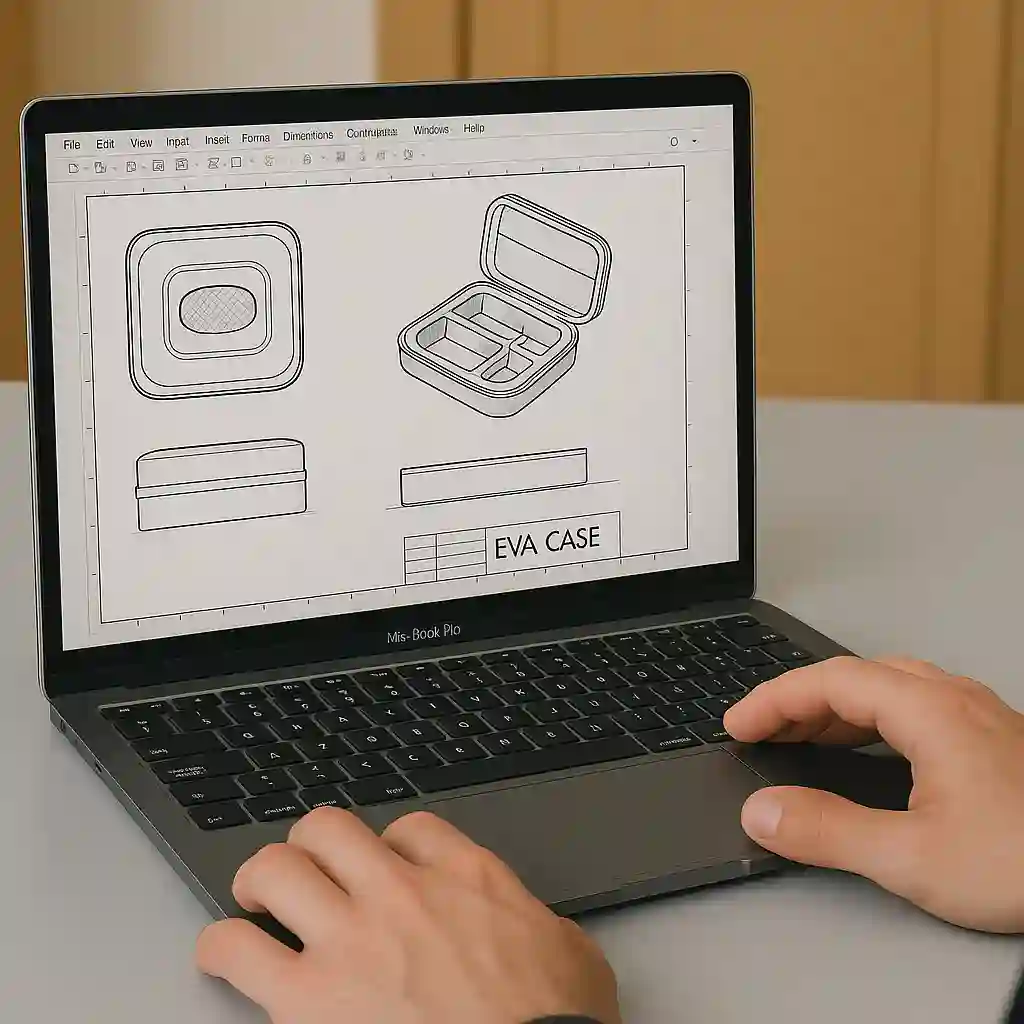
The Anatomy of a $4.50 Custom EVA Case
Let’s start with a real example. Not a hypothetical — this is the actual cost structure for a standard electronics organizer pouch (200mm × 120mm × 60mm, 600D Oxford exterior, mesh interior, nylon zipper, 500-piece order) coming off our production line.
Component Costs (per unit) EVA shell — $0.55
This is the molded foam body. Raw EVA resin costs fluctuate with oil prices, but the bigger cost driver is wall thickness and hardness. A 3mm shell at 60° hardness uses about 40% less material than a 5mm shell at 70° hardness. For this example, we’re using 3.5mm at 60° — the sweet spot for a mid-size electronics case.
The EVA molding process itself (heating, pressing, cooling) consumes electricity and machine time. Our 12 hydraulic heat-pressing machines run continuously, which keeps per-unit machine cost low. A factory with only 2–3 machines has higher per-unit equipment cost because each run takes longer.
Exterior fabric (600D Oxford) — $0.45
Fabric is the second biggest material cost. Here’s where the price range matters:
- Standard 600D Oxford with PVC backing: ~$0.40–0.45 per unit at this size
- High-density 600D Oxford (tighter weave, more durable): ~$0.48–0.55 per unit
- Custom Pantone-dyed fabric: +$0.15–0.25 per unit, plus a 500-piece minimum for dyeing
That $0.10 difference between standard and high-density Oxford? It’s the difference between a case that looks worn after 6 months and one that still looks new after 18 months. We use high-density as default. Some suppliers use standard and don’t tell you.
Interior lining (mesh + nylon taffeta) — $0.30
Mesh for the pocket side, nylon taffeta for the flat side. Both are low-cost materials. The expense here is in the sewing labor, not the fabric itself.
If you upgrade to velvet lining (common for premium electronics), add $0.15–0.25 per unit.
Zipper + puller — $0.25
Standard #5 nylon coil zipper with a plain metal puller. This is where suppliers save money that you can’t see in a photo:
- Budget zipper (unbranded, ~3,000 cycle life): ~$0.12–0.15
- Standard quality coil zipper (~5,000 cycle life): ~$0.20–0.25
- YKK zipper (10,000+ cycle life): ~$0.35–0.45
- Metal zipper (premium look, heavy duty): ~$0.50–0.70
A budget zipper saves 0.10–0.13perunit.Ona5,000−pieceorder,that′s0.10–0.13perunit.Ona5,000−pieceorder,that′s500–$650 in the supplier’s pocket — and your customer gets a zipper that breaks in 6 months
CNC foam insert (if applicable) — $0.60
Not included in our $4.50 example (this case uses mesh + taffeta), but worth breaking out because it’s the single biggest cost variable. A CNC-cut foam insert requires:
- CNC programming: 100–100–300 one-time (amortized across the order)
- EVA foam sheet material: $0.35–0.50 per unit depending on density and thickness
- CNC machine time: $0.15–0.25 per unit
For a 500-piece order, the CNC program amortizes to 0.20–0.60perunit.At2,000+pieces,itdropsto0.20–0.60perunit.At2,000+pieces,itdropsto0.05–0.15 per unit. This is why CNC foam inserts get significantly cheaper at higher volumes — the one-time programming cost spreads out.
Logo application — $0.15
Silk screen printing, one color, one position. The most cost-effective branding method.
- Silk screen, 1 color: ~$0.10–0.15
- Silk screen, 2–3 colors: ~$0.18–0.25
- Heat transfer (full color): ~$0.25–0.40
- Embossing (requires mold): ~0.05–0.10perunitafter0.05–0.10perunitafter80–$200 tooling
- Rubber patch: ~0.20–0.35perunitafter0.20–0.35perunitafter100–$200 tooling
Labor — $0.90
This is the sewing, assembly, and finishing. Labor is the largest single cost component in any EVA case, and it’s the one that varies most by geography:
- Shenzhen (China): Higher labor cost, faster and more experienced for complex builds
- Vietnam: Lower labor cost, cost-advantage for sewing-intensive production runs
- Smaller cities in China (Dongguan, Quanzhou): Lower than Shenzhen, but less R&D support
For this $4.50 case, labor breaks down roughly as:
- Fabric cutting and prep: $0.10
- EVA shell preparation: $0.08
- Sewing exterior to shell: $0.35
- Interior assembly: $0.15
- Zipper installation: $0.12
- Logo application: $0.05
- Final inspection and packing: $0.05
The single most expensive labor step is sewing the exterior fabric to the EVA shell.
This is also the step where quality matters most — uneven stitching, skipped stitches, or misaligned seams all start here. A factory that rushes this step to save 5 minutes per batch will produce cases that unravel at the seams within weeks.
QC Inspection — $0.15
AQL 2.5 inspection on every order. This covers:
- Incoming material check (EVA hardness, fabric weight, zipper function)
- In-process check (stitch count, dimensional accuracy)
- Final inspection (visual defects, function test, packaging integrity)
Some factories skip formal QC or do “spot checks” instead of AQL-level inspection. This saves them $0.10–0.15 per unit. It costs you returns, complaints, and brand damage. We don’t skip it.
Packaging — $0.20
Standard export packaging: individual polybag, bulk carton with desiccant. Included at no extra charge.
Custom retail packaging (printed box, insert card, barcode sticker): +$0.40–1.20 per unit depending on complexity.
Overhead + Margin — $1.60
This covers electricity, equipment maintenance, factory rent, administrative costs, and profit margin. We’re transparent about this being in the quote — every factory has it. The question is whether it’s reasonable.
Our overhead + margin runs about 35% of total unit cost. Industry standard for a legitimate, ISO-certified factory is 30–40%. If a quote’s overhead + margin is below 25%, they’re either operating at a loss (unsustainable) or cutting something else to compensate.
The Full Breakdown
| Component | Cost | % of Total |
|---|---|---|
| EVA shell | $0.55 | 12% |
| Exterior fabric | $0.45 | 10% |
| Interior lining | $0.30 | 7% |
| Zipper + puller | $0.25 | 6% |
| Logo application | $0.15 | 3% |
| Labor | $0.90 | 20% |
| QC inspection | $0.15 | 3% |
| Packaging | $0.20 | 4% |
| Overhead + margin | $1.60 | 35% |
| Total per unit | $4.55 | **100% |
Where Quotes Hide the Difference
Now you know what goes into the price. Here’s where suppliers create that 3.20vs.3.20vs.4.50 vs. $6.80 gap.
The $3.20 Quote — What's Missing
When you see a quote that’s 30%+ below the midpoint, something was subtracted. Here’s what it usually is:
Substituted materials. Standard 600D instead of high-density. Budget zipper instead of standard quality. Lower EVA density than specified. These changes are invisible in product photos but fail in the field.
No formal QC. The factory does a visual glance at finished goods instead of AQL 2.5 inspection. This means 8–12% of your order may have defects you’ll discover when your customer does.
Lower labor standards. Overtime without proper compensation, rushed production timelines, or temporary workers without adequate training. The sewing quality drops and you see it in skipped stitches and misaligned seams.
No sample approval process. They go straight from spec to bulk production. Saves 7–10 days but means you have no physical confirmation that the case meets your expectations before 2,000 units are made.
The $6.80 Quote — What's Extra
Sometimes a higher quote is justified. Sometimes it’s padding. Here’s how to tell the difference:
Justified higher costs:
- YKK zippers or metal zippers (real cost increase)
- Custom Pantone dyeing (real cost + minimum order)
- ISTA transit testing requirement (requires specific construction methods)
- Very low volume (under 200 pcs — machine setup cost doesn’t amortize well)
- Complex interior (CNC foam with 10+ cavities)
Unjustified higher costs:
- “Premium” label without specifying what’s premium about it
- Vague “quality surcharge” without breakdown
- Inflated shipping estimates (compare with actual DHL/FedEx rates)
- Marking up standard features as upgrades
How to Actually Reduce Cost (Without Sacrificing Quality)
You don’t need to accept the cheapest quote to save money. Here are the real cost reductions that don’t compromise protection.
1. Use Stock Colors Instead of Custom Pantone
Black, navy, and grey are always in stock. Custom dyeing adds $0.15–0.25 per unit and requires a 500-piece minimum. If you’re ordering 300 cases, you can’t hit the dyeing minimum anyway — so you’d pay a setup surcharge on top.
Savings: $0.15–0.50 per unit
2. Order 500+ Pieces
Material purchasing efficiency increases significantly at 500 pieces. Fabric, EVA, and zippers are all bought in bulk. The per-unit material discount from 100 to 500 pieces is typically 15–20%.
Savings: $0.30–0.60 per unit
3. Choose ODM Over OEM (When Possible)
If your product fits within an existing case design with modifications, you skip the mold fee (300–300–800 one-time) and reduce sampling time from 7 days to 3 days. The interior and branding are still fully customizable.
Savings: 300–300–800 on tooling + faster time-to-market
4. Use Silk Screen Instead of Embossing for Your Logo
Silk screen printing looks professional, lasts 2–3 years of regular use, and costs a fraction of embossing. Embossing requires a mold (80–80–200) and adds $0.05–0.10 per unit. Unless your brand identity specifically requires a tactile logo impression, silk screen is the smart choice.
Savings: 0.05–0.10perunit+0.05–0.10perunit+80–$200 tooling
5. Simplify the Interior (When Your Product Allows It)
Not every product needs CNC foam. If you’re making a cable organizer, mesh pockets and elastic straps provide sufficient organization at half the interior cost. Reserve CNC foam for products where precision fit is a safety requirement — fragile electronics, optical instruments, or equipment over $200 retail.
Savings: $0.40–0.80 per unit
What You Should Never Cut
Some cost reductions aren’t worth it. Ever.
The zipper. A $0.10 savings per unit on a budget zipper means your customer gets a case that breaks in 6 months. The replacement cost (handling returns, negative reviews, lost repeat business) is 10–50x the savings.
The physical sample. Going straight to bulk production without sample approval is gambling. The 3–5 day sample delay is always cheaper than a 2,000-unit reorder because the first batch had a dimension error.
QC inspection. A factory that doesn’t inspect isn’t saving you money — they’re transferring quality risk to you. You find the defects when your customer does.
EVA hardness appropriate to your product. Don’t let a supplier talk you into softer EVA to save 0.05perunitifyourproductneedsrigidprotection.Acrackedscreenorbrokengimbalcostsyourcustomer0.05perunitifyourproductneedsrigidprotection.Acrackedscreenoubrokengimbalcostsyourcustomer100+ and costs you their trust.
Volume Pricing Reference
Every project is different, but here’s a realistic pricing framework based on our production data:
Order Volume Standard Organizer (mesh interior) Professional Kit (CNC foam) 100 pcs 5.00–5.00–7.00 8.00–8.00–14.00 500 pcs 3.50–3.50–5.00 5.50–5.50–10.00 1,000 pcs 2.80–2.80–4.00 4.50–4.50–8.00 5,000 pcs 2.20–2.20–3.50 3.80–3.80–7.00 Why the ranges? Because “standard organizer” and “professional kit” each have a wide spectrum of complexity. A small earbuds pouch at 1,000 pieces costs 2.50.Alargemulti−deviceelectronicscasewithCNCfoamat1,000piecescosts2.50.Alargemulti−deviceelectronicscasewithCNCfoamat1,000piecescosts6.00. Both are “standard” for their category.
What’s always included in these prices: Mold storage, AQL 2.5 quality inspection, standard export packaging, commercial documentation.
What’s not included: Shipping/freight, custom retail packaging, mold fee for OEM projects, duties/tariffs.
GAODA's Pricing Approach
We don’t play the quote-padding game. Here’s how we price:
- You share your requirements. Product dimensions, order volume, protection level, branding needs.
- We send a component-level quote. You see material costs, labor, and our margin separately. Not a mystery number.
- If you find a lower quote, send it to us. We’ll tell you exactly where the difference is — whether it’s a legitimate cost saving (stock color vs. custom dyeing) or a hidden corner cut (budget zipper vs. standard quality).
This isn’t charity — we make a fair margin on every order. But we think you should know what you’re paying for, and we think the best long-term business relationship starts with a transparent quote.
Get Your Custom EVA Case Quote
Request a Quote — share your product specs and we’ll send a component-level cost breakdown within 24 hours.
Start Customization — browse existing designs and we’ll price the modifications.
Direct contact: WhatsApp or email through gaodaeva.com. We respond within 24 hours (48 hours max during peak season).
FAQ: Custom EVA Case Cost
How much does a custom EVA case cost per unit?
A custom EVA case typically costs 1.50–1.50–6.00 per unit at 500-piece volume for a standard electronics organizer. Complex cases with CNC foam inserts, metal zippers, or retail packaging run 6.00–6.00–14.00. The final price depends on shell size, material grades, interior complexity, and order volume.
Why do custom EVA case quotes vary so much between suppliers?
Price differences usually come from material grade substitutions (standard vs. high-density Oxford, coil zipper quality, foam density), QC inspection level (AQL 2.5 vs. no inspection), and whether the factory does CNC foam in-house or outsources it. The cheapest quote is almost always cutting something you can’t see from a photo.
What is the MOQ for custom EVA cases?
GAODA’s MOQ is 100 pieces per order. Lower MOQs are available for sample runs. Volume discounts typically start at 500 pieces and increase at 1,000 and 5,000 pieces.
Can I reduce custom EVA case cost without sacrificing quality?
Yes. The most effective cost reductions come from: using standard stock colors instead of custom Pantone dyeing, choosing nylon coil zippers over metal, ordering at 500+ pieces for material purchasing efficiency, and using ODM (modified existing design) instead of OEM (new mold). These savings don’t affect protection quality.
Is there a mold fee for custom EVA cases?
OEM projects requiring a new aluminum mold have a one-time mold fee of 300–300–800 depending on case size and complexity. The mold is reusable for future orders and you own it. ODM projects using existing molds have no mold fee.
GAODA — Professional Custom EVA Case Manufacturer | ISO 9001 Certified | Shenzhen + Vietnam Dual Factories | 20+ Years OEM/ODM Experience


 French
  English
  Korean
  Japanese
  German
  Spanish
  Russian
  Arabic
  Italian
  Portuguese
  Turkish
  Thai
Thai  Vietnamese
  Chinese