
EVA vs Other Materials: Complete Comparison Guide for Custom Cases
When choosing materials for custom EVA cases, understanding how EVA compares to alternatives is crucial. EVA foam cases have become the industry standard, but polyurethane, neoprene, and polystyrene each offer distinct advantages and disadvantages.
This comprehensive comparison examines EVA against competing materials across cost, durability, protection, sustainability, and customization. Whether you’re sourcing custom EVA cases from a custom EVA case manufacturer or evaluating materials for your project, this guide provides the data you need to make an informed decision.
Key Comparison Points:
- Material properties and performance
- Cost analysis and ROI
- Durability and lifespan
- Environmental impact
- Customization capabilities
- Industry applications
- When to choose each material
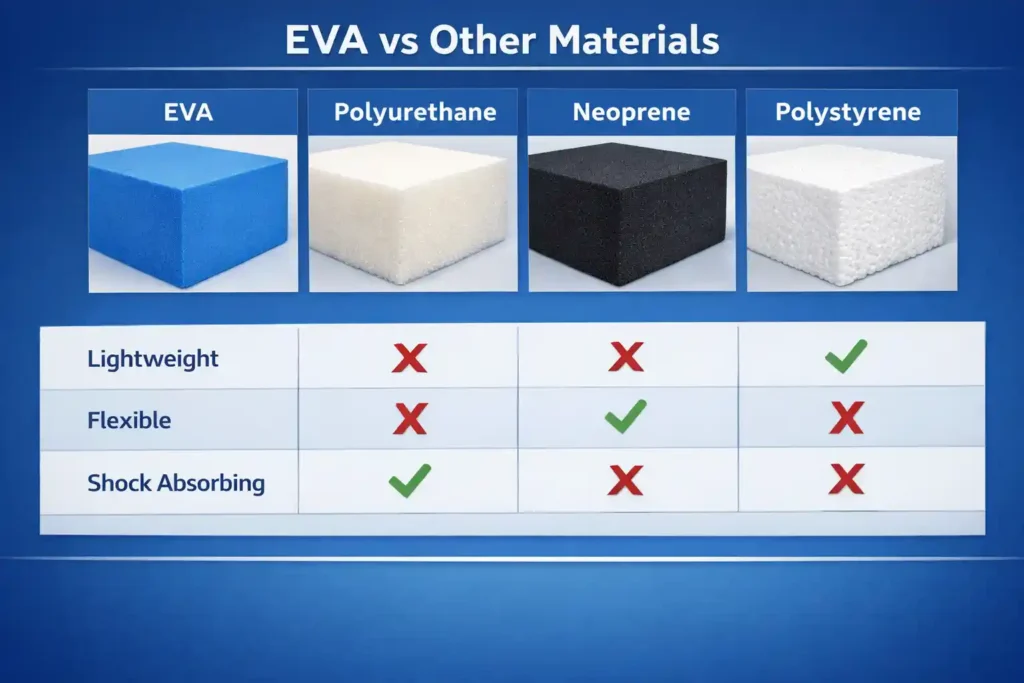
Material Properties Comparison
Property | EVA Foam | Polyurethane | Neoprene | Polystyrene |
Density | 20-40 kg/m³ | 30-50 kg/m³ | 25-45 kg/m³ | 15-35 kg/m³ |
Compression Strength | 0.5-2 MPa | 0.8-3 MPa | 0.4-1.5 MPa | 0.2-0.8 MPa |
Temperature Range | -20°C to 60°C | -30°C to 80°C | -40°C to 70°C | -20°C to 50°C |
Flexibility | High | Medium | High | Low |
Durability | 5-10 years | 3-7 years | 4-8 years | 2-4 years |
Cost/kg | $2-4 | $3-6 | $4-8 | $1-2 |
Cost Analysis: EVA vs Alternatives
Custom EVA cases offer the best value proposition:
Initial Material Cost
- EVA: $50-150 per case (depending on size/complexity)
- Polyurethane: $60-180 per case
- Neoprene: $80-200 per case
- Polystyrene: $30-80 per case
Lifecycle Cost (5-year period)
- EVA: $10-30 per year ($50-150 total)
- Polyurethane: $20-50 per year ($100-250 total)
- Neoprene: $20-40 per year ($100-200 total)
- Polystyrene: $15-40 per year ($75-200 total)
Winner: Custom EVA cases provide the best value over time due to durability and reusability.
EVA vs Polyurethane
Polyurethane is often compared to EVA for protective cases.
Advantages of Polyurethane:
- Higher compression strength
- Better temperature resistance
- Excellent cushioning properties
- Suitable for extreme environments
Advantages of EVA:
- Lower cost (20-30% cheaper)
- Better UV resistance
- More sustainable options available
- Easier to customize and print
- Longer lifespan (5-10 years vs 3-7 years)
Best For:
- Choose EVA: Budget-conscious projects, consumer goods, standard environments
- Choose Polyurethane: Extreme temperature applications, military/aerospace
EVA vs Neoprene
Neoprene is popular for water-resistant applications.
Advantages of Neoprene:
- Excellent water resistance
- Superior flexibility
- Thermal insulation properties
- Chemical resistance
Advantages of EVA:
- 50-60% lower cost
- Better impact protection
- Easier manufacturing and customization
- More sustainable alternatives
- Lighter weight
Best For:
- Choose EVA: General protective cases, cost-sensitive applications, custom EVA cases
- Choose Neoprene: Water sports, marine equipment, thermal protection
EVA vs Polystyrene
Polystyrene (Styrofoam) is the budget option.
Advantages of Polystyrene:
- Lowest initial cost
- Good insulation properties
- Lightweight
- Easy to produce
Disadvantages of Polystyrene:
- Fragile and easily damaged
- Poor durability (2-4 years)
- Breaks into microplastics
- Environmental concerns
- Limited customization
Advantages of EVA:
- 5x longer lifespan
- Reusable and durable
- Better environmental profile
- Superior protection
- Professional appearance
Best For:
- Choose EVA: Any professional application requiring durability and protection
Durability and Lifespan Comparison
Custom EVA cases outlast alternatives significantly:
Material | Expected Lifespan | Reuse Cycles | Degradation Rate |
EVA Foam | 5-10 years | 100-500 cycles | 2-3% per year |
Polyurethane | 3-7 years | 50-200 cycles | 5-8% per year |
Neoprene | 4-8 years | 75-250 cycles | 4-6% per year |
Polystyrene | 2-4 years | 10-50 cycles | 15-25% per year |
Result: One custom EVA case replaces 5-10 polystyrene cases over its lifetime.
Environmental Impact Comparison
Sustainability Analysis:
Factor | EVA | Polyurethane | Neoprene | Polystyrene |
Recyclability | High (60-70%) | Medium (30-40%) | Low (10-20%) | Low (5-10%) |
Carbon Footprint | 2.8 kg CO₂ | 4.2 kg CO₂ | 5.1 kg CO₂ | 1.8 kg CO₂ |
Biodegradability | 50-80 years | 200-300 years | 100+ years | 500+ years |
Sustainable Options | Yes (bio-based) | Limited | Rare | No |
Winner: Sustainable EVA packaging offers the best environmental profile.
Customization Capabilities
Custom EVA cases lead in customization flexibility:
EVA Advantages:
- Easy CNC cutting for complex shapes
- Multiple color options (20+ standard colors)
- Excellent printing and branding
- Custom density options
- Flexible design modifications
- Rapid prototyping capability
Polyurethane Limitations:
- More difficult to cut precisely
- Limited color options
- Harder to print on
- Longer modification lead times
Neoprene Limitations:
- Difficult to achieve complex shapes
- Limited color palette
- Printing challenges
- Higher modification costs
Polystyrene Limitations:
- Fragile during customization
- Limited aesthetic options
- Poor printing quality
Industry Applications and Material Selection
Medical Devices:
- Best Choice: EVA (ISO 13485 compliant, hypoallergenic)
- Alternative: Polyurethane
Electronics:
- Best Choice: EVA (excellent shock absorption, static-free options)
- Alternative: Polystyrene (budget option)
Tools and Equipment:
- Best Choice: EVA (durable, customizable)
- Alternative: Polyurethane
Sports and Recreation:
- Best Choice: Neoprene (water-resistant)
- Alternative: EVA (for dry applications)
Luxury Goods:
- Best Choice: EVA (professional appearance, customizable)
- Alternative: Neoprene
Real-World Case Study: Material Comparison
Project: Protective case for professional camera equipment
Polystyrene Solution:
- Initial cost: $35
- Lifespan: 2 years
- Reusable cycles: 20
- Total cost: $35
- Environmental impact: High
EVA Solution:
- Initial cost: $95
- Lifespan: 8 years
- Reusable cycles: 400
- Total cost: $95
- Environmental impact: Low
Result: EVA provides 4x better value and 10x better environmental profile.
How to Choose the Right Material
Decision Framework:
- Budget Constraints
- Lowest cost: Polystyrene
- Best value: EVA
- Premium: Polyurethane
- Durability Requirements
- Short-term: Polystyrene
- Medium-term: Neoprene
- Long-term: EVA or Polyurethane
- Environmental Concerns
- Sustainability priority: EVA (especially bio-based)
- Recyclability: EVA > Polyurethane > Neoprene
- Customization Needs
- Complex shapes: EVA
- Standard designs: Any material
- Branding/printing: EVA
- Application Environment
- Water-resistant: Neoprene
- Extreme temperature: Polyurethane
- Standard conditions: EVA
GADAO's Material Expertise
As a leading EVA case manufacturer, GADAO offers:
- Material Selection Consultation: Expert guidance on best material choice
- Custom EVA Cases: Optimized for your specific application
- Hybrid Solutions: Combining materials for optimal performance
- Sustainable Options: Bio-based and recycled EVA alternatives
- Quality Assurance: All materials tested to international standards
PREGUNTAS FRECUENTES
Q: Is EVA better than polyurethane? A: For most applications, yes. Custom EVA cases offer better value, durability, and customization options. Polyurethane is better only for extreme temperature applications.
Q: Can I recycle my custom EVA case? A: Yes! EVA is 60-70% recyclable. GADAO’s custom EVA cases can be recycled into new products.
Q: Why is EVA more sustainable than polystyrene? A: EVA lasts 5-10 years vs 2-4 years for polystyrene, and is recyclable. One custom EVA case replaces 5-10 polystyrene cases.
Q: What’s the cost difference between materials? A: Initial cost varies, but custom EVA cases offer the best lifetime value due to durability and reusability.
Conclusion and Next Steps
Custom EVA cases provide the optimal balance of cost, durability, customization, and sustainability. Whether you need EVA foam cases for medical devices, electronics, or industrial applications, EVA outperforms alternatives in most scenarios.
Ready to choose the right material for your project?
- Contact GADAO for a free material consultation
- Request samples of different materials
- Get a custom quote for your specific needs


 Spanish
  English
  Korean
  Japanese
  French
  German
  Russian
  Arabic
  Italian
  Portuguese
  Turkish
  Thai
Thai  Vietnamese
  Chinese